(Preprint) Successful New-entry Prediction for Multi-Party Online Conversations via Latent Topics and Discourse Modeling
Lingzhi Wang ¹, Jing Li 李菁 ², Xingshan Zeng 曾幸山 ³, Kam-Fai Wong 黄锦辉 ¹
¹ The Chinese University of Hong Kong, Hong Kong, China
中国 香港 香港中文大学
² The Hong Kong Polytechnic University, Hong Kong, China
中国 香港 香港理工大学
³ Huawei Noah’s Ark Lab, Hong Kong, China
中国 香港 华为诺亚方舟实验室
arXiv, 2021-08-18
Abstract
With the increasing popularity of social media, online interpersonal communication now plays an essential role in people's everyday information exchange. Whether and how a newcomer can better engage in the community has attracted great interest due to its application in many scenarios. Although some prior works that explore early socialization have obtained salient achievements, they are focusing on sociological surveys based on the small group.
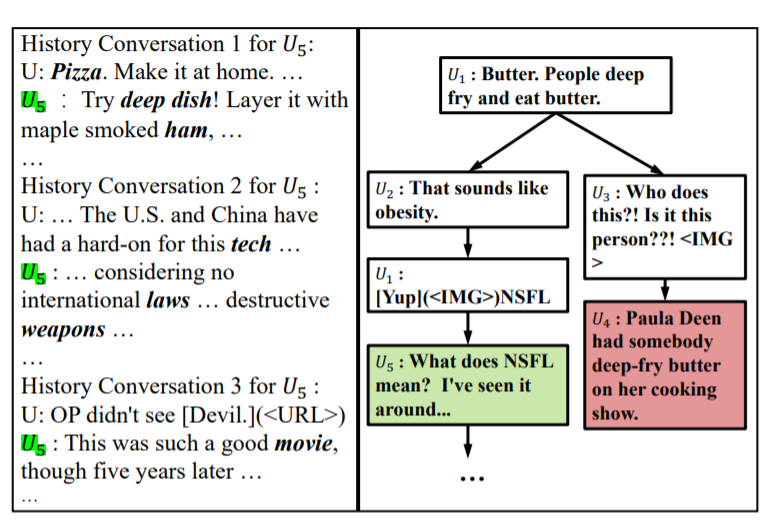
To help individuals get through the early socialization period and engage well in online conversations, we study a novel task to foresee whether a newcomer's message will be responded to by other participants in a multi-party conversation (henceforth \textbf{Successful New-entry Prediction}). The task would be an important part of the research in online assistants and social media. To further investigate the key factors indicating such engagement success, we employ an unsupervised neural network, Variational Auto-Encoder (\textbf{VAE}), to examine the topic content and discourse behavior from newcomer's chatting history and conversation's ongoing context. Furthermore, two large-scale datasets, from Reddit and Twitter, are collected to support further research on new-entries.
Extensive experiments on both Twitter and Reddit datasets show that our model significantly outperforms all the baselines and popular neural models. Additional explainable and visual analyses on new-entry behavior shed light on how to better join in others' discussions.
Electrically switchable bright-field and interference-synthesized edge-enhanced imaging with a polarization-multiplexed metalens
Xiaotong Li, Junhwa Seong, Yeseul Kim, Kwang-Suk Oh, Shiqi Hu, Le Dai, Harit Keawmuang, Beomha Yang, Minseok Choi, Youngsun Jeon, Cherry Park, Weiyan Li, Tianxu Jia, Han Zhu, Xiaodong Cai, Qi Zheng, Jinhui Shi, Young-Ki Kim, Yuchuan Shao, Trevon Badloe, Junsuk Rho
Opto-Electronic Science
2026-09-20
3D-printed copper water cooling system assisted fabrication of 10.6-μm high-power CO₂ laser resistance reflectors
Hongfei Jiao, Binbin Jiang, Xinshang Niu, Yifan Wang, Dongdong Li, Jun Yu, Xiaochuan Ji, Jingjing Xia, Jinlong Zhang, Xinbin Cheng, Zhanshan Wang
Opto-Electronic Advances
2026-09-15
Ultrafast all-optical modulation of wide-bandwidth pulses enabled by silicon-metasurfaces
Kaloyan Georgiev, Khosro Zangeneh Kamali, Anton A. Trifonov, Giulia Crotti, Lyuben Petrov, Stefan Georgiev, Hristo Iliev, Lei Xu, Unai Arregui Leon, Mohsen Rahmani, Giuseppe Della Valle, Ivan Buchvarov, Dragomir Neshev
Opto-Electronic Advances
2026-09-15
Physics-informed neural fields enable blind aberration correction for partially coherent quantitative phase imaging
Shun Zhou, Xingyu Huang, Linpeng Lu, Habib Ullah, Kaiyu Du, Maciej Trusiak, Malgorzata Kujawinska, Yuzhen Zhang, Yao Fan, Qian Chen, Qinrong Zhang, Chao Zuo
Opto-Electronic Science
2026-08-26