(Preprint) Instance Segmentation in 3D Scenes using Semantic Superpoint Tree Networks
Zhihao Liang ¹ ², Zhihao Li ³, Songcen Xu 许松岑 ³, Mingkui Tan 谭明奎 ¹, Kui Jia 贾奎 ¹ ⁴ ⁵
¹ South China University of Technology
华南理工大学
² DexForce Technology Co., Ltd.
跨维(广州)智能科技有限公司
³ Noah’s Ark Lab, Huawei Technologies
华为诺亚方舟实验室
⁴ Pazhou Laboratory
琶洲实验室 (人工智能与数字经济广东省实验室)
⁵ Peng Cheng Laboratory
鹏城实验室
arXiv, 2021-08-17
Abstract
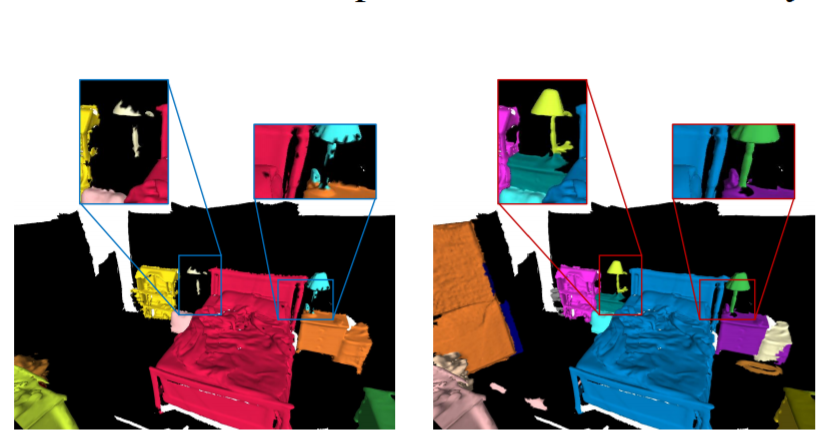
Instance segmentation in 3D scenes is fundamental in many applications of scene understanding. It is yet challenging due to the compound factors of data irregularity and uncertainty in the numbers of instances. State-of-the-art methods largely rely on a general pipeline that first learns point-wise features discriminative at semantic and instance levels, followed by a separate step of point grouping for proposing object instances. While promising, they have the shortcomings that (1) the second step is not supervised by the main objective of instance segmentation, and (2) their point-wise feature learning and grouping are less effective to deal with data irregularities, possibly resulting in fragmented segmentations.
To address these issues, we propose in this work an end-to-end solution of Semantic Superpoint Tree Network (SSTNet) for proposing object instances from scene points. Key in SSTNet is an intermediate, semantic superpoint tree (SST), which is constructed based on the learned semantic features of superpoints, and which will be traversed and split at intermediate tree nodes for proposals of object instances. We also design in SSTNet a refinement module, termed CliqueNet, to prune superpoints that may be wrongly grouped into instance proposals.
Experiments on the benchmarks of ScanNet and S3DIS show the efficacy of our proposed method. At the time of submission, SSTNet ranks top on the ScanNet (V2) leaderboard, with 2% higher of mAP than the second best method.
Ultrafast all-optical modulation of wide-bandwidth pulses enabled by silicon-metasurfaces
Kaloyan Georgiev, Khosro Zangeneh Kamali, Anton A. Trifonov, Giulia Crotti, Lyuben Petrov, Stefan Georgiev, Hristo Iliev, Lei Xu, Unai Arregui Leon, Mohsen Rahmani, Giuseppe Della Valle, Ivan Buchvarov, Dragomir Neshev
Opto-Electronic Advances
2026-09-15
Physics-informed neural fields enable blind aberration correction for partially coherent quantitative phase imaging
Shun Zhou, Xingyu Huang, Linpeng Lu, Habib Ullah, Kaiyu Du, Maciej Trusiak, Malgorzata Kujawinska, Yuzhen Zhang, Yao Fan, Qian Chen, Qinrong Zhang, Chao Zuo
Opto-Electronic Science
2026-08-26
Heterogeneously integrated micro-ring with SnS₂ for dual-functional optical modulation and photodetection
Jinyi Du, Lidan Lu, Xu Zhang, Bofei Zhu, Wenbo Bo, Yingjie Xu, Guang Chen, Yanlin He, Guanghui Ren, Xiaoping Lou, Zheng You, Lianqing Zhu
Opto-Electronic Advances
2026-08-25
Hardware-aware lightweight photonic spiking neural network for pattern classification
Shuiying Xiang, Yahui Zhang, Shangxuan Shi, Haowen Zhao, Dianzhuang Zheng, Xingxing Guo, Yanan Han, Ye Tian, Liyue Zhang, Yuechun Shi, Yue Hao
Opto-Electronic Advances
2026-08-25
PhyspeNet: An empirical physics-aware network for adaptive speckle reconstructive spectrometry
Junrui Liang, Min Jiang, Jun Li, Zhongming Huang, Junhong He, Yanting Guo, Yanzhao Ke, Jun Ye, Jiangming Xu, Jinyong Leng, Pu Zhou
Opto-Electronic Advances
2026-08-25
A 36 × 240 Gbps hybrid mode/wavelength division multiplexing transmitter using lithium niobate on insulator
Mingyu Zhu, Weihan Wang, Ruitao Ma, Aoyun Gao, Chun Gao, Zexu Wang, Fei Huang, Zhenyuan Bao, Dajian Liu, Jiaxuan Gan, Zejie Yu, Huan Li, Weike Zhao, Daoxin Dai
Opto-Electronic Advances
2026-08-25