(Peer-Reviewed) 2D Nb₂CTₓ MXene/MoS₂ heterostructure construction for nonlinear optical absorption modulation
Yiduo Wang 王一多 ¹, Yingwei Wang 王迎威 ¹, Yulan Dong 董玉兰 ², Li Zhou 周莉 ¹, Jianlong Kang 康建龙 ¹, Ning Wang 王宁 ¹, Yejun Li 李业军 ¹, Xiaoming Yuan 袁小明 ¹, Zhengwei Zhang 张正伟 ¹, Han Huang 黄寒 ¹, Mengqiu Long 龙孟秋 ¹, Si Xiao 肖思 ¹, Jun He 何军 ¹
¹ Hunan Key Laboratory of Nanophotonics and Devices, School of Physics and Electronics, Central South University, Changsha 410083, China
中国 长沙 中南大学物理与电子学院 纳米光子学与器件湖南省重点实验室
² Key Laboratory of Hunan Province for Statistical Learning and Intelligent Computation, School of Mathematics and Statistics, Hunan University of Technology and Business, Changsha 410205, China
中国 长沙 湖南工商大学数学与统计学院 统计学习与智能计算湖南省重点实验室
Opto-Electronic Advances, 2023-10-31
Abstract
Two-dimensional (2D) nonlinear optical mediums with high and tunable light modulation capability can significantly stimulate the development of ultrathin, compact, and integrated optoelectronics devices and photonic elements. 2D carbides and nitrides of transition metals (MXenes) are a new class of 2D materials with excellent intrinsic and strong light-matter interaction characteristics. However, the current understanding of their photo-physical properties and strategies for improving optical performance is insufficient.
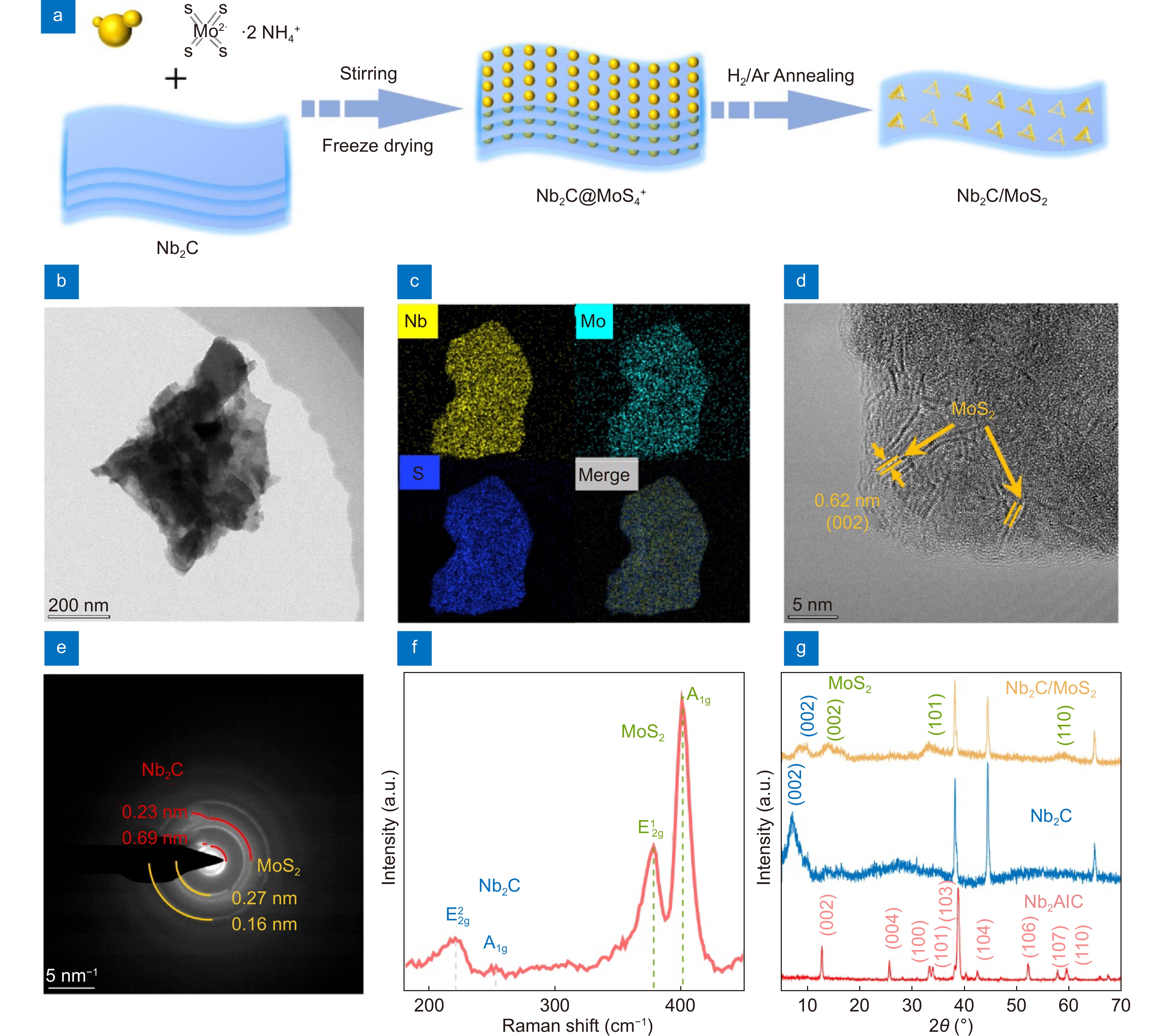
To address this issue, we rationally designed and in situsynthesized a 2D Nb₂C/MoS₂ heterostructure that outperforms pristine Nb₂C in both linear and nonlinear optical performance. Excellent agreement between experimental and theoretical results demonstrated that the Nb₂C/MoS₂ inherited the preponderance of Nb₂C and MoS₂ in absorption at different wavelengths, resulting in the broadband enhanced optical absorption characteristics. In addition to linear optical modulation, we also achieved stronger near infrared nonlinear optical modulation, with a nonlinear absorption coefficient of Nb₂C/MoS₂ being more than two times that of the pristine Nb₂C.
These results were supported by the band alinement model which was determined by the X-ray photoelectron spectroscopy (XPS) experiment and first-principal theory calculation. The presented facile synthesis approach and robust light modulation strategy pave the way for broadband optoelectronic devices and optical modulators.
Electrically switchable bright-field and interference-synthesized edge-enhanced imaging with a polarization-multiplexed metalens
Xiaotong Li, Junhwa Seong, Yeseul Kim, Kwang-Suk Oh, Shiqi Hu, Le Dai, Harit Keawmuang, Beomha Yang, Minseok Choi, Youngsun Jeon, Cherry Park, Weiyan Li, Tianxu Jia, Han Zhu, Xiaodong Cai, Qi Zheng, Jinhui Shi, Young-Ki Kim, Yuchuan Shao, Trevon Badloe, Junsuk Rho
Opto-Electronic Science
2026-09-20
3D-printed copper water cooling system assisted fabrication of 10.6-μm high-power CO₂ laser resistance reflectors
Hongfei Jiao, Binbin Jiang, Xinshang Niu, Yifan Wang, Dongdong Li, Jun Yu, Xiaochuan Ji, Jingjing Xia, Jinlong Zhang, Xinbin Cheng, Zhanshan Wang
Opto-Electronic Advances
2026-09-15
Ultrafast all-optical modulation of wide-bandwidth pulses enabled by silicon-metasurfaces
Kaloyan Georgiev, Khosro Zangeneh Kamali, Anton A. Trifonov, Giulia Crotti, Lyuben Petrov, Stefan Georgiev, Hristo Iliev, Lei Xu, Unai Arregui Leon, Mohsen Rahmani, Giuseppe Della Valle, Ivan Buchvarov, Dragomir Neshev
Opto-Electronic Advances
2026-09-15
Physics-informed neural fields enable blind aberration correction for partially coherent quantitative phase imaging
Shun Zhou, Xingyu Huang, Linpeng Lu, Habib Ullah, Kaiyu Du, Maciej Trusiak, Malgorzata Kujawinska, Yuzhen Zhang, Yao Fan, Qian Chen, Qinrong Zhang, Chao Zuo
Opto-Electronic Science
2026-08-26