(Peer-Reviewed) All-fiber ellipsometer for nanoscale dielectric coatings
Jose Javier Imas ¹ ², Ignacio R. Matías ¹ ², Ignacio Del Villar ¹ ², Aritz Ozcáriz ¹ ², Carlos Ruiz Zamarreño ¹ ², Jacques Albert ³
¹ Department of Electrical, Electronic and Communications Engineering, Public University of Navarre, Pamplona 31006, Spain
² Institute of Smart Cities, Public University of Navarre, Pamplona 31006, Spain
³ Department of Electronics, Carleton University, Ottawa (Ontario) K1S 5B6, Canada
Opto-Electronic Advances, 2023-10-31
Abstract
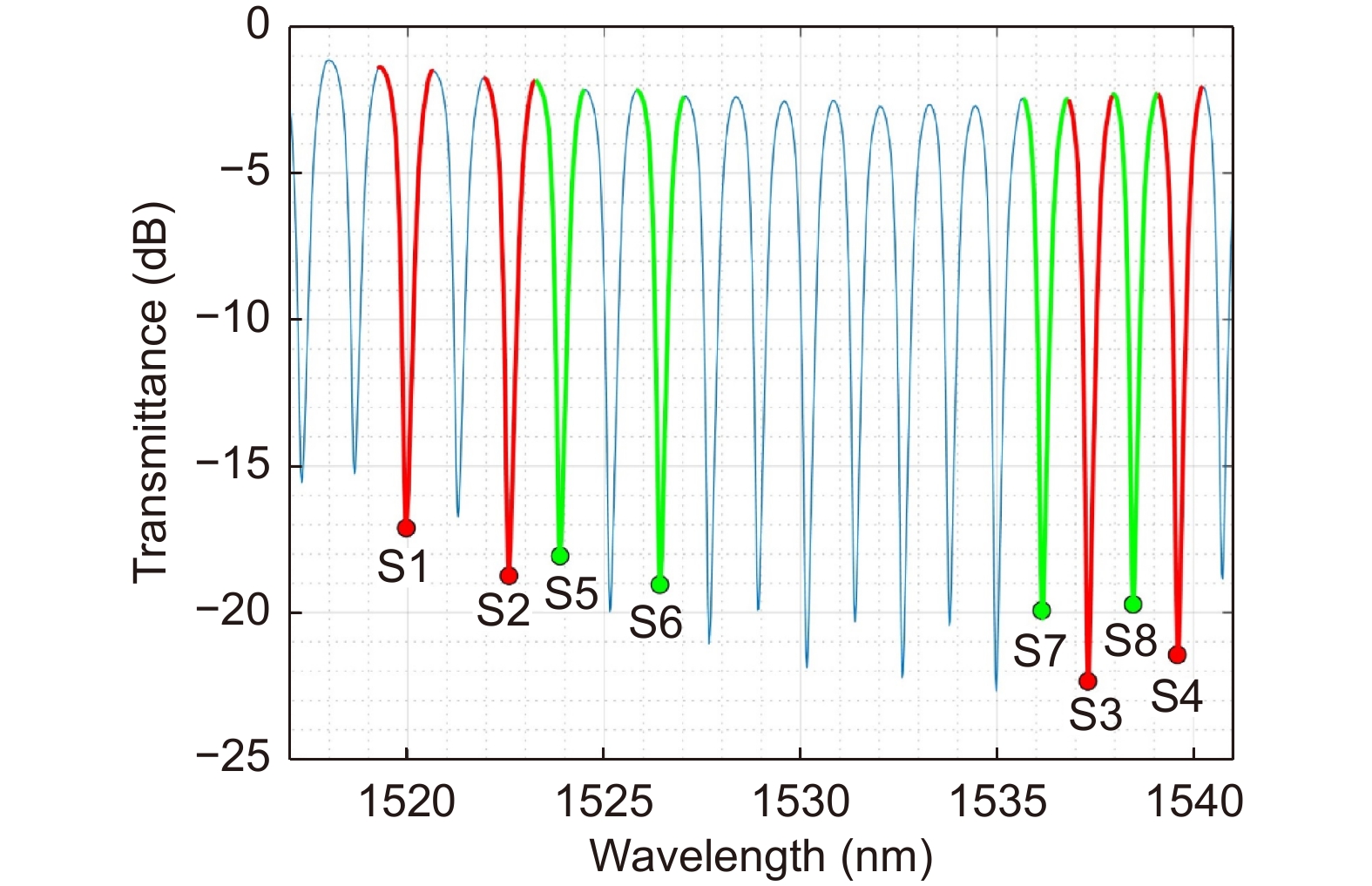
Multiple mode resonance shifts in tilted fiber Bragg gratings (TFBGs) are used to simultaneously measure the thickness and the refractive index of TiO₂ thin films formed by Atomic Layer Deposition (ALD) on optical fibers. This is achieved by comparing the experimental wavelength shifts of 8 TFBG resonances during the deposition process with simulated shifts from a range of thicknesses (T) and values of the real part of the refractive index (n).
The minimization of an error function computed for each (n,T) pair then provides a solution for the thickness and refractive index of the deposited film and, a posteriori, to verify the deposition rate throughout the process from the time evolution of the wavelength shift data. Validations of the results were carried out with a conventional ellipsometer on flat witness samples deposited simultaneously with the fiber and with scanning electron measurements on cut pieces of the fiber itself. The final values obtained by the TFBG (n= 2.25, final thickness of 185 nm) were both within 4% of the validation measurements.
This approach provides a method to measure the formation of nanoscale dielectric coatings on fibers in situ for applications that require precise thicknesses and refractive indices, such as the optical fiber sensor field. Furthermore, the TFBG can also be used as a process monitor for deposition on other substrates for deposition methods that produce uniform coatings on dissimilar shaped substrates, such as ALD.
Heterogeneously integrated micro-ring with SnS₂ for dual-functional optical modulation and photodetection
Jinyi Du, Lidan Lu, Xu Zhang, Bofei Zhu, Wenbo Bo, Yingjie Xu, Guang Chen, Yanlin He, Guanghui Ren, Xiaoping Lou, Zheng You, Lianqing Zhu
Opto-Electronic Advances
2026-08-25
Hardware-aware lightweight photonic spiking neural network for pattern classification
Shuiying Xiang, Yahui Zhang, Shangxuan Shi, Haowen Zhao, Dianzhuang Zheng, Xingxing Guo, Yanan Han, Ye Tian, Liyue Zhang, Yuechun Shi, Yue Hao
Opto-Electronic Advances
2026-08-25
PhyspeNet: An empirical physics-aware network for adaptive speckle reconstructive spectrometry
Junrui Liang, Min Jiang, Jun Li, Zhongming Huang, Junhong He, Yanting Guo, Yanzhao Ke, Jun Ye, Jiangming Xu, Jinyong Leng, Pu Zhou
Opto-Electronic Advances
2026-08-25
A 36 × 240 Gbps hybrid mode/wavelength division multiplexing transmitter using lithium niobate on insulator
Mingyu Zhu, Weihan Wang, Ruitao Ma, Aoyun Gao, Chun Gao, Zexu Wang, Fei Huang, Zhenyuan Bao, Dajian Liu, Jiaxuan Gan, Zejie Yu, Huan Li, Weike Zhao, Daoxin Dai
Opto-Electronic Advances
2026-08-25
Light-perception-based interactive control of an underwater digital twin hand
Jinlong Lu, Chao Zhang, Hengchang Nong, Dongying Wang, Hongyu Zhou, Junjie Weng, Yuehua Deng, Yang Yu, Qiang Bian, Jianfa Zhang, Chaofan Zhang, Zhenrong Zhang, Junbo Yang
Opto-Electronic Advances
2026-07-10