(Peer-Reviewed) Direct growth of hexagonal boron nitride films on dielectric sapphire substrates by pulsed laser deposition for optoelectronic applications
Gaokai Wang 王高凯 ¹ ², Jingren Chen 陈镜壬 ¹ ², Junhua Meng 孟军华 ³, Zhigang Yin 尹志岗 ¹ ², Ji Jiang 江季 ¹ ², Yan Tian 田琰 ¹ ², Jingzhen Li 李景祯 ¹ ², Jinliang Wu 吴金良 ¹ ², Peng Jin 金鹏 ¹ ², Xingwang Zhang 张兴旺 ¹ ²
¹ Key Lab of Semiconductor Materials Science, Institute of Semiconductors, Chinese Academy of Sciences, Beijing, 100083, P. R. China
中国 北京 中国科学院半导体研究所 半导体材料科学重点实验室
² Center of Materials Science and Optoelectronics Engineering, University of Chinese Academy of Sciences, Beijing 100049, P. R. China
中国 北京 中国科学院大学材料科学与光电子工程中心
³ Faculty of Science, Beijing University of Technology, Beijing, 100124, China
中国 北京 北京工业大学理学部
Abstract
Recently, hexagonal boron nitride (h-BN), an ultra-wide bandgap semiconductor, has attracted considerable attention owing to its excellent properties. In thin films grown on metal catalysts, contamination and damage induced by a transfer process cannot be avoided. Therefore, synthesizing h-BN films on non-catalytic dielectric substrates is desirable for electronic applications.
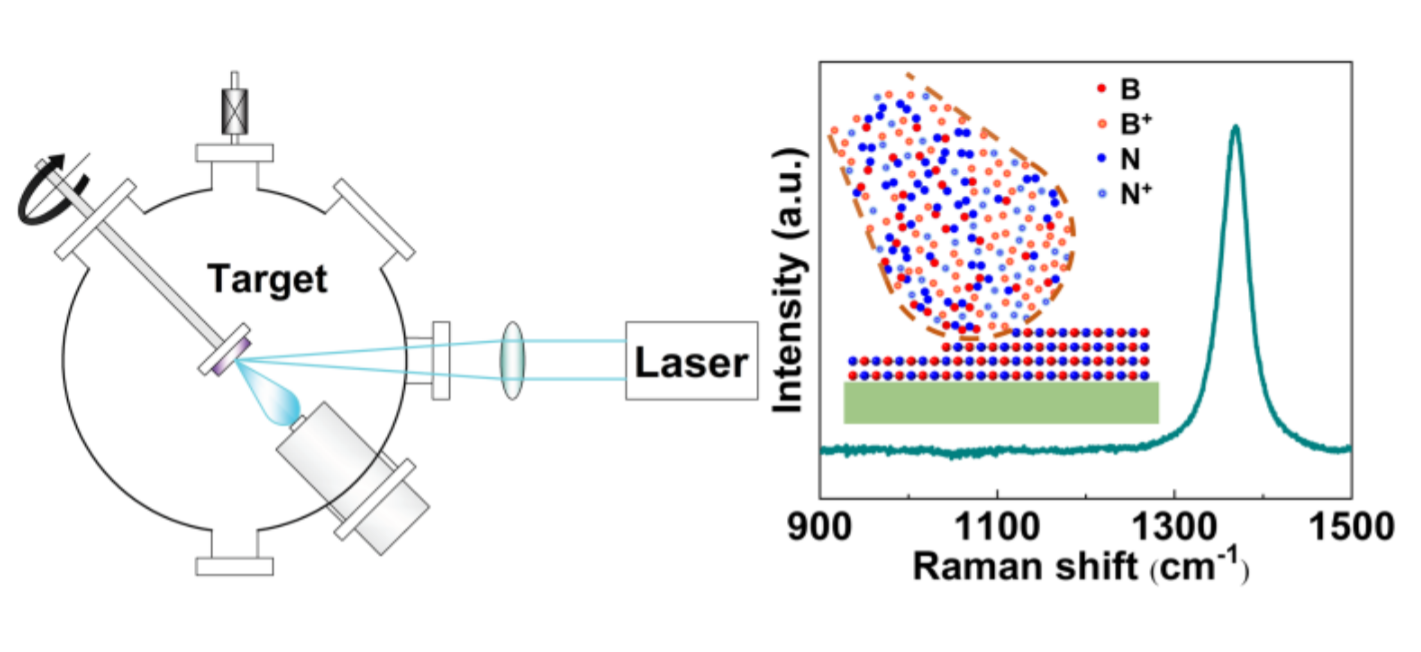
In this study, we demonstrate the direct growth of high-quality h-BN films with a controllable thickness on sapphire substrates by using the pulsed laser deposition (PLD) technique. The effects of the deposition conditions and laser parameters on the growth of the h-BN films are systematically investigated by evaluating their characteristic Raman peaks. Among the various growth parameters studied, the substrate temperature has the greatest influence on the crystalline quality of the h-BN films, and the optimal pressure varies depending on the target-substrate distance.
The h-BN film grown under optimal conditions exhibits a narrow Raman line width of ∼30 cm⁻¹, indicating a high crystalline quality. The photodetectors fabricated from the PLD-grown h-BN films exhibit superior deep-ultraviolet detection performance with a large on/off ratio of >10⁴, high photoresponsivity, and a sharp cut-off wavelength of 220 nm. This study presents the possibility of producing high-quality h-BN films by applying PLD on dielectric substrates for optoelectronic applications.
Ultrafast all-optical modulation of wide-bandwidth pulses enabled by silicon-metasurfaces
Kaloyan Georgiev, Khosro Zangeneh Kamali, Anton A. Trifonov, Giulia Crotti, Lyuben Petrov, Stefan Georgiev, Hristo Iliev, Lei Xu, Unai Arregui Leon, Mohsen Rahmani, Giuseppe Della Valle, Ivan Buchvarov, Dragomir Neshev
Opto-Electronic Advances
2026-09-15
Physics-informed neural fields enable blind aberration correction for partially coherent quantitative phase imaging
Shun Zhou, Xingyu Huang, Linpeng Lu, Habib Ullah, Kaiyu Du, Maciej Trusiak, Malgorzata Kujawinska, Yuzhen Zhang, Yao Fan, Qian Chen, Qinrong Zhang, Chao Zuo
Opto-Electronic Science
2026-08-26
Heterogeneously integrated micro-ring with SnS₂ for dual-functional optical modulation and photodetection
Jinyi Du, Lidan Lu, Xu Zhang, Bofei Zhu, Wenbo Bo, Yingjie Xu, Guang Chen, Yanlin He, Guanghui Ren, Xiaoping Lou, Zheng You, Lianqing Zhu
Opto-Electronic Advances
2026-08-25
Hardware-aware lightweight photonic spiking neural network for pattern classification
Shuiying Xiang, Yahui Zhang, Shangxuan Shi, Haowen Zhao, Dianzhuang Zheng, Xingxing Guo, Yanan Han, Ye Tian, Liyue Zhang, Yuechun Shi, Yue Hao
Opto-Electronic Advances
2026-08-25
PhyspeNet: An empirical physics-aware network for adaptive speckle reconstructive spectrometry
Junrui Liang, Min Jiang, Jun Li, Zhongming Huang, Junhong He, Yanting Guo, Yanzhao Ke, Jun Ye, Jiangming Xu, Jinyong Leng, Pu Zhou
Opto-Electronic Advances
2026-08-25
A 36 × 240 Gbps hybrid mode/wavelength division multiplexing transmitter using lithium niobate on insulator
Mingyu Zhu, Weihan Wang, Ruitao Ma, Aoyun Gao, Chun Gao, Zexu Wang, Fei Huang, Zhenyuan Bao, Dajian Liu, Jiaxuan Gan, Zejie Yu, Huan Li, Weike Zhao, Daoxin Dai
Opto-Electronic Advances
2026-08-25