(Peer-Reviewed) Direct laser interference patterning of nonvolatile magnetic nanostructures in Fe₆₀Al₄₀ alloy via disorder-induced ferromagnetism
Philipp Graus ¹, Thomas B. Möller ¹, Paul Leiderer ¹, Johannes Boneberg ¹, Nikolay I. Polushkin ²
¹ Department of Physics, University of Konstanz, 78457 Konstanz, Germany
² Institute for Physics of Microstructures of RAS, 603950 GSP-105 Nizhny Novgorod, Russian
Opto-Electronic Advances, 2020-01-20
Abstract
Current magnetic memories are based on writing and reading out the domains with opposite orientation of the magnetization vector. Alternatively, information can be encoded in regions with a different value of the saturation magnetization. The latter approach can be realized in principle with chemical order-disorder transitions in intermetallic alloys.
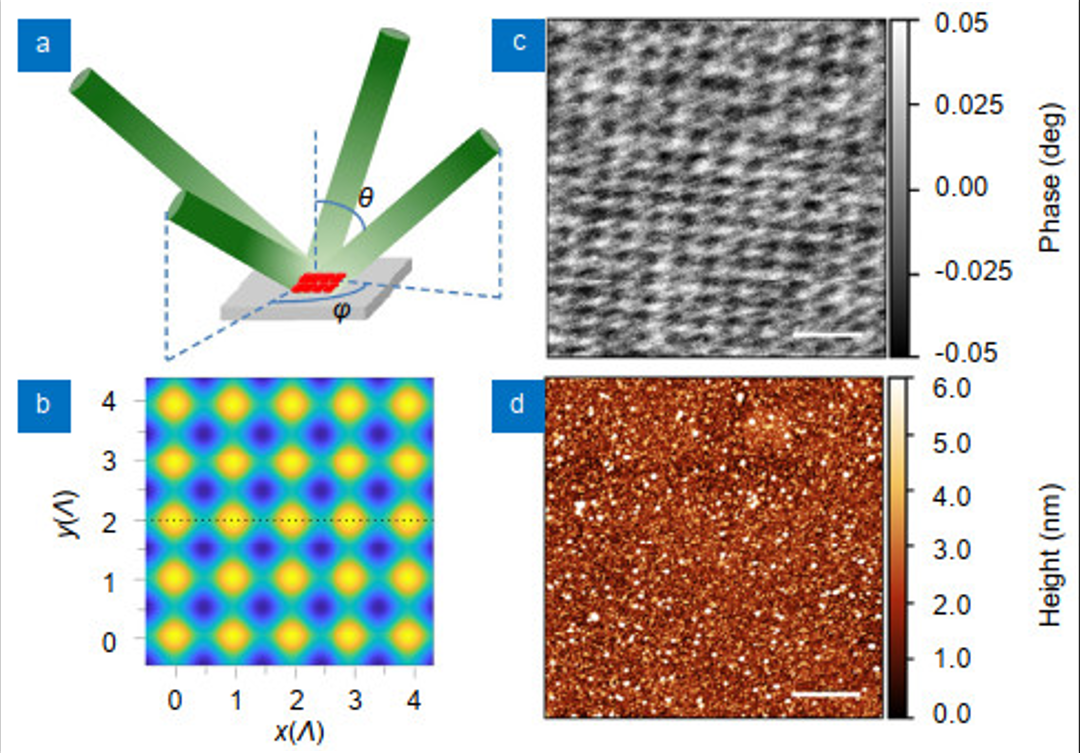
Here, we study such transformations in a thin-film (35 nm) Fe₆₀Al₄₀ alloy and demonstrate the formation of periodic magnetic nanostructures (PMNS) on its surface by direct laser interference patterning (DLIP). These PMNS are nonvolatile and detectable by magnetic force microscopy (MFM) at room temperature after DLIP with a single nanosecond pulse. We provide different arguments that the PMNS we observe originate from increasing magnetization in maxima of the interference pattern because of chemical disordering in the atomic lattice of the alloy at temperatures T higher than the critical temperature Tc for the order (B2)-disorder (A2) transition.
Theoretically, our simulations of the temporal evolution of a partially ordered state at T > Tc reveal that the disordering rate is significant even below the melting threshold. Experimentally, we find that the PMNS are erasable with standard thermal annealing at T < Tc.
Unlocking home-based nocturnal health management: A fiber-optic approach for early detection of cardiorespiratory rhythm disorders
Hanyu Jin, Hao Li, Zhuolin Chen, Liangye Li, Zurui Wang, Kai Zhou, Weijian Hang, Zhipeng Chen, Junfeng Chen, Kai Shen, Jianfeng Wen, Chen Chen, Cunzheng Fan, Zhijun Yan, Feng Wang, Qizhen Sun
Opto-Electronic Advances
2026-07-10
A flexible wireless system for prospective photodynamic therapy applications
Rolan Mansour, Bhavani Yalagala, Vikas Vikas, Nikolas Bruce, Fawziye Tarhini, Georgios N. Arvanitakis, Mohammed Mughal, Jamie Blanche, Ahmad Taha, Jonathan Copper, Muhammad Imran, Karin Williams, Karin Oien, Mahmoud Wagih, Hadi Heidari, Robert Hadfield, David Flynn
Opto-Electronic Advances
2026-07-10
Parallel bright-field and multi-order edge imaging via wide field-of-view trichannel metalens
Xiaotong Li, Yeseul Kim, Youngsun Jeon, Junhwa Seong, Jaekyung Kim, Peng Tang, Shiqi Hu, Harit Keawmuang, Beomha Yang, Dongmin Jeon, Le Dai, Weiyan Li, Xiaodong Cai, Jinhui Shi, Yong-Sang Ryu, Trevon Badloe, Junsuk Rho
Opto-Electronic Advances
2026-07-10