(Peer-Reviewed) Parent–offspring and inter-offspring responses to conspecific versus heterospecific distress calls in 2 sympatric birds
Yuxin Jiang 蒋宇鑫, Jingru Han 韩静茹, Ziqi Zhang 张子奇, Xiangyang Chen 陈向阳, Canchao Yang 杨灿朝
Ministry of Education Key Laboratory for Ecology of Tropical Islands, College of Life Sciences, Hainan NormalUniversity, Haikou 571158, China
中国 海口 海南师范大学生命科学学院 热带岛屿生态学教育部重点实验室
Abstract
Distress calls, as a type of alarm call, play important roles in expressing bodily condition and conveying information concerning predation threats. In this study, we examined the communication via distress calls in parent–offspring and inter-offspring interactions.
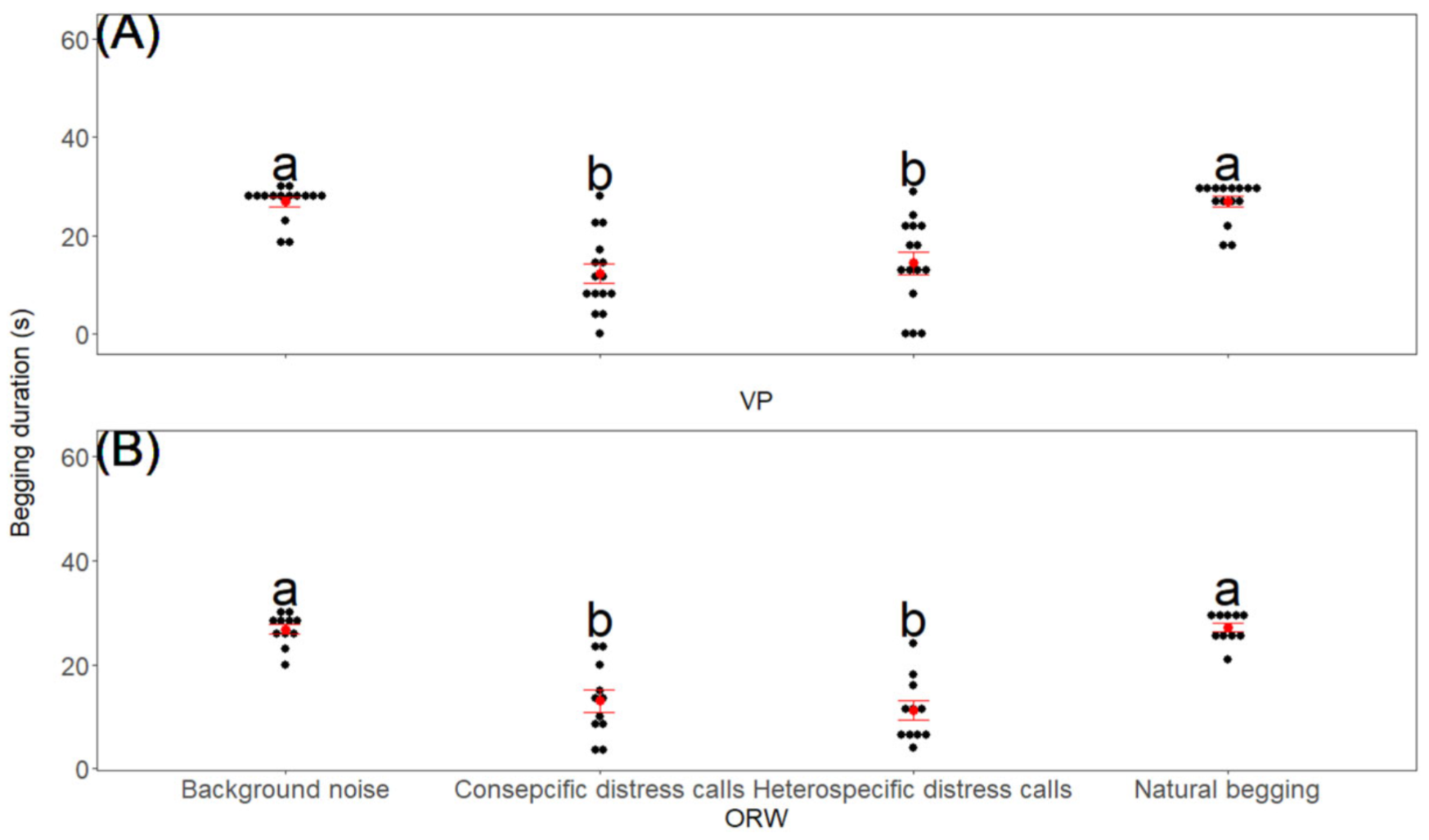
First, we used playback of chick distress calls of 2 sympatric breeders, the vinous-throated parrotbill Sinosuthora webbiana and the oriental reed warbler Acrocephalus orientalis, to the adults/chicks of these 2 species, respectively, and measured the responses of conspecifics or heterospecifics. The playback-to-chicks experiment showed that both species of chicks reduced the number of begging calls and begging duration time as a response to conspecific/heterospecific distress calls compared with natural begging and background noise controls. However, reed warbler chicks also reduced beak opening frequency in the response to conspecific distress calls compared with other playback stimuli.
Second, the results of the playback-to-adults experiment showed that reed warbler adults could eavesdrop on distress calls of conspecific neighbors and sympatric heterospecifics. Furthermore, the nest-leaving behavior of reed warblers did not differ significantly when they heard the distress calls of conspecifics or parrotbills. Finally, reed warbler adults responded to heterospecific distress calls more quickly than to conspecific distress calls, and parrotbill adults presented the same response.
Our results supported the warn-kin hypothesis and show that chick distress calls play an important role in conveying risk and the condition of chicks to enhance individual fitness. In addition, we also found that eavesdropping on distress calls is a congenital behavior that begins in the chick stage.
Unlocking home-based nocturnal health management: A fiber-optic approach for early detection of cardiorespiratory rhythm disorders
Hanyu Jin, Hao Li, Zhuolin Chen, Liangye Li, Zurui Wang, Kai Zhou, Weijian Hang, Zhipeng Chen, Junfeng Chen, Kai Shen, Jianfeng Wen, Chen Chen, Cunzheng Fan, Zhijun Yan, Feng Wang, Qizhen Sun
Opto-Electronic Advances
2026-07-10
A flexible wireless system for prospective photodynamic therapy applications
Rolan Mansour, Bhavani Yalagala, Vikas Vikas, Nikolas Bruce, Fawziye Tarhini, Georgios N. Arvanitakis, Mohammed Mughal, Jamie Blanche, Ahmad Taha, Jonathan Copper, Muhammad Imran, Karin Williams, Karin Oien, Mahmoud Wagih, Hadi Heidari, Robert Hadfield, David Flynn
Opto-Electronic Advances
2026-07-10
Parallel bright-field and multi-order edge imaging via wide field-of-view trichannel metalens
Xiaotong Li, Yeseul Kim, Youngsun Jeon, Junhwa Seong, Jaekyung Kim, Peng Tang, Shiqi Hu, Harit Keawmuang, Beomha Yang, Dongmin Jeon, Le Dai, Weiyan Li, Xiaodong Cai, Jinhui Shi, Yong-Sang Ryu, Trevon Badloe, Junsuk Rho
Opto-Electronic Advances
2026-07-10