(Peer-Reviewed) Physical Layer Authentication in UAV-enabled Relay Networks Based on Manifold Learning
Shida Xia 夏仕达 ¹, XiaoFeng Tao 陶小峰 ¹, Na Li 李娜 ¹ ², Shiji Wang 王施霁 ¹, Jin Xu 徐瑨 ¹
¹ The National Engineering Lab for Mobile Network Technologies, Beijing University of Posts and Telecommunications, Beijing 100876 China
中国 北京 北京邮电大学 移动互联网安全技术国家工程实验室
² Beijing University of Posts and Telecommunications Research Institute, Shenzhen, 518000, China
中国 深圳 北京邮电大学深圳研究院
Abstract
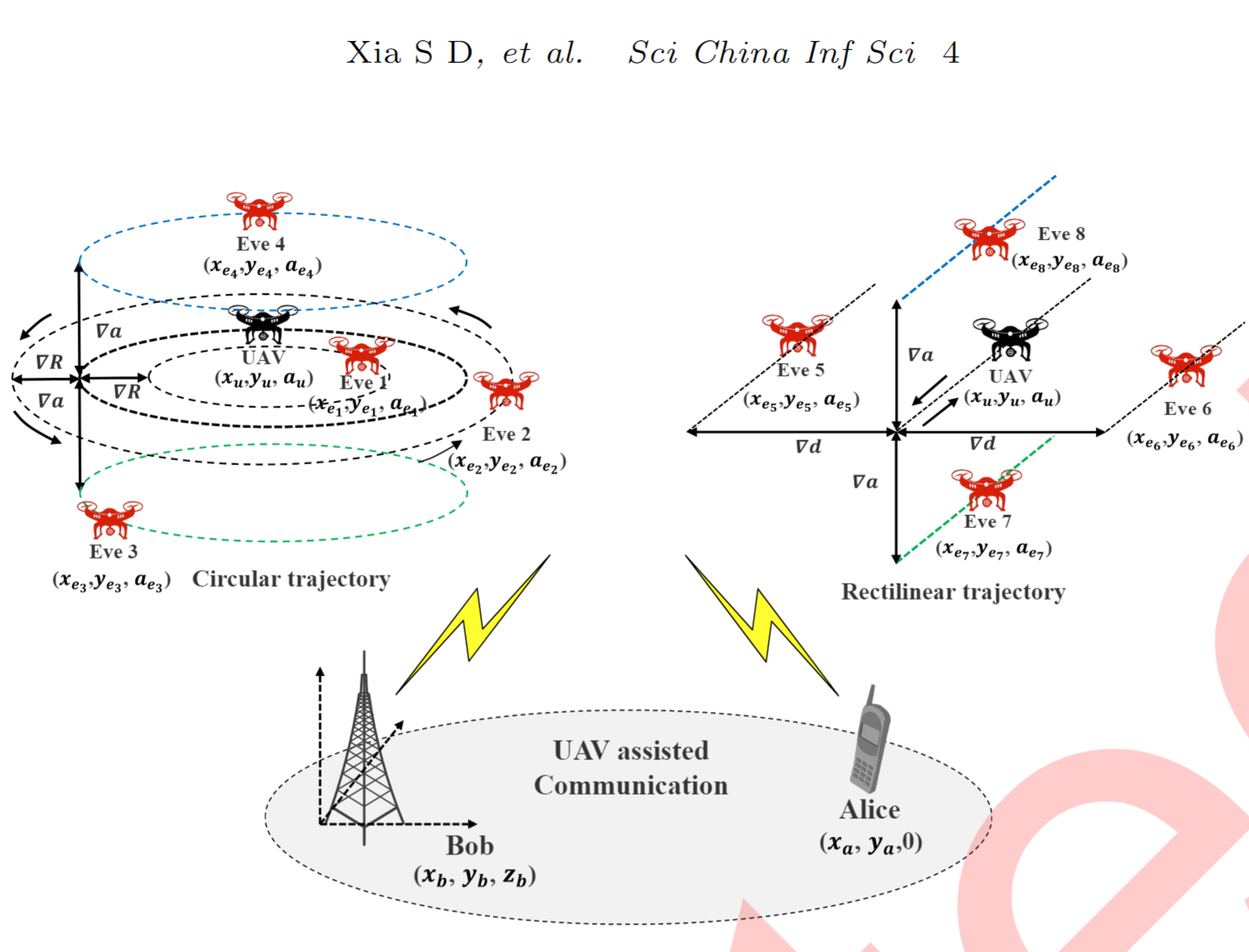
Unmanned aerial vehicle (UAV) relay network is a promising solution in the next-generation wireless networks due to its high capacity and unlimited geography. However, because of the openness of wireless channels and UAV mobility, it is remarkably challenging to guarantee the secure access of UAV relay. In this paper, we investigate the physical layer authentication (PLA) to verify the identity of the UAV relay for preventing unauthorized access to users' information or network service.
Unlike the most existing PLA methods for UAV, the proposed PLA scheme fully considers the time-varying of physical layer attributes caused by UAV mobility, and transforms the authentication problem into recognizing nonlinearly separable physical layer data. Particularly, we propose a manifold learning-based PLA scheme that can authenticate the mobile UAV relay in real-time by establishing the local correlation of physical layer attributes. The Markov chain of physical layer data in the time domain is established to evaluate UAV state transition probability through the proposed diffusion map algorithm. The legitimate UAV and spoofing attackers can always be authenticated by the different motion states.
Performance analysis offered a comprehensive understanding of the proposed scheme. Extensive simulations confirm that the performance of the proposed scheme improves over 18% in resisting the intelligent spoofing UAV compared to the traditional methods.
Unlocking home-based nocturnal health management: A fiber-optic approach for early detection of cardiorespiratory rhythm disorders
Hanyu Jin, Hao Li, Zhuolin Chen, Liangye Li, Zurui Wang, Kai Zhou, Weijian Hang, Zhipeng Chen, Junfeng Chen, Kai Shen, Jianfeng Wen, Chen Chen, Cunzheng Fan, Zhijun Yan, Feng Wang, Qizhen Sun
Opto-Electronic Advances
2026-07-10
A flexible wireless system for prospective photodynamic therapy applications
Rolan Mansour, Bhavani Yalagala, Vikas Vikas, Nikolas Bruce, Fawziye Tarhini, Georgios N. Arvanitakis, Mohammed Mughal, Jamie Blanche, Ahmad Taha, Jonathan Copper, Muhammad Imran, Karin Williams, Karin Oien, Mahmoud Wagih, Hadi Heidari, Robert Hadfield, David Flynn
Opto-Electronic Advances
2026-07-10
Parallel bright-field and multi-order edge imaging via wide field-of-view trichannel metalens
Xiaotong Li, Yeseul Kim, Youngsun Jeon, Junhwa Seong, Jaekyung Kim, Peng Tang, Shiqi Hu, Harit Keawmuang, Beomha Yang, Dongmin Jeon, Le Dai, Weiyan Li, Xiaodong Cai, Jinhui Shi, Yong-Sang Ryu, Trevon Badloe, Junsuk Rho
Opto-Electronic Advances
2026-07-10