(Peer-Reviewed) Integral imaging-based tabletop light field 3D display with large viewing angle
Yan Xing 邢妍 ¹, Xing-Yu Lin 林星雨 ¹, Lin-Bo Zhang 张林博 ¹, Yun-Peng Xia 夏云鹏 ², Han-Le Zhang 张汉乐 ¹, Hong-Yu Cui 崔宏宇 ¹, Shuang Li 李爽 ², Tong-Yu Wang 王童语 ¹, Hui Ren 任慧 ², Di Wang 王迪 ¹, Huan Deng 邓欢 ², Qiong-Hua Wang 王琼华 ¹
¹ School of Instrumentation and Optoelectronic Engineering, Beihang University, Beijing 100191, China
中国 北京 北京航空航天大学仪器科学与光电工程学院
² College of Electronics and Information Engineering, Sichuan University, Chengdu 610065, China
中国 成都 四川大学电子信息学院
Opto-Electronic Advances, 2023-06-25
Abstract
Light field 3D display technology is considered a revolutionary technology to address the critical visual fatigue issues in the existing 3D displays. Tabletop light field 3D display provides a brand-new display form that satisfies multi-user shared viewing and collaborative works, and it is poised to become a potential alternative to the traditional wall and portable display forms.
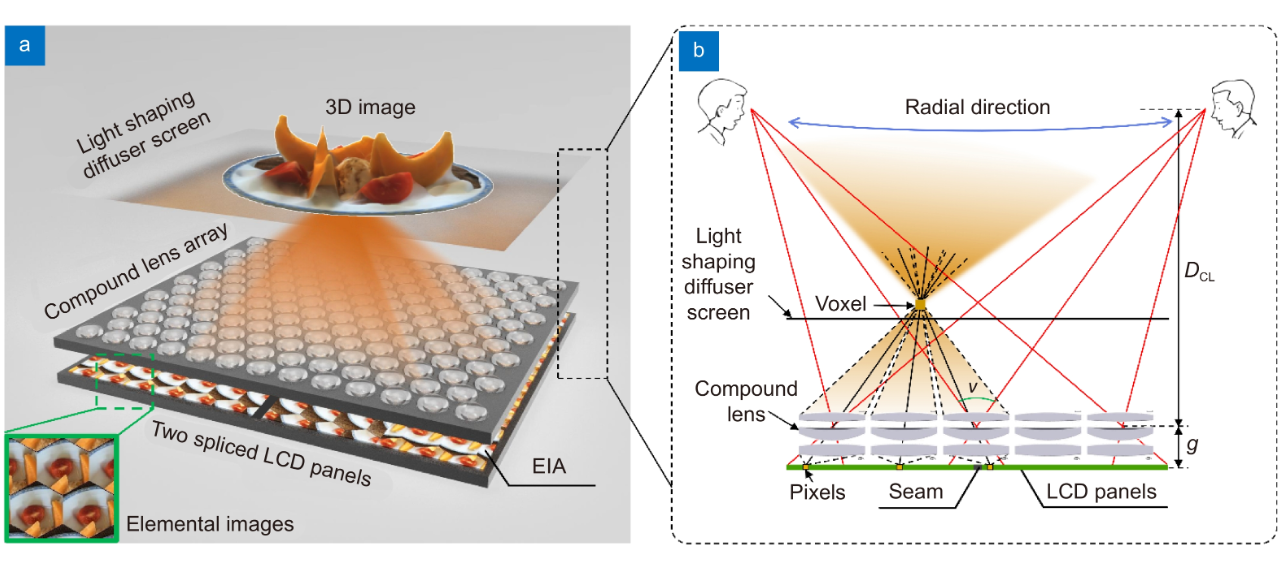
However, a large radial viewing angle and correct radial perspective and parallax are still out of reach for most current tabletop light field 3D displays due to the limited amount of spatial information. To address the viewing angle and perspective issues, a novel integral imaging-based tabletop light field 3D display with a simple flat-panel structure is proposed and developed by applying a compound lens array, two spliced 8K liquid crystal display panels, and a light shaping diffuser screen. The compound lens array is designed to be composed of multiple three-piece compound lens units by employing a reverse design scheme, which greatly extends the radial viewing angle in the case of a limited amount of spatial information and balances other important 3D display parameters.
The proposed display has a radial viewing angle of 68.7° in a large display size of 43.5 inches, which is larger than the conventional tabletop light field 3D displays. The radial perspective and parallax are correct, and high-resolution 3D images can be reproduced in large radial viewing positions. We envision that this proposed display opens up possibility for redefining the display forms of consumer electronics.
A 36 × 240 Gbps hybrid mode/wavelength division multiplexing transmitter using lithium niobate on insulator
Mingyu Zhu, Weihan Wang, Ruitao Ma, Aoyun Gao, Chun Gao, Zexu Wang, Fei Huang, Zhenyuan Bao, Dajian Liu, Jiaxuan Gan, Zejie Yu, Huan Li, Weike Zhao, Daoxin Dai
Opto-Electronic Advances
2026-08-25
Light-perception-based interactive control of an underwater digital twin hand
Jinlong Lu, Chao Zhang, Hengchang Nong, Dongying Wang, Hongyu Zhou, Junjie Weng, Yuehua Deng, Yang Yu, Qiang Bian, Jianfa Zhang, Chaofan Zhang, Zhenrong Zhang, Junbo Yang
Opto-Electronic Advances
2026-07-10
Unlocking home-based nocturnal health management: A fiber-optic approach for early detection of cardiorespiratory rhythm disorders
Hanyu Jin, Hao Li, Zhuolin Chen, Liangye Li, Zurui Wang, Kai Zhou, Weijian Hang, Zhipeng Chen, Junfeng Chen, Kai Shen, Jianfeng Wen, Chen Chen, Cunzheng Fan, Zhijun Yan, Feng Wang, Qizhen Sun
Opto-Electronic Advances
2026-07-10
A flexible wireless system for prospective photodynamic therapy applications
Rolan Mansour, Bhavani Yalagala, Vikas Vikas, Nikolas Bruce, Fawziye Tarhini, Georgios N. Arvanitakis, Mohammed Mughal, Jamie Blanche, Ahmad Taha, Jonathan Copper, Muhammad Imran, Karin Williams, Karin Oien, Mahmoud Wagih, Hadi Heidari, Robert Hadfield, David Flynn
Opto-Electronic Advances
2026-07-10
Parallel bright-field and multi-order edge imaging via wide field-of-view trichannel metalens
Xiaotong Li, Yeseul Kim, Youngsun Jeon, Junhwa Seong, Jaekyung Kim, Peng Tang, Shiqi Hu, Harit Keawmuang, Beomha Yang, Dongmin Jeon, Le Dai, Weiyan Li, Xiaodong Cai, Jinhui Shi, Yong-Sang Ryu, Trevon Badloe, Junsuk Rho
Opto-Electronic Advances
2026-07-10