(Peer-Reviewed) Fast source mask co-optimization method for high-NA EUV lithography
Ziqi Li 李梓棋 ¹ ³, Lisong Dong 董立松 ¹ ³ ⁴, Xu Ma 马旭 ², Yayi Wei 韦亚一 ¹ ³ ⁴
¹ EDA Center, Institute of Microelectronics of Chinese Academy of Sciences, Beijing 100029, China
中国 北京 中国科学院微电子研究所EDA中心
² Key Laboratory of Photoelectronic Imaging Technology and System of Ministry of Education of China, School of Optics and Photonics, Beijing Institute of Technology, Beijing 100081, China
中国 北京 北京理工大学光电学院 光电成像技术与系统教育部重点实验室
³ University of Chinese Academy of Sciences, Beijing 100049, China
中国 北京 中国科学院大学
⁴ Guangdong Greater Bay Area Applied Research Institute of Integrated Circuit and Systems, Guangzhou 510700, China
中国 广州 广东省大湾区集成电路与系统应用研究院
Opto-Electronic Advances, 2024-04-25
Abstract
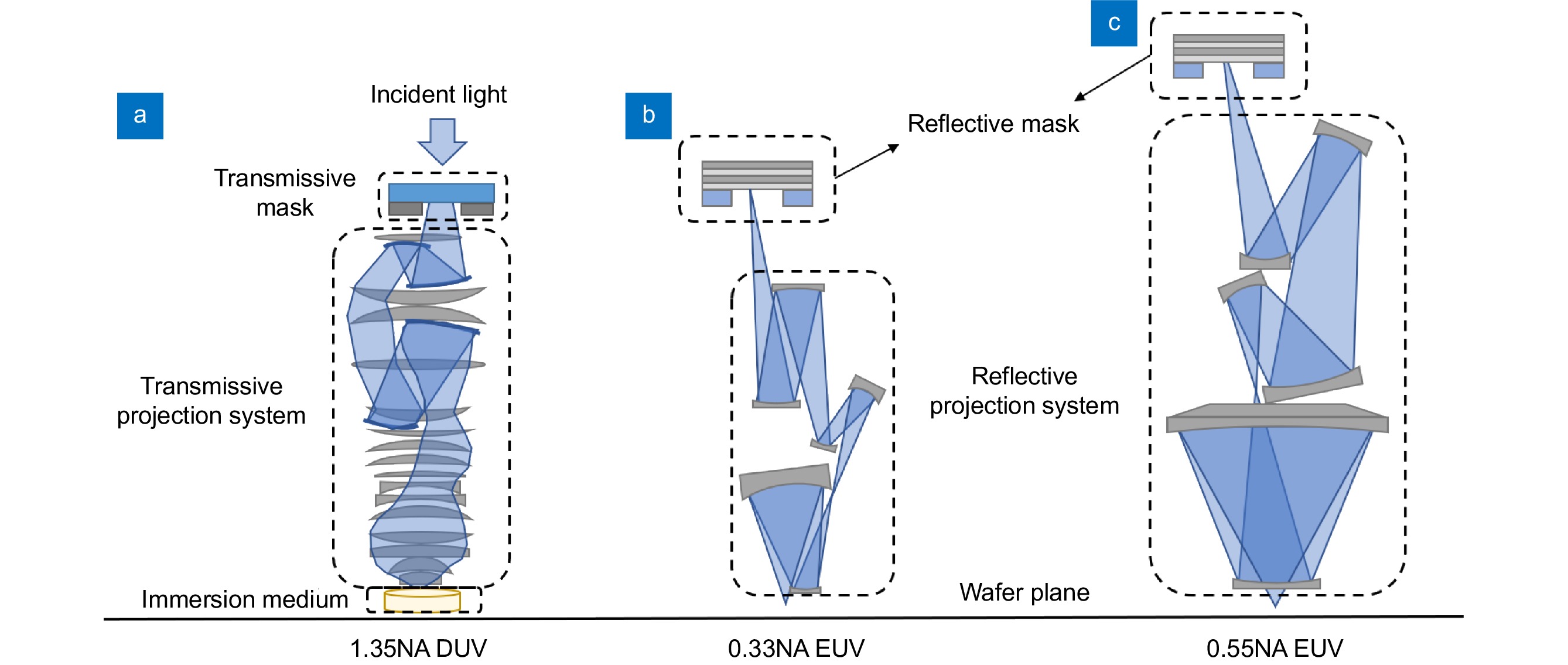
Extreme ultraviolet (EUV) lithography with high numerical aperture (NA) is a future technology to manufacture the integrated circuit in sub-nanometer dimension. Meanwhile, source mask co-optimization (SMO) is an extensively used approach for advanced lithography process beyond 28 nm technology node.
This work proposes a novel SMO method to improve the image fidelity of high-NA EUV lithography system. A fast high-NA EUV lithography imaging model is established first, which includes the effects of mask three-dimensional structure and anamorphic magnification. Then, this paper develops an efficient SMO method that combines the gradient-based mask optimization algorithm and the compressive-sensing-based source optimization algorithm.
A mask rule check (MRC) process is further proposed to simplify the optimized mask pattern. Results illustrate that the proposed SMO method can significantly reduce the lithography patterning error, and maintain high computational efficiency.
A 36 × 240 Gbps hybrid mode/wavelength division multiplexing transmitter using lithium niobate on insulator
Mingyu Zhu, Weihan Wang, Ruitao Ma, Aoyun Gao, Chun Gao, Zexu Wang, Fei Huang, Zhenyuan Bao, Dajian Liu, Jiaxuan Gan, Zejie Yu, Huan Li, Weike Zhao, Daoxin Dai
Opto-Electronic Advances
2026-08-25
Light-perception-based interactive control of an underwater digital twin hand
Jinlong Lu, Chao Zhang, Hengchang Nong, Dongying Wang, Hongyu Zhou, Junjie Weng, Yuehua Deng, Yang Yu, Qiang Bian, Jianfa Zhang, Chaofan Zhang, Zhenrong Zhang, Junbo Yang
Opto-Electronic Advances
2026-07-10
Unlocking home-based nocturnal health management: A fiber-optic approach for early detection of cardiorespiratory rhythm disorders
Hanyu Jin, Hao Li, Zhuolin Chen, Liangye Li, Zurui Wang, Kai Zhou, Weijian Hang, Zhipeng Chen, Junfeng Chen, Kai Shen, Jianfeng Wen, Chen Chen, Cunzheng Fan, Zhijun Yan, Feng Wang, Qizhen Sun
Opto-Electronic Advances
2026-07-10
A flexible wireless system for prospective photodynamic therapy applications
Rolan Mansour, Bhavani Yalagala, Vikas Vikas, Nikolas Bruce, Fawziye Tarhini, Georgios N. Arvanitakis, Mohammed Mughal, Jamie Blanche, Ahmad Taha, Jonathan Copper, Muhammad Imran, Karin Williams, Karin Oien, Mahmoud Wagih, Hadi Heidari, Robert Hadfield, David Flynn
Opto-Electronic Advances
2026-07-10
Parallel bright-field and multi-order edge imaging via wide field-of-view trichannel metalens
Xiaotong Li, Yeseul Kim, Youngsun Jeon, Junhwa Seong, Jaekyung Kim, Peng Tang, Shiqi Hu, Harit Keawmuang, Beomha Yang, Dongmin Jeon, Le Dai, Weiyan Li, Xiaodong Cai, Jinhui Shi, Yong-Sang Ryu, Trevon Badloe, Junsuk Rho
Opto-Electronic Advances
2026-07-10