(Peer-Reviewed) Direct field-to-pattern monolithic design of holographic metasurface via residual encoder-decoder convolutional neural network
Ruichao Zhu 朱瑞超 ¹, Jiafu Wang 王甲富 ¹, Tianshuo Qiu 邱天硕 ¹, Dingkang Yang 杨鼎康 ², Bo Feng 封波 ¹, Zuntian Chu 楚遵天 ¹, Tonghao Liu 刘同豪 ¹, Yajuan Han 韩亚娟 ¹, Hongya Chen 陈红雅 ¹, Shaobo Qu 屈绍波 ¹
¹ Shaanxi Key Laboratory of Artificially-Structured Functional Materials and Devices, Air Force Engineering University, Xi'an 710051, China
中国 西安 中国人民解放军空军工程大学 陕西省人工结构功能材料与器件重点实验室
² The Academy for Engineering & Technology, Fudan University, Shanghai 200433, China
中国 上海 复旦大学工程与应用技术研究院
Opto-Electronic Advances, 2023-08-31
Abstract
Complex-amplitude holographic metasurfaces (CAHMs) with the flexibility in modulating phase and amplitude profiles have been used to manipulate the propagation of wavefront with an unprecedented level, leading to higher image-reconstruction quality compared with their natural counterparts. However, prevailing design methods of CAHMs are based on Huygens-Fresnel theory, meta-atom optimization, numerical simulation and experimental verification, which results in a consumption of computing resources.
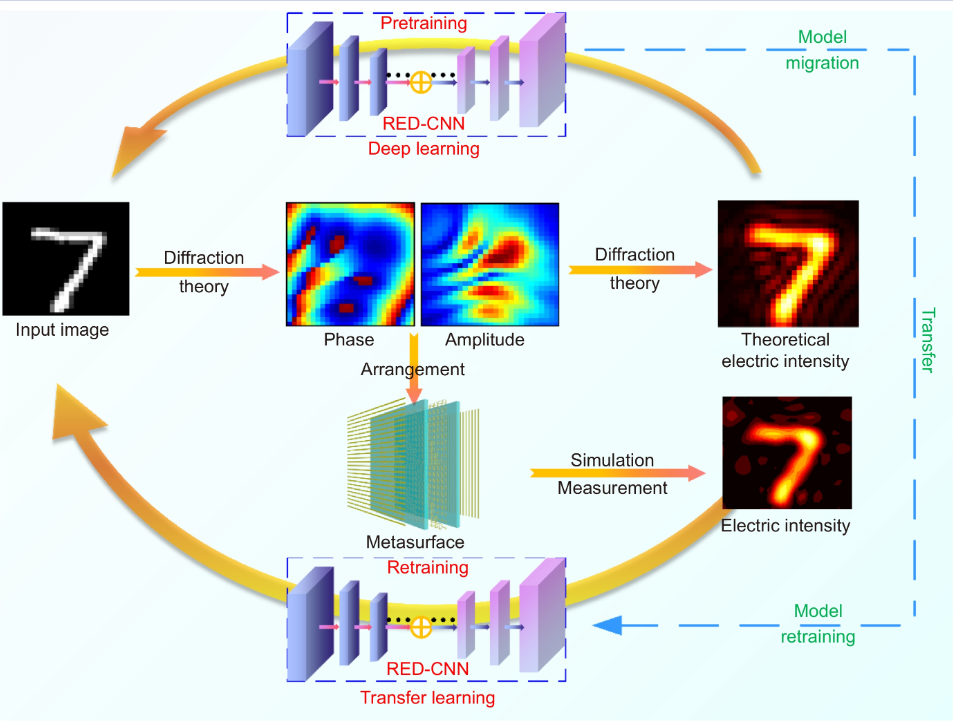
Here, we applied residual encoder-decoder convolutional neural network to directly map the electric field distributions and input images for monolithic metasurface design. A pretrained network is firstly trained by the electric field distributions calculated by diffraction theory, which is subsequently migrated as transfer learning framework to map the simulated electric field distributions and input images. The training results show that the normalized mean pixel error is about 3% on dataset.
As verification, the metasurface prototypes are fabricated, simulated and measured. The reconstructed electric field of reverse-engineered metasurface exhibits high similarity to the target electric field, which demonstrates the effectiveness of our design. Encouragingly, this work provides a monolithic field-to-pattern design method for CAHMs, which paves a new route for the direct reconstruction of metasurfaces.
Ultrafast all-optical modulation of wide-bandwidth pulses enabled by silicon-metasurfaces
Kaloyan Georgiev, Khosro Zangeneh Kamali, Anton A. Trifonov, Giulia Crotti, Lyuben Petrov, Stefan Georgiev, Hristo Iliev, Lei Xu, Unai Arregui Leon, Mohsen Rahmani, Giuseppe Della Valle, Ivan Buchvarov, Dragomir Neshev
Opto-Electronic Advances
2026-09-15
Physics-informed neural fields enable blind aberration correction for partially coherent quantitative phase imaging
Shun Zhou, Xingyu Huang, Linpeng Lu, Habib Ullah, Kaiyu Du, Maciej Trusiak, Malgorzata Kujawinska, Yuzhen Zhang, Yao Fan, Qian Chen, Qinrong Zhang, Chao Zuo
Opto-Electronic Science
2026-08-26
Heterogeneously integrated micro-ring with SnS₂ for dual-functional optical modulation and photodetection
Jinyi Du, Lidan Lu, Xu Zhang, Bofei Zhu, Wenbo Bo, Yingjie Xu, Guang Chen, Yanlin He, Guanghui Ren, Xiaoping Lou, Zheng You, Lianqing Zhu
Opto-Electronic Advances
2026-08-25
Hardware-aware lightweight photonic spiking neural network for pattern classification
Shuiying Xiang, Yahui Zhang, Shangxuan Shi, Haowen Zhao, Dianzhuang Zheng, Xingxing Guo, Yanan Han, Ye Tian, Liyue Zhang, Yuechun Shi, Yue Hao
Opto-Electronic Advances
2026-08-25
PhyspeNet: An empirical physics-aware network for adaptive speckle reconstructive spectrometry
Junrui Liang, Min Jiang, Jun Li, Zhongming Huang, Junhong He, Yanting Guo, Yanzhao Ke, Jun Ye, Jiangming Xu, Jinyong Leng, Pu Zhou
Opto-Electronic Advances
2026-08-25
A 36 × 240 Gbps hybrid mode/wavelength division multiplexing transmitter using lithium niobate on insulator
Mingyu Zhu, Weihan Wang, Ruitao Ma, Aoyun Gao, Chun Gao, Zexu Wang, Fei Huang, Zhenyuan Bao, Dajian Liu, Jiaxuan Gan, Zejie Yu, Huan Li, Weike Zhao, Daoxin Dai
Opto-Electronic Advances
2026-08-25