(Peer-Reviewed) Study on electron stochastic motions in the magnetosonic wave field: Test particle simulations
Kai Fan 樊凯 ¹ ², XinLiang Gao 高新亮 ¹ ², QuanMing Lu 陆全明 ¹ ², Shui Wang 王水 ¹ ²
¹ CAS Key Laboratory of Geospace Environment, Department of Geophysics and Planetary Science, University of Science and Technology of China, Hefei 230026, China
中国 合肥 中国科学技术大学地球物理与行星科学系 中国科学院近地空间环境重点实验室
² CAS Center for Excellence in Comparative Planetology, Hefei 230026, China
中国 合肥 中国科学院比较行星学卓越创新中心
Earth and Planetary Physics, 2021-10-15
Abstract
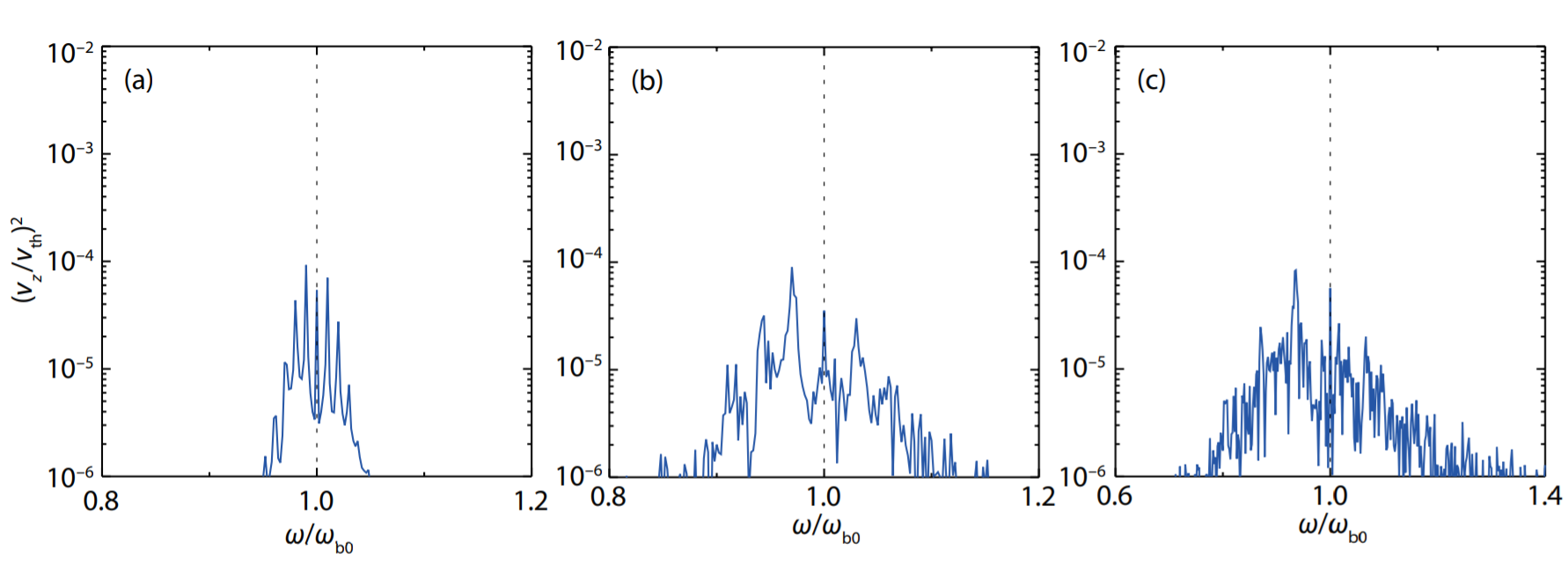
Using the test particle simulation method, we investigate the stochastic motion of electrons with energy of 300 keV in a monochromatic magnetosonic (MS) wave field. This study is motivated by the violation of the quasi-linear theory assumption, when strong MS waves (amplitude up to ~1 nT) are present in the Earth’s magnetosphere.
First, electron motion can become stochastic when the wave amplitude exceeds a certain threshold. If an electron initially resonates with the MS wave via bounce resonance, as the bounce resonance order increases, the amplitude threshold of electron stochastic motion increases until it reaches the peak at about the 11th order in our study, then the amplitude threshold slowly declines. Further, we find that the coexistence of bounce and Landau resonances between electrons and MS waves will significantly reduce the amplitude threshold. In some cases, the electron motion can become stochastic in the field of an MS wave with amplitudes below 1 nT.
Regardless, if neither the bounce nor Landau resonance condition is satisfied initially, then the amplitude threshold of stochastic motion shows an increasing trend for lower frequencies and a decreasing trend for higher frequencies, even though the amplitude threshold is always very large (> 5 nT). Our study suggests that electron stochastic motion should also be considered when modeling electron dynamics regulated by intense MS waves in the Earth’s magnetosphere.
Ultrafast all-optical modulation of wide-bandwidth pulses enabled by silicon-metasurfaces
Kaloyan Georgiev, Khosro Zangeneh Kamali, Anton A. Trifonov, Giulia Crotti, Lyuben Petrov, Stefan Georgiev, Hristo Iliev, Lei Xu, Unai Arregui Leon, Mohsen Rahmani, Giuseppe Della Valle, Ivan Buchvarov, Dragomir Neshev
Opto-Electronic Advances
2026-09-15
Physics-informed neural fields enable blind aberration correction for partially coherent quantitative phase imaging
Shun Zhou, Xingyu Huang, Linpeng Lu, Habib Ullah, Kaiyu Du, Maciej Trusiak, Malgorzata Kujawinska, Yuzhen Zhang, Yao Fan, Qian Chen, Qinrong Zhang, Chao Zuo
Opto-Electronic Science
2026-08-26
Heterogeneously integrated micro-ring with SnS₂ for dual-functional optical modulation and photodetection
Jinyi Du, Lidan Lu, Xu Zhang, Bofei Zhu, Wenbo Bo, Yingjie Xu, Guang Chen, Yanlin He, Guanghui Ren, Xiaoping Lou, Zheng You, Lianqing Zhu
Opto-Electronic Advances
2026-08-25
Hardware-aware lightweight photonic spiking neural network for pattern classification
Shuiying Xiang, Yahui Zhang, Shangxuan Shi, Haowen Zhao, Dianzhuang Zheng, Xingxing Guo, Yanan Han, Ye Tian, Liyue Zhang, Yuechun Shi, Yue Hao
Opto-Electronic Advances
2026-08-25
PhyspeNet: An empirical physics-aware network for adaptive speckle reconstructive spectrometry
Junrui Liang, Min Jiang, Jun Li, Zhongming Huang, Junhong He, Yanting Guo, Yanzhao Ke, Jun Ye, Jiangming Xu, Jinyong Leng, Pu Zhou
Opto-Electronic Advances
2026-08-25
A 36 × 240 Gbps hybrid mode/wavelength division multiplexing transmitter using lithium niobate on insulator
Mingyu Zhu, Weihan Wang, Ruitao Ma, Aoyun Gao, Chun Gao, Zexu Wang, Fei Huang, Zhenyuan Bao, Dajian Liu, Jiaxuan Gan, Zejie Yu, Huan Li, Weike Zhao, Daoxin Dai
Opto-Electronic Advances
2026-08-25