(Peer-Reviewed) Residual-stress relaxation mechanism and model description of 5052H32 Al alloy spun ellipsoidal heads during annealing treatment
Yong-Cheng Lin 蔺永诚, Jiang-Shan Zhu 朱江山, Jia-Yang Chen, Jun-Quan Wang
School of Mechanical and Electrical Engineering, Central South University, Changsha, 410083, People's Republic of China
中国 长沙 中南大学机电工程学院
Abstract
Marginal-restraint mandrel-free spinning is an advanced technology for manufacturing ellipsoidal heads with large diameter-thickness ratios. Nevertheless, the spinning-induced residual stress, which greatly influences the in-service performance of spun heads, should be removed.
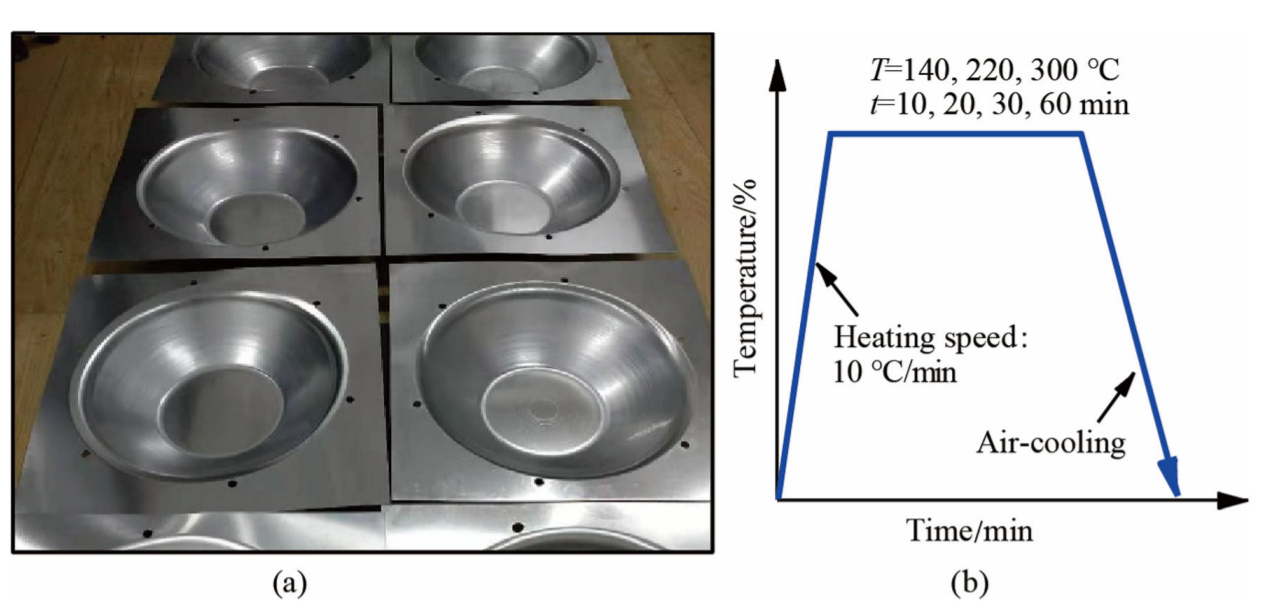
In this study, the effects of annealing on the residual-stress relaxation behavior of 5052H32 aluminum alloy spun heads were investigated. It is found that the residual stress first rapidly decreases and then remains steady with the increase in annealing time at the tested annealing temperatures. The relaxation of the residual stress becomes increasingly obvious with the increase in annealing temperature. When the annealing temperature is less than 220 °C, there are no obvious changes in grain size. Moreover, the spinning-induced dislocations are consumed by the static recovery behavior, which decreases the residual stress during annealing. When the annealing temperature is approximately 300 °C, the broken grains transform into equiaxed grains.
In addition, static recrystallization and recovery behaviors occur simultaneously to promote the relaxation of the residual stress. Considering the different stress relaxation mechanisms, a model based on the Zener-Wert-Avrami equation was established to predict the residual-stress relaxation behavior. Finally, the optimized annealing temperature and time were approximately 300 °C and 30 min, respectively.
Unlocking home-based nocturnal health management: A fiber-optic approach for early detection of cardiorespiratory rhythm disorders
Hanyu Jin, Hao Li, Zhuolin Chen, Liangye Li, Zurui Wang, Kai Zhou, Weijian Hang, Zhipeng Chen, Junfeng Chen, Kai Shen, Jianfeng Wen, Chen Chen, Cunzheng Fan, Zhijun Yan, Feng Wang, Qizhen Sun
Opto-Electronic Advances
2026-07-10
A flexible wireless system for prospective photodynamic therapy applications
Rolan Mansour, Bhavani Yalagala, Vikas Vikas, Nikolas Bruce, Fawziye Tarhini, Georgios N. Arvanitakis, Mohammed Mughal, Jamie Blanche, Ahmad Taha, Jonathan Copper, Muhammad Imran, Karin Williams, Karin Oien, Mahmoud Wagih, Hadi Heidari, Robert Hadfield, David Flynn
Opto-Electronic Advances
2026-07-10
Parallel bright-field and multi-order edge imaging via wide field-of-view trichannel metalens
Xiaotong Li, Yeseul Kim, Youngsun Jeon, Junhwa Seong, Jaekyung Kim, Peng Tang, Shiqi Hu, Harit Keawmuang, Beomha Yang, Dongmin Jeon, Le Dai, Weiyan Li, Xiaodong Cai, Jinhui Shi, Yong-Sang Ryu, Trevon Badloe, Junsuk Rho
Opto-Electronic Advances
2026-07-10