(Peer-Reviewed) Highly efficient emission and high-CRI warm white light-emitting diodes from ligand-modified CsPbBr3 quantum dots
Dongdong Yan 鄢冬冬 ¹, Shuangyi Zhao 赵双易 ¹, Yubo Zhang 张玉波 ², Huaxin Wang 王华昕 ¹, Zhigang Zang 臧志刚 ¹
¹ Key Laboratory of Optoelectronic Technology & Systems (Ministry of Education), Chongqing University, Chongqing 400044, China
中国 重庆 重庆大学 光电技术及系统教育部重点实验室
² Department of Physics, Southern University of Science and Technology, Shenzhen 518055, China
中国 深圳 南方科技大学物理系
Opto-Electronic Advances, 2022-01-25
Abstract
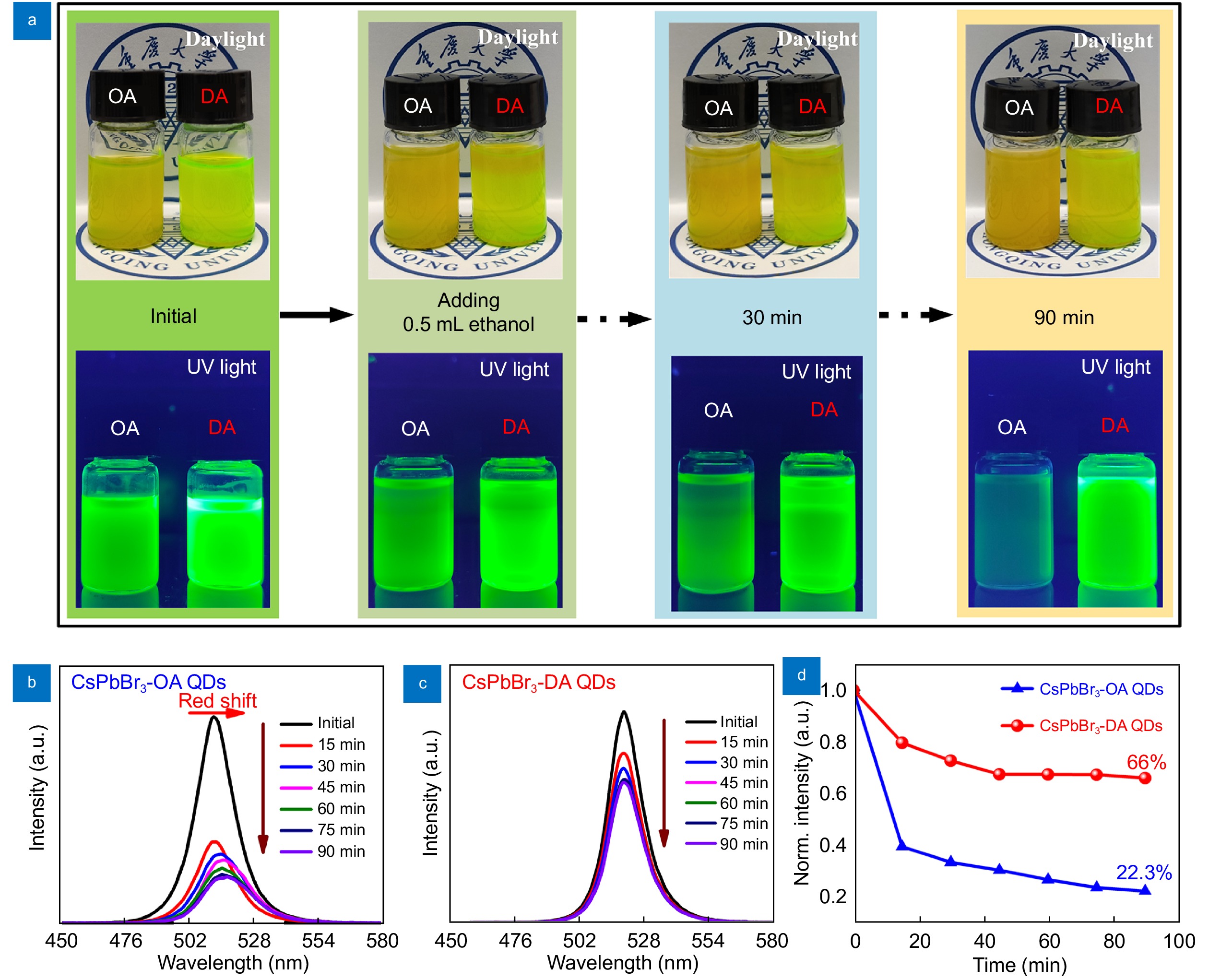
All-inorganic CsPbBr₃ perovskite quantum dots (QDs) have received great attention in white light emission because of their outstanding properties. However, their practical application is hindered by poor stability. Herein, we propose a simple strategy to synthesize excellent stability and efficient emission of CsPbBr₃ QDs by using 2-hexyldecanoic acid (DA) as a ligand to replace the regular oleic acid (OA) ligand.
Thanks to the strong binding energy between DA ligand and QDs, the modified QDs not only show a high photoluminescence quantum yield (PLQY) of 96% but also exhibit high stability against ethanol and water. Thereby warm white light-emitting diodes (WLEDs) are constructed by combining ligand modified CsPbBr₃ QDs with red AgInZnS QDs on blue emitting InGaN chips, exhibiting a color rendering index of 93, a power efficiency of 64.8 lm/W, a CIE coordinate of (0.44, 0.42) and correlated color temperature value of 3018 K.
In addition, WLEDs based on ligand modified CsPbBr₃ QDs also exhibit better thermal performance than that of WLEDs based on the regular CsPbBr₃ QDs. The combination of improved efficiency and better thermal stability with high color quality indicates that the modified CsPbBr₃ QDs are ideal for WLEDs application.
Unlocking home-based nocturnal health management: A fiber-optic approach for early detection of cardiorespiratory rhythm disorders
Hanyu Jin, Hao Li, Zhuolin Chen, Liangye Li, Zurui Wang, Kai Zhou, Weijian Hang, Zhipeng Chen, Junfeng Chen, Kai Shen, Jianfeng Wen, Chen Chen, Cunzheng Fan, Zhijun Yan, Feng Wang, Qizhen Sun
Opto-Electronic Advances
2026-07-10
A flexible wireless system for prospective photodynamic therapy applications
Rolan Mansour, Bhavani Yalagala, Vikas Vikas, Nikolas Bruce, Fawziye Tarhini, Georgios N. Arvanitakis, Mohammed Mughal, Jamie Blanche, Ahmad Taha, Jonathan Copper, Muhammad Imran, Karin Williams, Karin Oien, Mahmoud Wagih, Hadi Heidari, Robert Hadfield, David Flynn
Opto-Electronic Advances
2026-07-10
Parallel bright-field and multi-order edge imaging via wide field-of-view trichannel metalens
Xiaotong Li, Yeseul Kim, Youngsun Jeon, Junhwa Seong, Jaekyung Kim, Peng Tang, Shiqi Hu, Harit Keawmuang, Beomha Yang, Dongmin Jeon, Le Dai, Weiyan Li, Xiaodong Cai, Jinhui Shi, Yong-Sang Ryu, Trevon Badloe, Junsuk Rho
Opto-Electronic Advances
2026-07-10