(Peer-Reviewed) Single-beam optical trap-based surface-enhanced raman scattering optofluidic molecular fingerprint spectroscopy detection system
Ning Sun 孙宁, Yuan Gan 甘愿, Yujie Wu 吴予杰, Xing Wang 王幸, Shen Shen 申珅, Yong Zhu 朱永, Jie Zhang 张洁
The Key Laboratory of Optoelectronic Technology & System, Education Ministry of China, Chongqing University, Chongqing 400044, China
中国 重庆 重庆大学光电技术及系统教育部重点实验室
Opto-Electronic Advances, 2025-01-22
Abstract
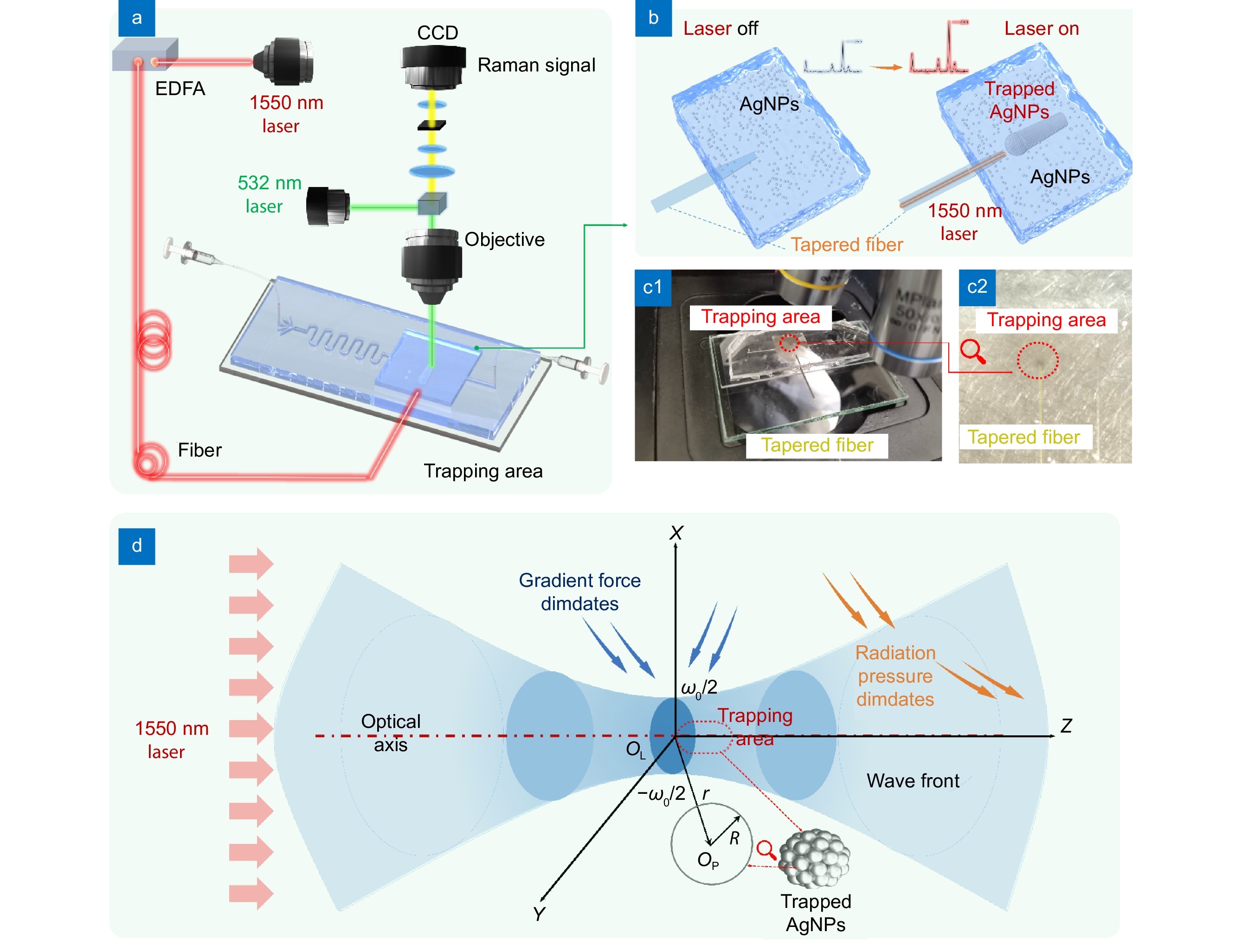
In this study, we developed a single-beam optical trap-based surface-enhanced Raman scattering (SERS) optofluidic molecular fingerprint spectroscopy detection system. This system utilizes a single-beam optical trap to concentrate free silver nanoparticles (AgNPs) within an optofluidic chip, significantly enhancing SERS performance.
We investigated the optical field distribution characteristics within the tapered fiber using COMSOL simulation software and established a MATLAB simulation model to validate the single-beam optical trap's effectiveness in capturing AgNPs, demonstrating the theoretical feasibility of our approach. To verify the particle capture efficacy of the system, we experimentally controlled the optical trap's on-off state to manage the capture and release of particles precisely.
The experimental results indicated that the Raman signal intensity in the capture state was significantly higher than in the non-capture state, confirming that the single-beam optical trap effectively enhances the SERS detection capability of the optofluidic detection system. Furthermore, we employed Raman mapping techniques to investigate the impact of the capture area on the SERS effect, revealing that the spectral intensity of molecular fingerprints in the laser-trapping region is significantly improved.
We successfully detected the Raman spectrum of crystal violet at a concentration of 10−9 mol/L and pesticide thiram at a concentration of 10−5 mol/L, further demonstrating the ability of the single-beam optical trap in enhancing the molecular fingerprint spectrum identification capability of the SERS optofluidic chips.
The optical trapping SERS optofluidic detection system developed in this study, as a key component of an integrated optoelectronic sensing system, holds the potential for integration with portable high-power lasers and high-performance Raman spectrometers. This integration is expected to advance highly integrated technologies and significantly enhance the overall performance and portability of optoelectronic sensing systems.
Ultrafast all-optical modulation of wide-bandwidth pulses enabled by silicon-metasurfaces
Kaloyan Georgiev, Khosro Zangeneh Kamali, Anton A. Trifonov, Giulia Crotti, Lyuben Petrov, Stefan Georgiev, Hristo Iliev, Lei Xu, Unai Arregui Leon, Mohsen Rahmani, Giuseppe Della Valle, Ivan Buchvarov, Dragomir Neshev
Opto-Electronic Advances
2026-09-15
Physics-informed neural fields enable blind aberration correction for partially coherent quantitative phase imaging
Shun Zhou, Xingyu Huang, Linpeng Lu, Habib Ullah, Kaiyu Du, Maciej Trusiak, Malgorzata Kujawinska, Yuzhen Zhang, Yao Fan, Qian Chen, Qinrong Zhang, Chao Zuo
Opto-Electronic Science
2026-08-26
Heterogeneously integrated micro-ring with SnS₂ for dual-functional optical modulation and photodetection
Jinyi Du, Lidan Lu, Xu Zhang, Bofei Zhu, Wenbo Bo, Yingjie Xu, Guang Chen, Yanlin He, Guanghui Ren, Xiaoping Lou, Zheng You, Lianqing Zhu
Opto-Electronic Advances
2026-08-25
Hardware-aware lightweight photonic spiking neural network for pattern classification
Shuiying Xiang, Yahui Zhang, Shangxuan Shi, Haowen Zhao, Dianzhuang Zheng, Xingxing Guo, Yanan Han, Ye Tian, Liyue Zhang, Yuechun Shi, Yue Hao
Opto-Electronic Advances
2026-08-25
PhyspeNet: An empirical physics-aware network for adaptive speckle reconstructive spectrometry
Junrui Liang, Min Jiang, Jun Li, Zhongming Huang, Junhong He, Yanting Guo, Yanzhao Ke, Jun Ye, Jiangming Xu, Jinyong Leng, Pu Zhou
Opto-Electronic Advances
2026-08-25
A 36 × 240 Gbps hybrid mode/wavelength division multiplexing transmitter using lithium niobate on insulator
Mingyu Zhu, Weihan Wang, Ruitao Ma, Aoyun Gao, Chun Gao, Zexu Wang, Fei Huang, Zhenyuan Bao, Dajian Liu, Jiaxuan Gan, Zejie Yu, Huan Li, Weike Zhao, Daoxin Dai
Opto-Electronic Advances
2026-08-25