(Peer-Reviewed) Nonlinear optics with structured light
Wagner Tavares Buono, Andrew Forbes
School of Physics, University of the Witwatersrand, Private Bag 3, Johannesburg 2050, South Africa
Opto-Electronic Advances, 2022-06-22
Abstract
The interest in tailoring light in all its degrees of freedom is steadily gaining traction, driven by the tremendous developments in the toolkit for the creation, control and detection of what is now called structured light. Because the complexity of these optical fields is generally understood in terms of interference, the tools have historically been linear optical elements that create the desired superpositions.
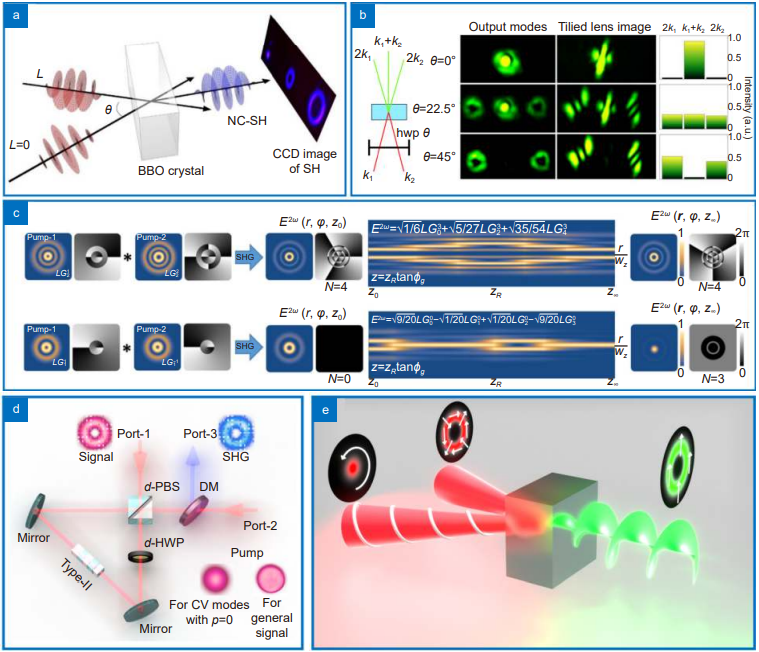
For this reason, despite the long and impressive history of nonlinear optics, only recently has the spatial structure of light in nonlinear processes come to the fore. In this review we provide a concise theoretical framework for understanding nonlinear optics in the context of structured light, offering an overview and perspective on the progress made, and the challenges that remain.
Unlocking home-based nocturnal health management: A fiber-optic approach for early detection of cardiorespiratory rhythm disorders
Hanyu Jin, Hao Li, Zhuolin Chen, Liangye Li, Zurui Wang, Kai Zhou, Weijian Hang, Zhipeng Chen, Junfeng Chen, Kai Shen, Jianfeng Wen, Chen Chen, Cunzheng Fan, Zhijun Yan, Feng Wang, Qizhen Sun
Opto-Electronic Advances
2026-07-10
A flexible wireless system for prospective photodynamic therapy applications
Rolan Mansour, Bhavani Yalagala, Vikas Vikas, Nikolas Bruce, Fawziye Tarhini, Georgios N. Arvanitakis, Mohammed Mughal, Jamie Blanche, Ahmad Taha, Jonathan Copper, Muhammad Imran, Karin Williams, Karin Oien, Mahmoud Wagih, Hadi Heidari, Robert Hadfield, David Flynn
Opto-Electronic Advances
2026-07-10
Parallel bright-field and multi-order edge imaging via wide field-of-view trichannel metalens
Xiaotong Li, Yeseul Kim, Youngsun Jeon, Junhwa Seong, Jaekyung Kim, Peng Tang, Shiqi Hu, Harit Keawmuang, Beomha Yang, Dongmin Jeon, Le Dai, Weiyan Li, Xiaodong Cai, Jinhui Shi, Yong-Sang Ryu, Trevon Badloe, Junsuk Rho
Opto-Electronic Advances
2026-07-10