(Peer-Reviewed) A compression-decompression framework for universal acceleration of photonic neuromorphic computing
Changdi Zhou 周长笛 ¹ ², Deyu Cai 蔡德宇 ¹ ², Yu Huang 黄于 ¹ ², Yigong Yang 杨一功 ¹ ², Pei Zhou 周沛 ¹ ², Kuenyao Lau 刘坤耀 ¹ ², Nianqiang Li 李念强 ¹ ²
¹ School of Optoelectronic Science and Engineering & Collaborative Innovation Center of Suzhou Nano Science and Technology, Soochow University, Suzhou 215006, China
中国 苏州 苏州大学光电科学与工程学院 苏州纳米科技协同创新中心
² Key Laboratory of Advanced Optical Manufacturing Technologies of Jiangsu Province & Key Laboratory of Modern Optical Technologies of the Ministry of Education, Soochow University, Suzhou 215006, China
中国 苏州 苏州大学 江苏省先进光学制造技术重点实验室 教育部现代光学技术重点实验室
Opto-Electronic Advances, 2026-05-06
Abstract
Photonic neuromorphic computing provides an effective route to overcoming the fundamental bottlenecks of the von Neumann architecture. However, the realization of complex optical nonlinearities by time-division multiplexing in traditional photonic neuromorphic computing limits both information-processing speed and scalability of these systems.
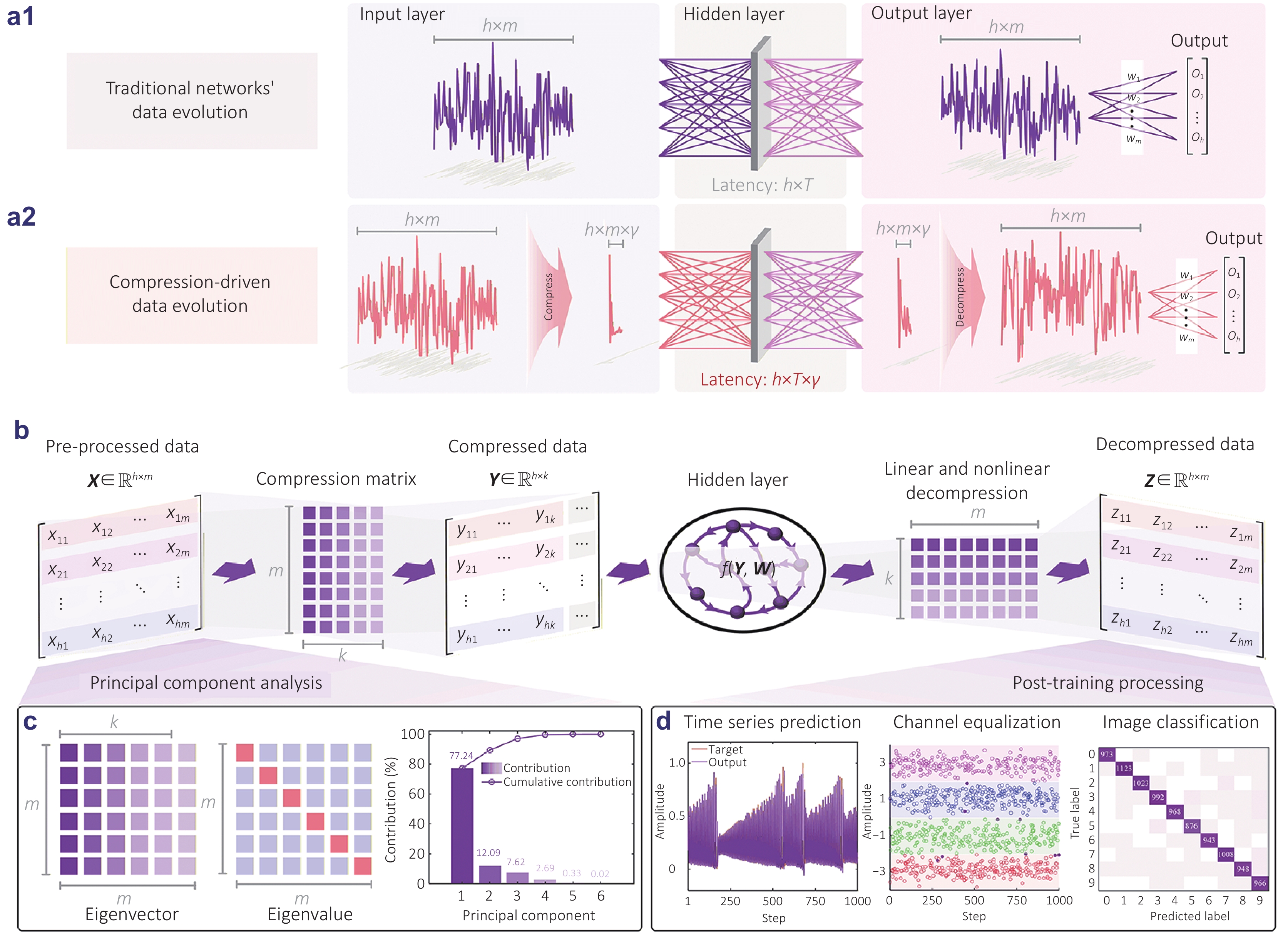
Here, we break this bottleneck by introducing an accuracy-compensated compression strategy that co-optimizes latency and speed without sacrificing computational fidelity. Our core innovation is an eigenvector-driven compression-decompression framework that projects input data into a task-relevant subspace, drastically reducing the data volume processed by the hidden layer. This paradigm shift enables photonic neuromorphic computing to achieve image recognition and time-series prediction tasks in the optical domain at speeds of 100 million images and 600 million data points per second, respectively.
We experimentally validate our approach across both a continuous-wave system based on off-the-shelf lasers and a spiking system composed of a specifically fabricated photonic neuro-synaptic chip, demonstrating that the compression-decompression framework effectively recovers the accuracy to the level of uncompressed networks—e.g., achieving >95% on MNIST and >84% on Fashion-MNIST—while slashing latency and hardware resource demands by an order of magnitude.
This strategy establishes a scalable pathway towards high-throughput, low-power neuromorphic chips, bridging a critical gap between algorithmic efficiency and physical computing paradigms.
Ultrafast all-optical modulation of wide-bandwidth pulses enabled by silicon-metasurfaces
Kaloyan Georgiev, Khosro Zangeneh Kamali, Anton A. Trifonov, Giulia Crotti, Lyuben Petrov, Stefan Georgiev, Hristo Iliev, Lei Xu, Unai Arregui Leon, Mohsen Rahmani, Giuseppe Della Valle, Ivan Buchvarov, Dragomir Neshev
Opto-Electronic Advances
2026-09-15
Physics-informed neural fields enable blind aberration correction for partially coherent quantitative phase imaging
Shun Zhou, Xingyu Huang, Linpeng Lu, Habib Ullah, Kaiyu Du, Maciej Trusiak, Malgorzata Kujawinska, Yuzhen Zhang, Yao Fan, Qian Chen, Qinrong Zhang, Chao Zuo
Opto-Electronic Science
2026-08-26
Heterogeneously integrated micro-ring with SnS₂ for dual-functional optical modulation and photodetection
Jinyi Du, Lidan Lu, Xu Zhang, Bofei Zhu, Wenbo Bo, Yingjie Xu, Guang Chen, Yanlin He, Guanghui Ren, Xiaoping Lou, Zheng You, Lianqing Zhu
Opto-Electronic Advances
2026-08-25
Hardware-aware lightweight photonic spiking neural network for pattern classification
Shuiying Xiang, Yahui Zhang, Shangxuan Shi, Haowen Zhao, Dianzhuang Zheng, Xingxing Guo, Yanan Han, Ye Tian, Liyue Zhang, Yuechun Shi, Yue Hao
Opto-Electronic Advances
2026-08-25
PhyspeNet: An empirical physics-aware network for adaptive speckle reconstructive spectrometry
Junrui Liang, Min Jiang, Jun Li, Zhongming Huang, Junhong He, Yanting Guo, Yanzhao Ke, Jun Ye, Jiangming Xu, Jinyong Leng, Pu Zhou
Opto-Electronic Advances
2026-08-25
A 36 × 240 Gbps hybrid mode/wavelength division multiplexing transmitter using lithium niobate on insulator
Mingyu Zhu, Weihan Wang, Ruitao Ma, Aoyun Gao, Chun Gao, Zexu Wang, Fei Huang, Zhenyuan Bao, Dajian Liu, Jiaxuan Gan, Zejie Yu, Huan Li, Weike Zhao, Daoxin Dai
Opto-Electronic Advances
2026-08-25