(Peer-Reviewed) Ultrahigh-efficiency and robust thermophotovoltaic devices via spectral-heat filtering
Heng Zhang 张恒 ¹, Zhequn Huang 黄哲群 ², Min Ding 丁旻 ³, Yilin Feng 冯祎林 ¹, Jian Zhang 章健 ⁴, Tao Deng 邓涛 ¹, Hongxing Xu 徐红星 ⁵, Kehang Cui 崔可航 ¹
¹ School of Material Science and Engineering, State Key Laboratory of Metal Matrix Composites, Center for Hydrogen Science, Shanghai Jiao Tong University, Shanghai 200240, China
中国 上海 上海交通大学材料科学与工程学院 金属基复合材料国家重点实验室
² Zhiyuan Innovative Research Center, Shanghai Jiao Tong University, Shanghai 200240, China
中国 上海 上海交通大学致远创新研究中心
³ Shanghai HeiYi Materials Technology Co. Ltd., Shanghai 200240, China
中国 上海 上海黑翊材料科技有限公司
⁴ Research Center for Transparent Ceramics, Shanghai Institute of Ceramics, Chinese Academy of Sciences, Shanghai 200050, China
中国 上海 中国科学院 上海硅酸盐研究所透明陶瓷研究中心
⁵ Wuhan Institute of Quantum Technology, Wuhan University, Wuhan 430072, China
中国 武汉 武汉大学 武汉量子技术研究院
Opto-Electronic Advances, 2026-05-27
Abstract
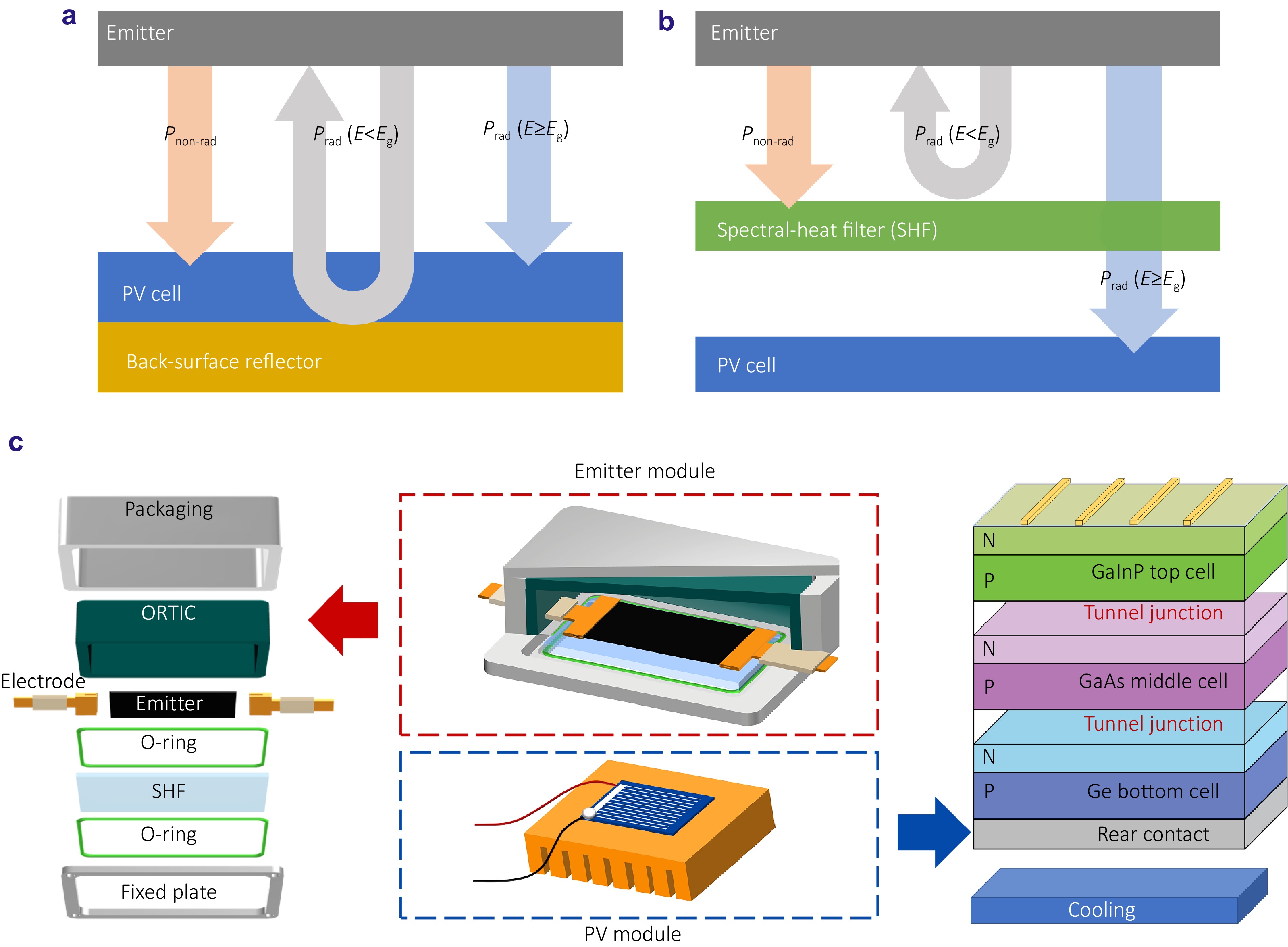
Thermophotovoltaics (TPVs) are solid-state photonic heat engines that convert thermal radiation into continuous power generation through photovoltaics. Recent work on photon recuperation using back-surface reflectors has remarkably boosted TPV efficiencies. However, building a practical TPV device with photons actually recuperated remains a challenge because of the strong emitter-cell thermal coupling.
Here we build a robust TPV device through emitter-side photon recuperation using a spectral-heat filter (SHF). The SHF, optimized via multi-objective machine learning, blocks 99% of the sub-bandgap radiation as well as the thermal conduction and convection from the emitter. The accelerated thermal ageing test shows the fabricated SHF has a L70-rated lifetime of 57,477 hours. The emitter-SHF pair decouples the temperature-susceptible PV cell from the photon-recuperation process, and unlocks the mass-produced state-of-the-art photovoltaic cells for use in TPV.
The emitter-SHF pair engineers the above-bandgap radiation to achieve current matching in the GaInP/GaAs/Ge triple-junction photovoltaic cell. The efficiency of the TPV device reaches 47.16% ± 1.12% at the emitter temperature of 2,162 °C. The spectral-heat filtering architecture offers inherent operational robustness as well as the power conversion efficiency surpassing conventional heat engines.
Ultrafast all-optical modulation of wide-bandwidth pulses enabled by silicon-metasurfaces
Kaloyan Georgiev, Khosro Zangeneh Kamali, Anton A. Trifonov, Giulia Crotti, Lyuben Petrov, Stefan Georgiev, Hristo Iliev, Lei Xu, Unai Arregui Leon, Mohsen Rahmani, Giuseppe Della Valle, Ivan Buchvarov, Dragomir Neshev
Opto-Electronic Advances
2026-09-15
Physics-informed neural fields enable blind aberration correction for partially coherent quantitative phase imaging
Shun Zhou, Xingyu Huang, Linpeng Lu, Habib Ullah, Kaiyu Du, Maciej Trusiak, Malgorzata Kujawinska, Yuzhen Zhang, Yao Fan, Qian Chen, Qinrong Zhang, Chao Zuo
Opto-Electronic Science
2026-08-26
Heterogeneously integrated micro-ring with SnS₂ for dual-functional optical modulation and photodetection
Jinyi Du, Lidan Lu, Xu Zhang, Bofei Zhu, Wenbo Bo, Yingjie Xu, Guang Chen, Yanlin He, Guanghui Ren, Xiaoping Lou, Zheng You, Lianqing Zhu
Opto-Electronic Advances
2026-08-25
Hardware-aware lightweight photonic spiking neural network for pattern classification
Shuiying Xiang, Yahui Zhang, Shangxuan Shi, Haowen Zhao, Dianzhuang Zheng, Xingxing Guo, Yanan Han, Ye Tian, Liyue Zhang, Yuechun Shi, Yue Hao
Opto-Electronic Advances
2026-08-25
PhyspeNet: An empirical physics-aware network for adaptive speckle reconstructive spectrometry
Junrui Liang, Min Jiang, Jun Li, Zhongming Huang, Junhong He, Yanting Guo, Yanzhao Ke, Jun Ye, Jiangming Xu, Jinyong Leng, Pu Zhou
Opto-Electronic Advances
2026-08-25
A 36 × 240 Gbps hybrid mode/wavelength division multiplexing transmitter using lithium niobate on insulator
Mingyu Zhu, Weihan Wang, Ruitao Ma, Aoyun Gao, Chun Gao, Zexu Wang, Fei Huang, Zhenyuan Bao, Dajian Liu, Jiaxuan Gan, Zejie Yu, Huan Li, Weike Zhao, Daoxin Dai
Opto-Electronic Advances
2026-08-25