(Peer-Reviewed) An ultra-compact polarization-insensitive slot-strip mode converter
Zihan Tao 陶子涵 ¹, Bo Wang 王博 ¹, Bowen Bai 白博文 ¹, Ruixuan Chen 陈睿轩 ¹, Haowen Shu 舒浩文 ¹, Xuguang Zhang 张绪光 ¹, Xingjun Wang 王兴军 ¹ ² ³ ⁴
¹ State Key Laboratory of Advanced Optical Communication Systems and Networks, School of Electronics, Peking University, Beijing 100871, China
中国 北京 北京大学电子学院 区域光纤通信网与新型光通信系统国家重点实验室
² Frontier Science Center for Nano-Optoelectronics, Peking University, Beijing 100871, China
中国 北京 北京大学纳光电子前沿科学中心
³ Peking University Yangtze Delta Institute of Optoelectronics, Nantong 226010, China
中国 南通 北京大学长三角光电科学研究院
⁴ Peng Cheng Laboratory, Shenzhen 518055, China
中国 深圳 鹏城实验室
Abstract
Integrated waveguides with slot structures have attracted increasing attention due to their advantages of tight mode confinement and strong light-matter interaction. Although extensively studied, the issue of mode mismatch with other strip waveguide-based optical devices is a huge challenge that prevents integrated waveguides from being widely utilized in large-scale photonic-based circuits.
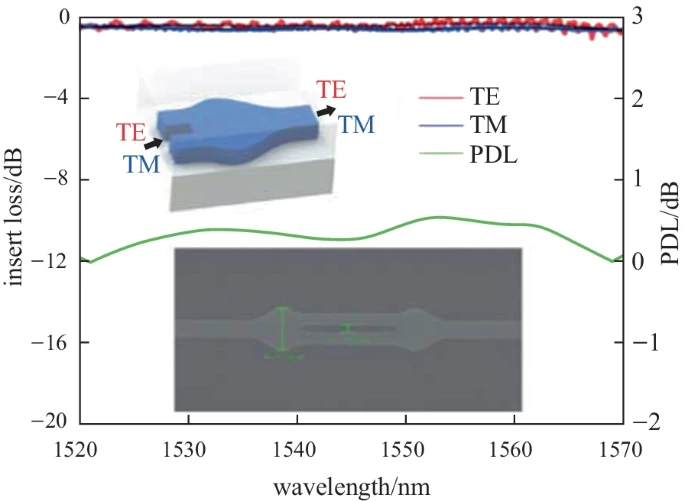
In this paper, we demonstrate an ultra-compact low-loss slot-strip converter with polarization insensitivity based on the multimode interference (MMI) effect. Sleek sinusoidal profiles are adopted to allow for smooth connection between the slot and strip waveguide, resulting reflection reduction. By manipulating the MMI effect with structure optimization, the self-imaging positions of the TE0 and TM0 modes are aligned with minimized footprint, leading to low-loss transmission for both polarizations.
The measurement results show that high coupling efficiencies of − 0.40 and − 0.64 dB are achieved for TE0 and TM0 polarizations, respectively. The device has dimensions as small as 1.1 μm × 1.2 μm and composed of factory-available structures. The above characteristics of our proposed compact slot-strip converter makes it a promising device for future deployment in multi-functional integrated photonics systems.
Ultrafast all-optical modulation of wide-bandwidth pulses enabled by silicon-metasurfaces
Kaloyan Georgiev, Khosro Zangeneh Kamali, Anton A. Trifonov, Giulia Crotti, Lyuben Petrov, Stefan Georgiev, Hristo Iliev, Lei Xu, Unai Arregui Leon, Mohsen Rahmani, Giuseppe Della Valle, Ivan Buchvarov, Dragomir Neshev
Opto-Electronic Advances
2026-09-15
Physics-informed neural fields enable blind aberration correction for partially coherent quantitative phase imaging
Shun Zhou, Xingyu Huang, Linpeng Lu, Habib Ullah, Kaiyu Du, Maciej Trusiak, Malgorzata Kujawinska, Yuzhen Zhang, Yao Fan, Qian Chen, Qinrong Zhang, Chao Zuo
Opto-Electronic Science
2026-08-26
Heterogeneously integrated micro-ring with SnS₂ for dual-functional optical modulation and photodetection
Jinyi Du, Lidan Lu, Xu Zhang, Bofei Zhu, Wenbo Bo, Yingjie Xu, Guang Chen, Yanlin He, Guanghui Ren, Xiaoping Lou, Zheng You, Lianqing Zhu
Opto-Electronic Advances
2026-08-25
Hardware-aware lightweight photonic spiking neural network for pattern classification
Shuiying Xiang, Yahui Zhang, Shangxuan Shi, Haowen Zhao, Dianzhuang Zheng, Xingxing Guo, Yanan Han, Ye Tian, Liyue Zhang, Yuechun Shi, Yue Hao
Opto-Electronic Advances
2026-08-25
PhyspeNet: An empirical physics-aware network for adaptive speckle reconstructive spectrometry
Junrui Liang, Min Jiang, Jun Li, Zhongming Huang, Junhong He, Yanting Guo, Yanzhao Ke, Jun Ye, Jiangming Xu, Jinyong Leng, Pu Zhou
Opto-Electronic Advances
2026-08-25
A 36 × 240 Gbps hybrid mode/wavelength division multiplexing transmitter using lithium niobate on insulator
Mingyu Zhu, Weihan Wang, Ruitao Ma, Aoyun Gao, Chun Gao, Zexu Wang, Fei Huang, Zhenyuan Bao, Dajian Liu, Jiaxuan Gan, Zejie Yu, Huan Li, Weike Zhao, Daoxin Dai
Opto-Electronic Advances
2026-08-25