(Peer-Reviewed) A flexible wireless system for prospective photodynamic therapy applications
Rolan Mansour ¹, Bhavani Yalagala ¹, Vikas Vikas ⁴, Nikolas Bruce ¹, Fawziye Tarhini ¹, Georgios N. Arvanitakis ², Mohammed Mughal ¹, Jamie Blanche ¹, Ahmad Taha ¹, Jonathan Copper ⁵, Muhammad Imran ¹, Karin Williams ³, Karin Oien ³, Mahmoud Wagih ¹, Hadi Heidari ¹, Robert Hadfield ⁴, David Flynn ¹
¹ James Watt School of Engineering, University of Glasgow, Glasgow G12 8QQ, UK
² Edinburgh Instruments Ltd, 2 Bain Square, Kirkton Campus, Livingston EH54 7DQ, UK
³ School of Cancer Sciences, University of Glasgow, Glasgow G61 1QH, UK
⁴ Quantum Sensors Group, Advanced Research Centre, University of Glasgow, Glasgow G11 6EW, UK
⁵ Biomedical Engineering, Advanced Research Centre, University of Glasgow, Glasgow G12 8QQ, UK
Opto-Electronic Advances, 2026-07-10
Abstract
Cancer treatments, dependent on several factors, deliver varying degrees of treatment effectiveness. Photodynamic therapy (PDT) is a treatment modality that selectively targets and destroys cancer cells using a light-sensitive drug with a specific optical wavelength. However, PDT encounters several constraints, mainly, limited penetration of light into deep tumors.
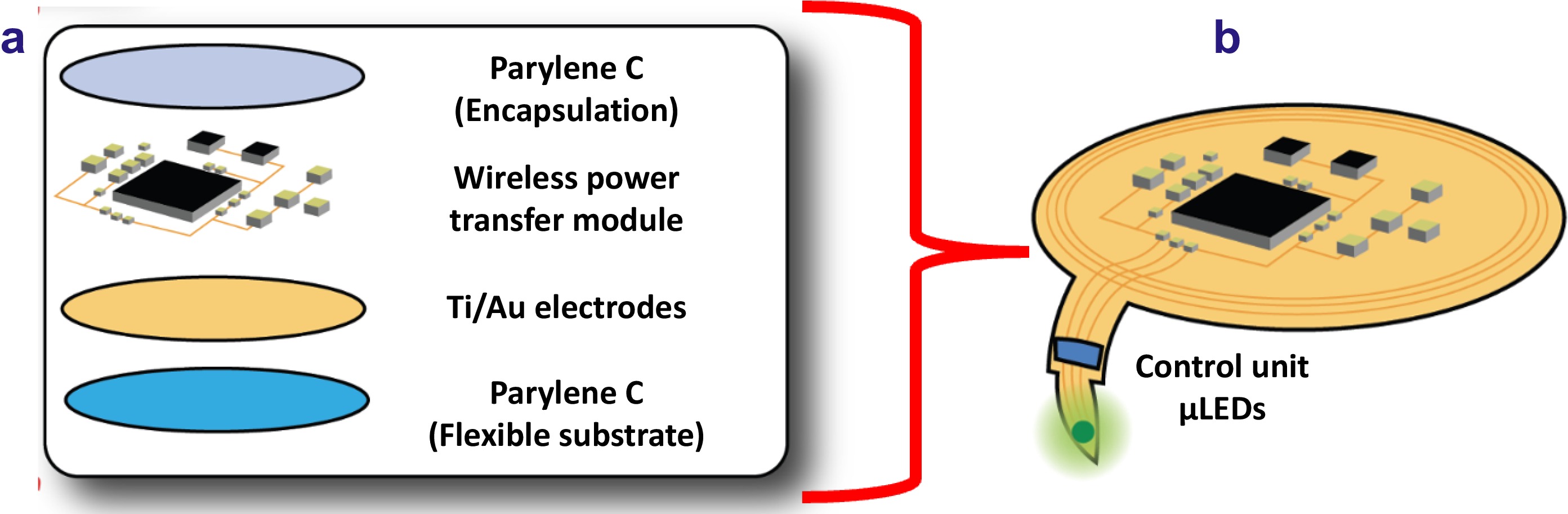
In this paper, we present a new wireless implantable PDT system towards overcoming the constraints of current PDT treatments. The wireless-powered prototype was evaluated showing resonant inductive power delivery in a tissue phantom, emulating the bladder, providing the necessary power level for PDT treatment. The production of singlet oxygen (1O2) using a multi-LED system was studied by utilizing a 1,3-diphenylisobenzofuran (DPBF) in a Rose Bengal (RB) and Dimethyl sulfoxide (DMSO) solution, under both DC and AC excitations, for direct wireless powering. The photosensitizer solution is illuminated with over 5 mW of optical power generated by the four-LED array to generate 1O2.
Our measurements confirm the production of 1O2 emissions as well as lifetime performance. The optical, electrical, and mechanical studies are presented on the resultant optoelectronic system, verifying the efficiency and mechanical robustness of our prototype. A fabrication flow for bio-compatible devices using laser ablation is also introduced towards large area manufacturability, scalability, and repeatability. Our manufacturing process is versatile to a variety of materials including polymeric substrates, metallic electrodes and offers design flexibility ranging from 30 microns to mm. This research advances the development of wirelessly powered implantable device for PDT, optimized for in-vivo use through careful LED selection and biocompatible design.
Our results evidence the potential of a new emergent technology that addresses the limitations of PDT as a potential future therapy to enhance the curative efficiency of cancer treatment and demonstrates promising preliminary potential for in vivo application, which requires further validation before therapeutic implementation can be established.
Unlocking home-based nocturnal health management: A fiber-optic approach for early detection of cardiorespiratory rhythm disorders
Hanyu Jin, Hao Li, Zhuolin Chen, Liangye Li, Zurui Wang, Kai Zhou, Weijian Hang, Zhipeng Chen, Junfeng Chen, Kai Shen, Jianfeng Wen, Chen Chen, Cunzheng Fan, Zhijun Yan, Feng Wang, Qizhen Sun
Opto-Electronic Advances
2026-07-10
Parallel bright-field and multi-order edge imaging via wide field-of-view trichannel metalens
Xiaotong Li, Yeseul Kim, Youngsun Jeon, Junhwa Seong, Jaekyung Kim, Peng Tang, Shiqi Hu, Harit Keawmuang, Beomha Yang, Dongmin Jeon, Le Dai, Weiyan Li, Xiaodong Cai, Jinhui Shi, Yong-Sang Ryu, Trevon Badloe, Junsuk Rho
Opto-Electronic Advances
2026-07-10