(Peer-Reviewed) Cylindrical vector beams reveal radiationless anapole condition in a resonant state
Yudong Lu 卢玉东 ¹, Yi Xu 徐毅 ¹ ², Xu Ouyang 欧阳旭 ¹ ², Mingcong Xian 冼铭聪 ², Yaoyu Cao 曹耀宇 ¹, Kai Chen 陈凯 ¹, Xiangping Li 李向平 ¹
¹ Guangdong Provincial Key Laboratory of Optical Fiber Sensing and Communications, Institute of Photonics Technology, Jinan University, Guangzhou 510632, China
中国 广州 暨南大学光子技术研究院 广东省光纤传感与通信技术重点实验室
² Department of Electronic Engineering, College of Information Science and Technology, Jinan University, Guangzhou 510632, China
中国 广州 暨南大学信息科学技术学院电子工程系
Opto-Electronic Advances, 2022-02-18
Abstract
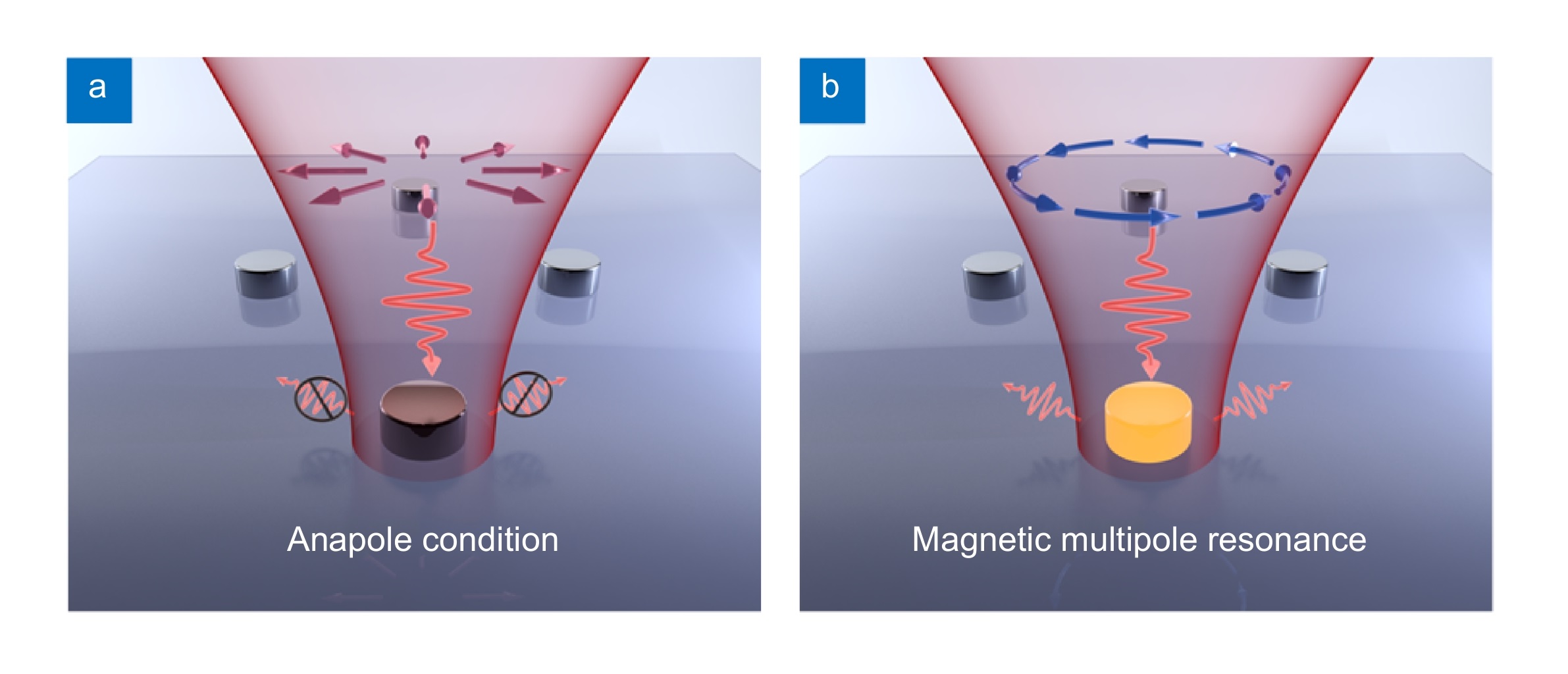
Nonscattering optical anapole condition is corresponding to the excitation of radiationless field distributions in open resonators, which offers new degrees of freedom for tailoring light-matter interaction. Conventional mechanisms for achieving such a condition relies on sophisticated manipulation of electromagnetic multipolar moments of all orders to guarantee superpositions of suppressed moment strengths at the same wavelength. In contrast, here we report on the excitation of optical radiationless anapole hidden in a resonant state of a Si nanoparticle utilizing a tightly focused radially polarized (RP) beam.
The coexistence of magnetic resonant state and anapole condition at the same wavelength further enables the triggering of resonant state by a tightly focused azimuthally polarized (AP) beam whose corresponding electric multipole coefficient could be zero. As a result, high contrast inter-transition between radiationless anapole condition and ideal magnetic resonant scattering can be achieved experimentally in visible spectrum. The proposed mechanism is general which can be realized in different types of nanostructures.
Our results showcase that the unique combination of structured light and structured Mie resonances could provide new degrees of freedom for tailoring light-matter interaction, which might shed new light on functional meta-optics.
Unlocking home-based nocturnal health management: A fiber-optic approach for early detection of cardiorespiratory rhythm disorders
Hanyu Jin, Hao Li, Zhuolin Chen, Liangye Li, Zurui Wang, Kai Zhou, Weijian Hang, Zhipeng Chen, Junfeng Chen, Kai Shen, Jianfeng Wen, Chen Chen, Cunzheng Fan, Zhijun Yan, Feng Wang, Qizhen Sun
Opto-Electronic Advances
2026-07-10
A flexible wireless system for prospective photodynamic therapy applications
Rolan Mansour, Bhavani Yalagala, Vikas Vikas, Nikolas Bruce, Fawziye Tarhini, Georgios N. Arvanitakis, Mohammed Mughal, Jamie Blanche, Ahmad Taha, Jonathan Copper, Muhammad Imran, Karin Williams, Karin Oien, Mahmoud Wagih, Hadi Heidari, Robert Hadfield, David Flynn
Opto-Electronic Advances
2026-07-10
Parallel bright-field and multi-order edge imaging via wide field-of-view trichannel metalens
Xiaotong Li, Yeseul Kim, Youngsun Jeon, Junhwa Seong, Jaekyung Kim, Peng Tang, Shiqi Hu, Harit Keawmuang, Beomha Yang, Dongmin Jeon, Le Dai, Weiyan Li, Xiaodong Cai, Jinhui Shi, Yong-Sang Ryu, Trevon Badloe, Junsuk Rho
Opto-Electronic Advances
2026-07-10