(Peer-Reviewed) Aberration-corrected differential phase contrast microscopy with annular illuminations
Yao Fan 范瑶 ¹ ² ³, Chenyue Zheng 郑辰越 ¹ ² ³, Yefeng Shu 束业峰 ¹ ² ³, Qingyang Fu 符庆杨 ¹ ² ³, Lixiang Xiong 熊立翔 ¹ ² ³, Guifeng Lu 卢桂锋 ¹ ² ³, Jiasong Sun 孙佳嵩 ¹ ² ³, Chao Zuo 左超 ¹ ² ³, Qian Chen 陈钱 ¹ ² ³
¹ Smart Computational Imaging Laboratory (SCILab), School of Electronic and Optical Engineering, Nanjing University of Science and Technology, Nanjing 210094, China
中国 南京 南京理工大学智能计算成像实验室
² Smart Computational Imaging Research Institute (SCIRI) of Nanjing University of Science and Technology, Nanjing 210019, China
中国 南京 南京理工大学智能计算成像研究院
³ Jiangsu Key Laboratory of Visual Sensing & Intelligent Perception, Nanjing 210094, China
中国 南京 江苏省光谱成像与智能感知重点实验室
Opto-Electronic Science, 2025-08-25
Abstract
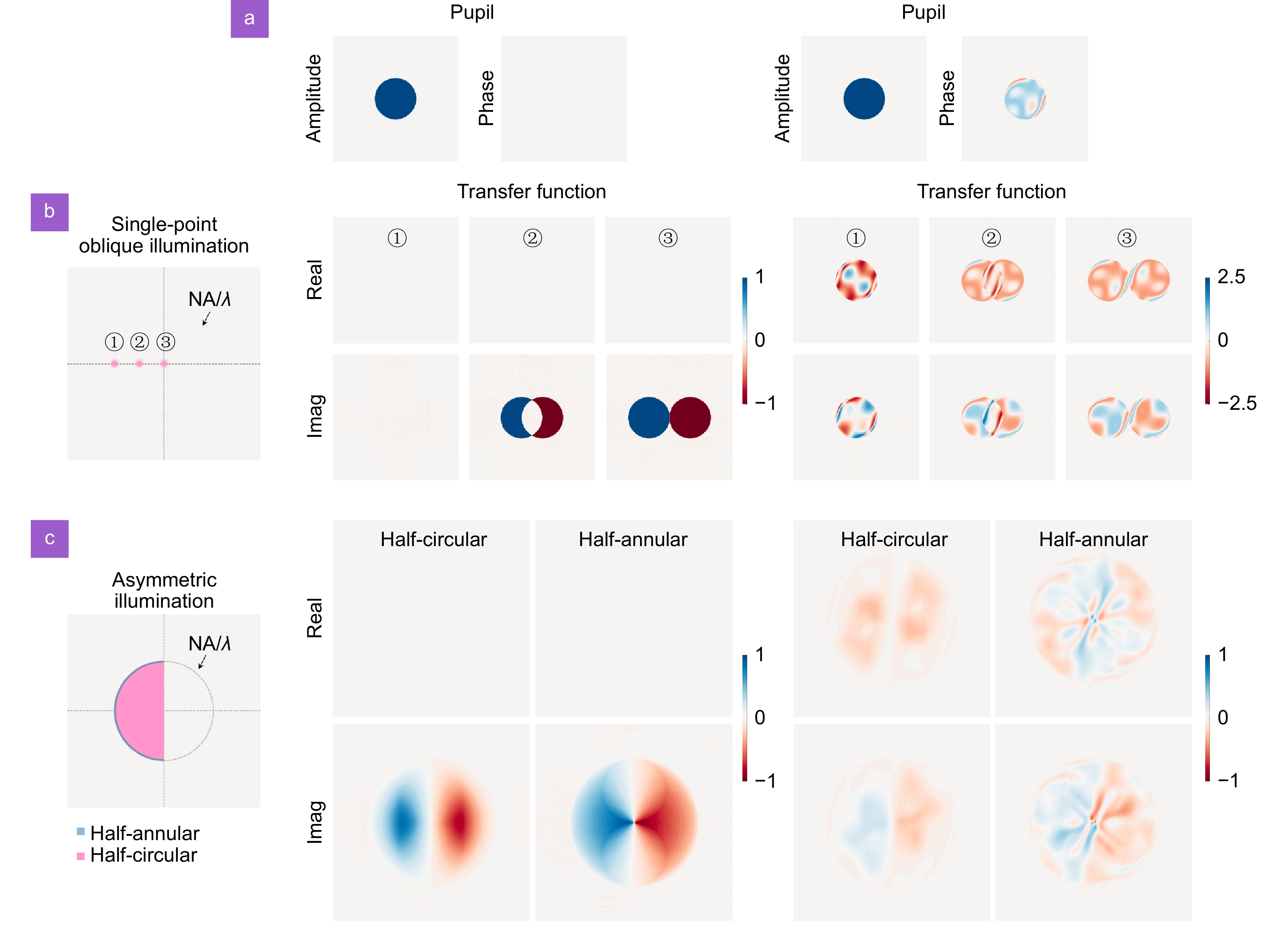
Quantitative phase imaging (QPI) enables non-invasive cellular analysis by utilizing cell thickness and refractive index as intrinsic probes, revolutionizing label-free microscopy in cellular research. Differential phase contrast (DPC), a non-interferometric QPI technique, requires only four intensity images under asymmetric illumination to recover the phase of a sample, offering the advantages of being label-free, non-coherent and highly robust. Its phase reconstruction result relies on precise modeling of the phase transfer function (PTF).
However, in real optical systems, the PTF will deviate from its theoretical ideal due to the unknown wavefront aberrations, which will lead to significant artifacts and distortions in the reconstructed phase. We propose an aberration-corrected DPC (ACDPC) method that utilizes three intensity images under annular illumination to jointly retrieve the aberration and the phase, achieving high-quality QPI with minimal raw data.
By employing three annular illuminations precisely matched to the numerical aperture of the objective lens, the object information is transmitted into the acquired intensity with a high signal-to-noise ratio. Phase retrieval is achieved by an iterative deconvolution algorithm that uses simulated annealing to estimate the aberration and further employs regularized deconvolution to reconstruct the phase, ultimately obtaining a refined complex pupil function and an aberration-corrected quantitative phase.
We demonstrate that ACDPC is robust to multi-order aberrations without any priori knowledge, and can effectively retrieve and correct system aberrations to obtain high-quality quantitative phase. Experimental results show that ACDPC can clearly reproduce subcellular structures such as vesicles and lipid droplets with higher resolution than conventional DPC, which opens up new possibilities for more accurate subcellular structure analysis in cell biology.
Light-perception-based interactive control of an underwater digital twin hand
Jinlong Lu, Chao Zhang, Hengchang Nong, Dongying Wang, Hongyu Zhou, Junjie Weng, Yuehua Deng, Yang Yu, Qiang Bian, Jianfa Zhang, Chaofan Zhang, Zhenrong Zhang, Junbo Yang
Opto-Electronic Advances
2026-07-10
Unlocking home-based nocturnal health management: A fiber-optic approach for early detection of cardiorespiratory rhythm disorders
Hanyu Jin, Hao Li, Zhuolin Chen, Liangye Li, Zurui Wang, Kai Zhou, Weijian Hang, Zhipeng Chen, Junfeng Chen, Kai Shen, Jianfeng Wen, Chen Chen, Cunzheng Fan, Zhijun Yan, Feng Wang, Qizhen Sun
Opto-Electronic Advances
2026-07-10
A flexible wireless system for prospective photodynamic therapy applications
Rolan Mansour, Bhavani Yalagala, Vikas Vikas, Nikolas Bruce, Fawziye Tarhini, Georgios N. Arvanitakis, Mohammed Mughal, Jamie Blanche, Ahmad Taha, Jonathan Copper, Muhammad Imran, Karin Williams, Karin Oien, Mahmoud Wagih, Hadi Heidari, Robert Hadfield, David Flynn
Opto-Electronic Advances
2026-07-10
Parallel bright-field and multi-order edge imaging via wide field-of-view trichannel metalens
Xiaotong Li, Yeseul Kim, Youngsun Jeon, Junhwa Seong, Jaekyung Kim, Peng Tang, Shiqi Hu, Harit Keawmuang, Beomha Yang, Dongmin Jeon, Le Dai, Weiyan Li, Xiaodong Cai, Jinhui Shi, Yong-Sang Ryu, Trevon Badloe, Junsuk Rho
Opto-Electronic Advances
2026-07-10