(Peer-Reviewed) Dynamic spatial beam shaping for ultrafast laser processing: a review
Cyril Mauclair ¹, Bahia Najih ² ³, Vincent Comte ⁴ ⁵, Florent Bourquard ², Martin Delaigue ³
¹ Université d'Angers, LPHIA, SFR MATRIX, 49000 Angers, France
² Laboratoire Hubert Curien, UMR 5516 CNRS, Université Jean Monnet, 42000 Saint-Étienne, France
³ Amplitude, 33600 Pessac, France
⁴ Laboratoire BiiO, Université Jean Monnet, 42000 Saint-Étienne, France
⁵ Keranova, 42000 Saint-Étienne, France
Opto-Electronic Science, 2025-08-25
Abstract
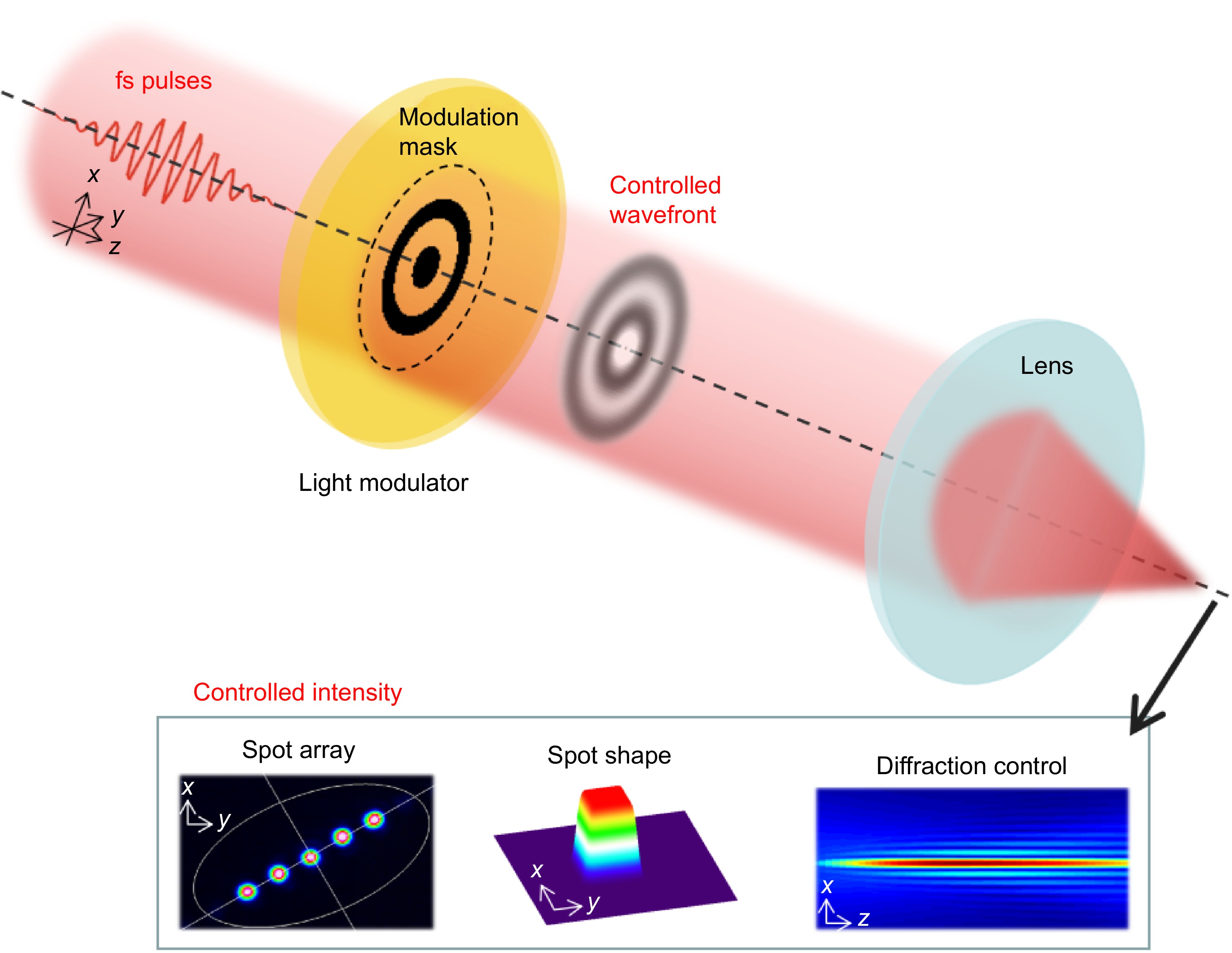
This review examines the state-of-the-art in spatial manipulation of ultrafast laser processing using dynamic light modulators, with a particular focus on liquid crystal-based systems. We discuss phase modulation strategies and highlight the current limitations and challenges in surface and bulk processing. Specifically, we emphasize the delicate balance between high-fidelity beam shaping and energy efficiency, both critical for surface and bulk processing applications.
Given the inherent physical limitations of spatial light modulators such as spatial resolution, fill factor, and phase modulation range. We explore techniques developed to bridge the gap between desired intensity distributions and actual experimental beam profiles. We present various laser light modulation technologies and the main algorithmic strategies for obtaining modulation patterns. The paper includes application examples across a wide range of fields, from surgery to surface structuring, cutting, bulk photo-inscription of optical functions, and additive manufacturing, highlighting the significant enhancements in processing speed and precision due to spatial beam shaping.
The diverse applications and the technological limitations underscore the need for adapted modulation pattern calculation methods. We discuss several advancements addressing these challenges, involving both experimental and algorithmic developments, including the recent incorporation of artificial intelligence. Additionally, we cover recent progress in phase and pulse front control based on spatial modulators, which introduces an extra control parameter for light excitation with high potential for achieving more controlled processing outcomes.
Light-perception-based interactive control of an underwater digital twin hand
Jinlong Lu, Chao Zhang, Hengchang Nong, Dongying Wang, Hongyu Zhou, Junjie Weng, Yuehua Deng, Yang Yu, Qiang Bian, Jianfa Zhang, Chaofan Zhang, Zhenrong Zhang, Junbo Yang
Opto-Electronic Advances
2026-07-10
Unlocking home-based nocturnal health management: A fiber-optic approach for early detection of cardiorespiratory rhythm disorders
Hanyu Jin, Hao Li, Zhuolin Chen, Liangye Li, Zurui Wang, Kai Zhou, Weijian Hang, Zhipeng Chen, Junfeng Chen, Kai Shen, Jianfeng Wen, Chen Chen, Cunzheng Fan, Zhijun Yan, Feng Wang, Qizhen Sun
Opto-Electronic Advances
2026-07-10
A flexible wireless system for prospective photodynamic therapy applications
Rolan Mansour, Bhavani Yalagala, Vikas Vikas, Nikolas Bruce, Fawziye Tarhini, Georgios N. Arvanitakis, Mohammed Mughal, Jamie Blanche, Ahmad Taha, Jonathan Copper, Muhammad Imran, Karin Williams, Karin Oien, Mahmoud Wagih, Hadi Heidari, Robert Hadfield, David Flynn
Opto-Electronic Advances
2026-07-10
Parallel bright-field and multi-order edge imaging via wide field-of-view trichannel metalens
Xiaotong Li, Yeseul Kim, Youngsun Jeon, Junhwa Seong, Jaekyung Kim, Peng Tang, Shiqi Hu, Harit Keawmuang, Beomha Yang, Dongmin Jeon, Le Dai, Weiyan Li, Xiaodong Cai, Jinhui Shi, Yong-Sang Ryu, Trevon Badloe, Junsuk Rho
Opto-Electronic Advances
2026-07-10