(Peer-Reviewed) Parallel all-optical encoded CDMA-driven anti-interference LiDAR for 78 MHz point acquisition
Shujian Gong 龚舒健 ¹ ² ³, Peng Tian 田鹏 ¹ ², Yinghui Guo 郭迎辉 ¹ ² ³ ⁴, Xiaoyin Li 李晓银 ¹ ², Mingbo Pu 蒲明博 ¹ ² ³ ⁴, Qi Zhang 张其 ¹ ², Yanqin Wang 王彦钦 ¹ ³, Heping Liu 刘何平 ⁵, Xiangang Luo 罗先刚 ¹ ² ³
¹ State Key Laboratory of Optical Field Manipulation Science and Technology, Institute of Optics and Electronics, Chinese Academy of Sciences, Chengdu 610209, China
中国 成都 中国科学院光电技术研究所 光场调控科学技术全国重点实验室
² Research Center on Vector Optical Fields, Institute of Optics and Electronics, Chinese Academy of Sciences, Chengdu 610209, China
中国 成都 中国科学院光电技术研究所 矢量光场研究中心
³ College of Materials Sciences and Opto-Electronic Technology, University of Chinese Academy of Sciences, Beijing 100049, China
中国 北京 中国科学院大学材料科学与光电技术学院
⁴ Sichuan Provincial Engineering Research Center of Digital Materials, Chengdu, 610213, China
中国 成都 四川省数字材料工程研究中心
⁵ Tianfu Xinglong Lake Laboratory, Chengdu, 610213, China
中国 成都 天府兴隆湖实验室
Opto-Electronic Technology, 2025-09-22
Abstract
High-speed, precise 3D sensing is essential for autonomous driving, robotics, and remote sensing, with light detection and ranging (LiDAR) as the leading technology. Nevertheless, single-channel LiDAR is bottlenecked by the light’s round-trip delay, limiting its point acquisition rate (PAR). While parallel detection can overcome this, current solutions either require multiple detectors—adding complexity—or are hampered by electronic encoder speeds, restricting scalability and resolution.
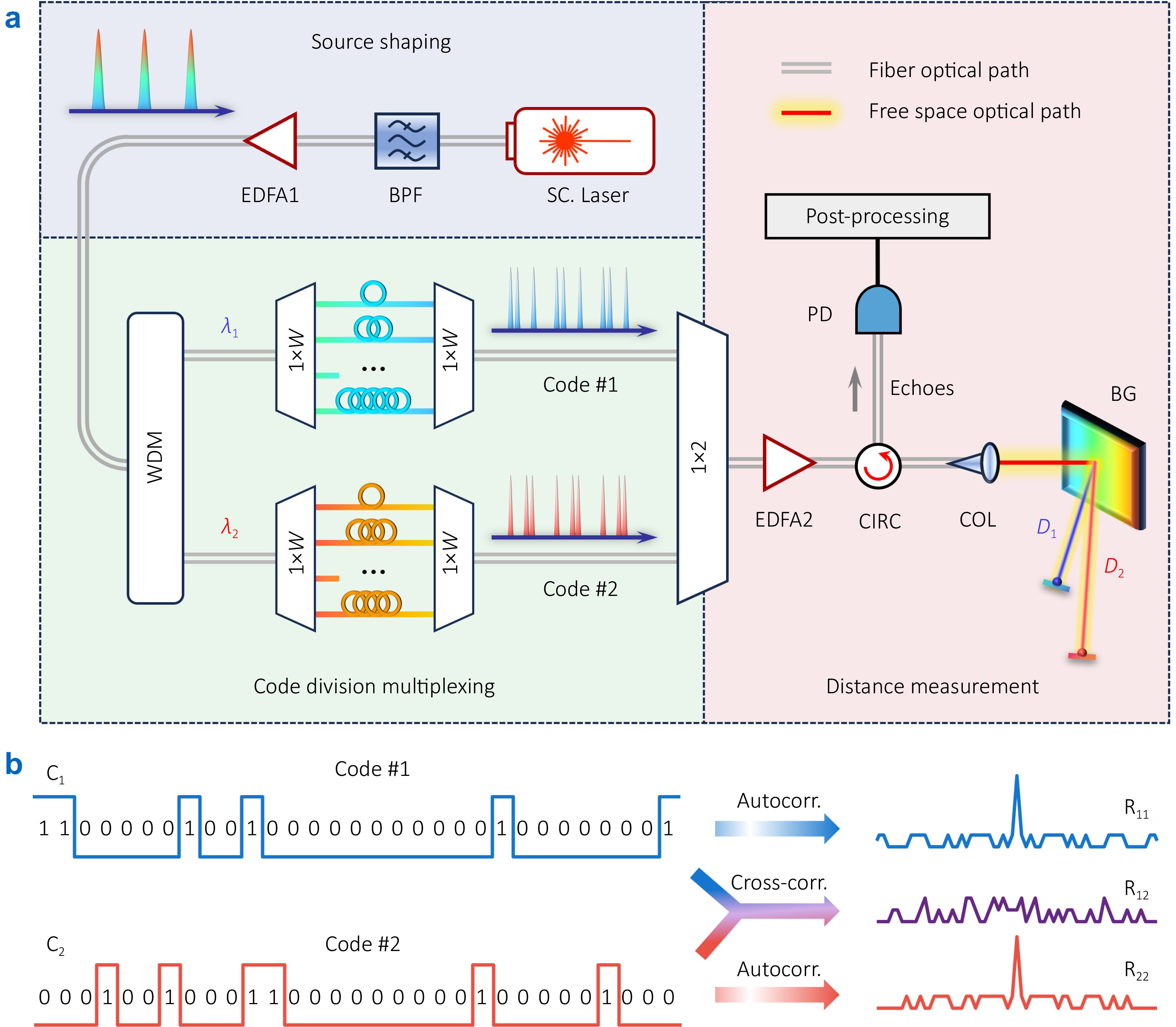
Here, we propose a parallel anti-interference LiDAR architecture based on code-division multiple access (CDMA) with all-optical encoding. A broadband source is split by wavelength-division multiplexing (WDM) into two spectral channels, each encoded with an orthogonal sequence via fiber splitters. A single-pixel photodetector captures mixed echoes, and matched filtering separates the channels for precise time-of-flight (TOF) extraction—achieving parallel detection with minimal hardware. Experimentally, operating at a 25.6 ns emission period, the system attains a dual-channel PAR of 78 MHz (ambiguity distance of 3.84 m) with ~2 mm ranging precision (standard deviation) under motion.
Furthermore, even at an extremely low signal-to-interference ratio (SIR) of −13 dB, the scheme retains over 50% valid demodulated points, validating its superior interference resilience. This low-complexity, highly integrable architecture establishes a critical foundation for ultrafast, high-precision, anti-interference 3D imaging in autonomous vehicles, drones, and robotics.
Heterogeneously integrated micro-ring with SnS₂ for dual-functional optical modulation and photodetection
Jinyi Du, Lidan Lu, Xu Zhang, Bofei Zhu, Wenbo Bo, Yingjie Xu, Guang Chen, Yanlin He, Guanghui Ren, Xiaoping Lou, Zheng You, Lianqing Zhu
Opto-Electronic Advances
2026-08-25
Hardware-aware lightweight photonic spiking neural network for pattern classification
Shuiying Xiang, Yahui Zhang, Shangxuan Shi, Haowen Zhao, Dianzhuang Zheng, Xingxing Guo, Yanan Han, Ye Tian, Liyue Zhang, Yuechun Shi, Yue Hao
Opto-Electronic Advances
2026-08-25
PhyspeNet: An empirical physics-aware network for adaptive speckle reconstructive spectrometry
Junrui Liang, Min Jiang, Jun Li, Zhongming Huang, Junhong He, Yanting Guo, Yanzhao Ke, Jun Ye, Jiangming Xu, Jinyong Leng, Pu Zhou
Opto-Electronic Advances
2026-08-25
A 36 × 240 Gbps hybrid mode/wavelength division multiplexing transmitter using lithium niobate on insulator
Mingyu Zhu, Weihan Wang, Ruitao Ma, Aoyun Gao, Chun Gao, Zexu Wang, Fei Huang, Zhenyuan Bao, Dajian Liu, Jiaxuan Gan, Zejie Yu, Huan Li, Weike Zhao, Daoxin Dai
Opto-Electronic Advances
2026-08-25
Light-perception-based interactive control of an underwater digital twin hand
Jinlong Lu, Chao Zhang, Hengchang Nong, Dongying Wang, Hongyu Zhou, Junjie Weng, Yuehua Deng, Yang Yu, Qiang Bian, Jianfa Zhang, Chaofan Zhang, Zhenrong Zhang, Junbo Yang
Opto-Electronic Advances
2026-07-10