(Peer-Reviewed) Spatiotemporal changes in water, land use, and ecosystem services in Central Asia considering climate changes and human activities
YU Yang 于洋 ¹ ² ³ ⁴, CHEN Xi 陈曦 ¹ ², Ireneusz MALIK ¹ ⁴, Malgorzata WISTUBA ¹ ⁴, CAO Yiguo 曹亦果 ⁵, HOU Dongde 侯东德 ⁵, TA Zhijie 他志杰 ⁶, HE Jing ¹ ², ZHANG Lingyun ¹ ², YU Ruide 于瑞德 ¹ ² ⁴ ⁷, ZHANG Haiyan 张海燕 ¹ ² ⁴, SUN Lingxiao 孙凌霄 ¹ ² ⁴
¹ State Key Laboratory of Desert and Oasis Ecology, Xinjiang Institute of Ecology and Geography, Chinese Academy of Sciences, Urumqi 830011, China
中国 乌鲁木齐 中国科学院新疆生态与地理研究所 荒漠与绿洲生态国家重点实验室
² University of Chinese Academy of Sciences, Beijing 100049, China
中国 北京 中国科学院大学
³ Cele National Station of Observation & Research for Desert Grassland Ecosystem in Xinjiang, Cele 848300, China
中国 策勒 新疆策勒荒漠草地生态系统国家野外科学观测研究站
⁴ Polish-Chinese Centre for Environmental Research, Institute of Earth Sciences, University of Silesia in Katowice, Bankowa 12, 40-007 Katowice, Poland
⁵ Advanced Research Institute, Southwest University of Political Science & Law, Chongqing 401120, China
中国 重庆 西南政法大学高等研究院
⁶ School of Tourism & Research Institute of Human Geography, Xi'an International Studies University, Xi'an 710128, China
中国 西安 西安外国语大学 旅游学院人文地理研究所
⁷ School of Environment and Material Engineering, Yantai University, Yantai 264005, China
中国 烟台 烟台大学环境与材料工程学院
Abstract
Central Asia is located in the hinterland of Eurasia, comprising Kazakhstan, Uzbekistan, Kyrgyzstan, Turkmenistan, and Tajikistan; over 93.00% of the total area is dryland. Temperature rise and human activities have severe impacts on the fragile ecosystems.
Since the 1970s, nearly half the great lakes in Central Asia have shrunk and rivers are drying rapidly owing to climate changes and human activities. Water shortage and ecological crisis have attracted extensive international attention. In general, ecosystem services in Central Asia are declining, particularly with respect to biodiversity, water, and soil conservation. Furthermore, the annual average temperature and annual precipitation in Central Asia increased by 0.30°C/decade and 6.9 mm/decade in recent decades, respectively.
Temperature rise significantly affected glacier retreat in the Tianshan Mountains and Pamir Mountains, which may intensify water shortage in the 21st century. The increase in precipitation cannot counterbalance the aggravation of water shortage caused by the temperature rise and human activities in Central Asia.
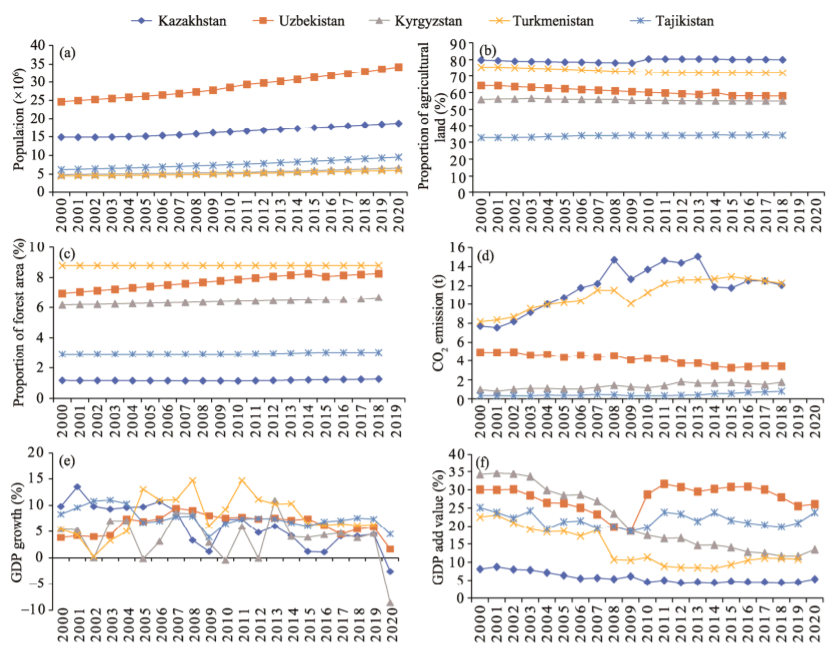
The population of Central Asia is growing gradually, and its economy is increasing steadily. Moreover, the agricultural land has not been expended in the last two decades. Thus, water and ecological crises, such as the Aral Sea shrinkage in the 21st century, cannot be attributed to agriculture extension any longer. Unbalanced regional development and water interception/transfer have led to the irrational exploitation of water resources in some watersheds, inducing downstream water shortage and ecological degradation.
In addition, accelerated industrialization and urbanization have intensified this process. Therefore, all Central Asian countries must urgently reach a consensus and adopt common measures for water and ecological protection.
Unlocking home-based nocturnal health management: A fiber-optic approach for early detection of cardiorespiratory rhythm disorders
Hanyu Jin, Hao Li, Zhuolin Chen, Liangye Li, Zurui Wang, Kai Zhou, Weijian Hang, Zhipeng Chen, Junfeng Chen, Kai Shen, Jianfeng Wen, Chen Chen, Cunzheng Fan, Zhijun Yan, Feng Wang, Qizhen Sun
Opto-Electronic Advances
2026-07-10
A flexible wireless system for prospective photodynamic therapy applications
Rolan Mansour, Bhavani Yalagala, Vikas Vikas, Nikolas Bruce, Fawziye Tarhini, Georgios N. Arvanitakis, Mohammed Mughal, Jamie Blanche, Ahmad Taha, Jonathan Copper, Muhammad Imran, Karin Williams, Karin Oien, Mahmoud Wagih, Hadi Heidari, Robert Hadfield, David Flynn
Opto-Electronic Advances
2026-07-10
Parallel bright-field and multi-order edge imaging via wide field-of-view trichannel metalens
Xiaotong Li, Yeseul Kim, Youngsun Jeon, Junhwa Seong, Jaekyung Kim, Peng Tang, Shiqi Hu, Harit Keawmuang, Beomha Yang, Dongmin Jeon, Le Dai, Weiyan Li, Xiaodong Cai, Jinhui Shi, Yong-Sang Ryu, Trevon Badloe, Junsuk Rho
Opto-Electronic Advances
2026-07-10