(Peer-Reviewed) Climate Suitability Assessment of Human Settlements for Regions along the Belt and Road
LIN Yumei 林裕梅 ¹, LI Peng 李鹏 ¹ ², FENG Zhiming 封志明 ¹ ², YANG Yanzhao 杨艳昭 ¹ ², YOU Zhen 游珍 ¹ ², ZHU Fuxin 朱付欣 ³
¹ Institute of Geographic Sciences and Natural Resources Research, Chinese Academy of Sciences, Beijing 100101, China
中国 北京 中国科学院地理科学与资源研究所
² College of Resources and Environment, University of Chinese Academy of Sciences, Beijing 100049, China
中国 北京 中国科学院大学资源与环境学院
³ National Tibetan Plateau Data Center, Key Laboratory of Tibetan Environmental Changes and Land Surface Processes, Institute of Tibetan Plateau Research, Chinese Academy of Sciences, Beijing 100101, China
中国 北京 中国科学院青藏高原研究所 青藏高原环境变化与地表过程重点实验室 国家青藏高原科学数据中心
Abstract
Climate is one important environmental variable that affects human life. As the regions along the Belt and Road (B & R) encompass vast territories and large populations, it is significant to assess climate suitability for human settlements, which will influence the migration of various surrounding countries.
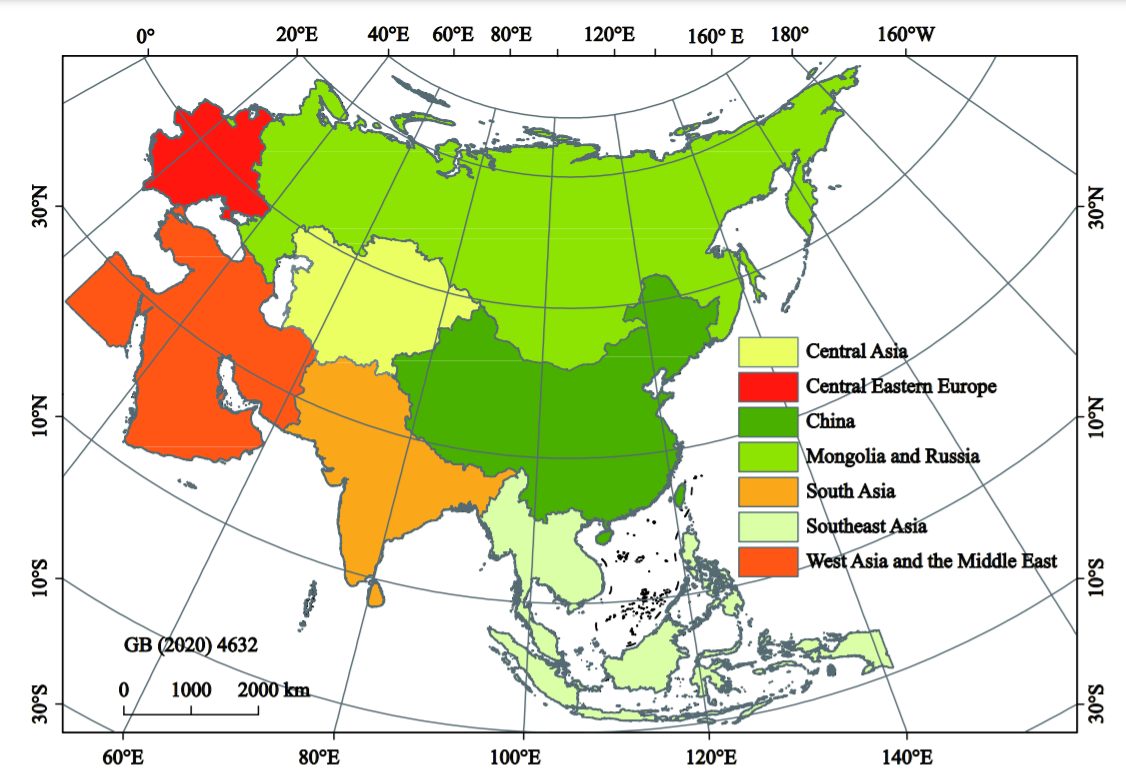
We selected seven regions including 65 countries along the B & R for the research area and adopted the temperature-humidity index (THI), to assess the climate suitability. We analyzed the spatial characteristics of THI and the correlation between population distribution and THI, the results of which enabled us to adjust the THI classification criteria. We finally assessed the climate suitability of each region. The results reveal that outside the Qinghai-Tibet Plateau, the THI values generally tend to decrease from west to east as longitude increases and downward with increasing latitude.
The population distribution is significantly correlated with the THI. Regions with relative suitable climate, including high suitability areas (HASs), moderately suitable areas (MSAs) and low suitability areas (LSAs), account for 50.62% of the total area and encompass in excess of 90% of total population.
These areas are widely distributed in the southern regions of 45°N latitude, again with the exception of the Qinghai-Tibet Plateau. Critical suitable area includes 19.48% of the entire area and 8.98% of total population. The non-suitable area accounts for less than 30% of total area, concentrated in the cold high-latitude and high-altitude areas.
Ultrafast all-optical modulation of wide-bandwidth pulses enabled by silicon-metasurfaces
Kaloyan Georgiev, Khosro Zangeneh Kamali, Anton A. Trifonov, Giulia Crotti, Lyuben Petrov, Stefan Georgiev, Hristo Iliev, Lei Xu, Unai Arregui Leon, Mohsen Rahmani, Giuseppe Della Valle, Ivan Buchvarov, Dragomir Neshev
Opto-Electronic Advances
2026-09-15
Physics-informed neural fields enable blind aberration correction for partially coherent quantitative phase imaging
Shun Zhou, Xingyu Huang, Linpeng Lu, Habib Ullah, Kaiyu Du, Maciej Trusiak, Malgorzata Kujawinska, Yuzhen Zhang, Yao Fan, Qian Chen, Qinrong Zhang, Chao Zuo
Opto-Electronic Science
2026-08-26
Heterogeneously integrated micro-ring with SnS₂ for dual-functional optical modulation and photodetection
Jinyi Du, Lidan Lu, Xu Zhang, Bofei Zhu, Wenbo Bo, Yingjie Xu, Guang Chen, Yanlin He, Guanghui Ren, Xiaoping Lou, Zheng You, Lianqing Zhu
Opto-Electronic Advances
2026-08-25
Hardware-aware lightweight photonic spiking neural network for pattern classification
Shuiying Xiang, Yahui Zhang, Shangxuan Shi, Haowen Zhao, Dianzhuang Zheng, Xingxing Guo, Yanan Han, Ye Tian, Liyue Zhang, Yuechun Shi, Yue Hao
Opto-Electronic Advances
2026-08-25
PhyspeNet: An empirical physics-aware network for adaptive speckle reconstructive spectrometry
Junrui Liang, Min Jiang, Jun Li, Zhongming Huang, Junhong He, Yanting Guo, Yanzhao Ke, Jun Ye, Jiangming Xu, Jinyong Leng, Pu Zhou
Opto-Electronic Advances
2026-08-25
A 36 × 240 Gbps hybrid mode/wavelength division multiplexing transmitter using lithium niobate on insulator
Mingyu Zhu, Weihan Wang, Ruitao Ma, Aoyun Gao, Chun Gao, Zexu Wang, Fei Huang, Zhenyuan Bao, Dajian Liu, Jiaxuan Gan, Zejie Yu, Huan Li, Weike Zhao, Daoxin Dai
Opto-Electronic Advances
2026-08-25