(Peer-Reviewed) Generation of super-resolved optical needle and multifocal array using graphene oxide metalenses
Hongtao Wang ¹ ² ³ ⁴, Chenglong Hao 郝成龙 ³, Han Lin 林瀚 ¹, Yongtian Wang 王涌天 ², Tian Lan 蓝天 ², Cheng-Wei Qiu 仇成伟 ³, Baohua Jia 贾宝华 ¹
¹ Centre for Translational Atomaterials, Faculty of Science, Engineering and Technology, Swinburne University of Technology, P.O. Box 218, Hawthorn VIC 3122, Australia
² Key Laboratory of Photoelectronic Imaging Technology and System, Ministry of Education of China, School of Optics and Photonics, Beijing Institute of Technology, Beijing 100081, China
中国 北京 北京理工大学光电学院 光电成像技术与系统教育部重点实验室
³ Department of Electrical and Computer Engineering, National University of Singapore, 4 Engineering Drive 3, Singapore 117583, Singapore
⁴ Engineering Product Development Pillar, Singapore University of Technology and Design, 8 Somapah Road, 487372, Singapore
Opto-Electronic Advances, 2021-02-28
Abstract
Ultrathin flat metalenses have emerged as promising alternatives to conventional diffractive lenses, offering new possibilities for myriads of miniaturization and interfacial applications. Graphene-based materials can achieve both phase and amplitude modulations simultaneously at a single position due to the modification of the complex refractive index and thickness by laser conversion from graphene oxide into graphene like materials.
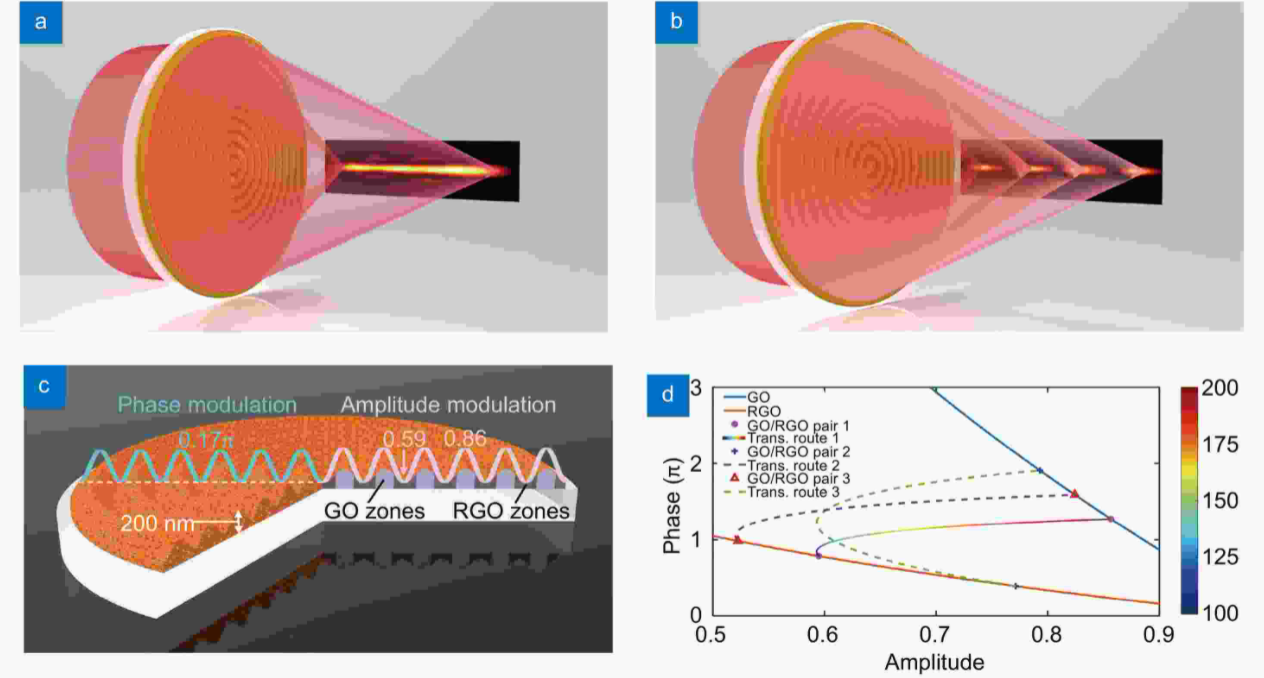
In this work, we develop graphene oxide metalenses to precisely control phase and amplitude modulations and to achieve a holistic and systematic lens design based on a graphene-based material system. We experimentally validate our strategies via demonstrations of two graphene oxide metalenses: one with an ultra-long (~16λ) optical needle, and the other with axial multifocal spots, at the wavelength of 632.8 nm with a 200 nm thin film. Our proposed graphene oxide metalenses unfold unprecedented opportunities for accurately designing graphene-based ultrathin integratable devices for broad applications.
Electrically switchable bright-field and interference-synthesized edge-enhanced imaging with a polarization-multiplexed metalens
Xiaotong Li, Junhwa Seong, Yeseul Kim, Kwang-Suk Oh, Shiqi Hu, Le Dai, Harit Keawmuang, Beomha Yang, Minseok Choi, Youngsun Jeon, Cherry Park, Weiyan Li, Tianxu Jia, Han Zhu, Xiaodong Cai, Qi Zheng, Jinhui Shi, Young-Ki Kim, Yuchuan Shao, Trevon Badloe, Junsuk Rho
Opto-Electronic Science
2026-09-20
3D-printed copper water cooling system assisted fabrication of 10.6-μm high-power CO₂ laser resistance reflectors
Hongfei Jiao, Binbin Jiang, Xinshang Niu, Yifan Wang, Dongdong Li, Jun Yu, Xiaochuan Ji, Jingjing Xia, Jinlong Zhang, Xinbin Cheng, Zhanshan Wang
Opto-Electronic Advances
2026-09-15
Ultrafast all-optical modulation of wide-bandwidth pulses enabled by silicon-metasurfaces
Kaloyan Georgiev, Khosro Zangeneh Kamali, Anton A. Trifonov, Giulia Crotti, Lyuben Petrov, Stefan Georgiev, Hristo Iliev, Lei Xu, Unai Arregui Leon, Mohsen Rahmani, Giuseppe Della Valle, Ivan Buchvarov, Dragomir Neshev
Opto-Electronic Advances
2026-09-15
Physics-informed neural fields enable blind aberration correction for partially coherent quantitative phase imaging
Shun Zhou, Xingyu Huang, Linpeng Lu, Habib Ullah, Kaiyu Du, Maciej Trusiak, Malgorzata Kujawinska, Yuzhen Zhang, Yao Fan, Qian Chen, Qinrong Zhang, Chao Zuo
Opto-Electronic Science
2026-08-26