(Peer-Reviewed) Effect of Failure Mode of Taut Mooring System on the Dynamic Response of A Semi-Submersible Platform
Teng WANG 王腾 ¹, jun-jie HAO ¹, Xiao-ni WU 毋晓妮 ² ³, Ye LI 李晔 ³, Xiao-tong WANG ⁴
¹ Department of Naval Architecture and Offshore Engineering, China University of Petroleum (East China), Qingdao 266580, China
中国 青岛 中国石油大学(华东)船舶与海洋工程所
² Shanghai Key Laboratory for Digital Maintenance of Buildings and Infrastructure, Department of Civil Engineering, Shanghai Jiao Tong University, Shanghai 200240, China
上海交通大学土木工程系 上海市公共建筑和基础设施数字化运维重点实验室
³ State Key Laboratory of Ocean Engineering, School of Naval Architecture, Ocean and Civil Engineering, Shanghai Jiao Tong University, Shanghai 200240, China
中国 上海 上海交通大学船舶海洋与建筑工程学院 海洋工程国家重点实验室
⁴ China National Oil and Gas Exploration and Development Co., Ltd., Beijing 100034, China
中国 北京 中国石油天然气勘探开发公司
Abstract
Mooring system failure can lead to largely different dynamic response of floating structures when compared to the response under the condition of intact mooring system. For a semi-submersible platform with taut mooring system under extreme environmental conditions, the typical mooring system failure includes anchor line breaking failure due to the broken anchor line, and the anchor dragging failure caused by the anchor failure in the seabed soil due to the shortage of the anchor bearing capacity. However, study on the mooring failure caused by anchor failure is rare.
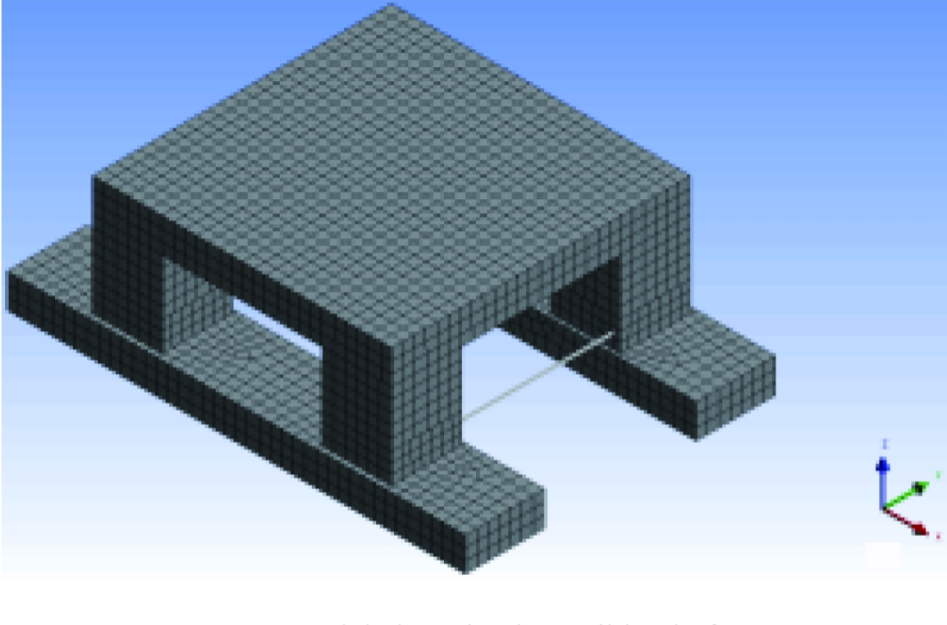
The current work investigates the effect of three failure modes of taut mooring system on dynamic response of a semi-submersible platform, including one line breaking failure, two lines breaking failure, and one line breaking with one line attached anchor dragging failure. The nonlinear polynomial mooring line model in AQWA was used with integrating the load and displacement curve from the anchor pulling study to characterize the anchor dragging behavior for mooring system failure caused by the anchor failure. The offsets of the platform and the tension of mooring lines were analyzed for mooring system failure with 100-year return period.
It is found that the mooring failure of one line breaking with one line attached anchor dragging is a case between the other two mooring failures. The traditional mooring analysis considering only the damaged condition with one line breaking is not safe enough. And the simple way of mooring analysis of two lines breaking is too conservative for the costly offshore engineering.
Light-perception-based interactive control of an underwater digital twin hand
Jinlong Lu, Chao Zhang, Hengchang Nong, Dongying Wang, Hongyu Zhou, Junjie Weng, Yuehua Deng, Yang Yu, Qiang Bian, Jianfa Zhang, Chaofan Zhang, Zhenrong Zhang, Junbo Yang
Opto-Electronic Advances
2026-07-10
Unlocking home-based nocturnal health management: A fiber-optic approach for early detection of cardiorespiratory rhythm disorders
Hanyu Jin, Hao Li, Zhuolin Chen, Liangye Li, Zurui Wang, Kai Zhou, Weijian Hang, Zhipeng Chen, Junfeng Chen, Kai Shen, Jianfeng Wen, Chen Chen, Cunzheng Fan, Zhijun Yan, Feng Wang, Qizhen Sun
Opto-Electronic Advances
2026-07-10
A flexible wireless system for prospective photodynamic therapy applications
Rolan Mansour, Bhavani Yalagala, Vikas Vikas, Nikolas Bruce, Fawziye Tarhini, Georgios N. Arvanitakis, Mohammed Mughal, Jamie Blanche, Ahmad Taha, Jonathan Copper, Muhammad Imran, Karin Williams, Karin Oien, Mahmoud Wagih, Hadi Heidari, Robert Hadfield, David Flynn
Opto-Electronic Advances
2026-07-10
Parallel bright-field and multi-order edge imaging via wide field-of-view trichannel metalens
Xiaotong Li, Yeseul Kim, Youngsun Jeon, Junhwa Seong, Jaekyung Kim, Peng Tang, Shiqi Hu, Harit Keawmuang, Beomha Yang, Dongmin Jeon, Le Dai, Weiyan Li, Xiaodong Cai, Jinhui Shi, Yong-Sang Ryu, Trevon Badloe, Junsuk Rho
Opto-Electronic Advances
2026-07-10