(Peer-Reviewed) Cascaded metasurfaces enabling adaptive aberration corrections for focus scanning
Xiaotong Li 李小桐 ¹ ², Xiaodong Cai 蔡晓东 ¹, Chang Liu 刘畅 ¹, Yeseul Kim ², Trevon Badloe ³, Huanhuan Liu ⁴, Junsuk Rho 鲁埈锡 ² ⁵ ⁶ ⁷, Shiyi Xiao 肖诗逸 ¹
¹ Key Laboratory of Specialty Fiber Optics and Optical Access Networks, Joint International Research Laboratory of Specialty Fiber Optics and Advanced Communication, Shanghai Institute for Advanced Communication and Data Science, Shanghai University, Shanghai 200240, China
中国 上海 上海大学上海先进通信与数据科学研究院 特种光纤与光接入网重点实验室 特种光纤与先进通信国际合作联合实验室
² Department of Mechanical Engineering, Pohang University of Science and Technology (POSTECH), Pohang 37673, Republic of Korea
³ Graduate School of Artificial Intelligence, Pohang University of Science and Technology (POSTECH), Pohang 37673, Republic of Korea
⁴ Shenzhen Institute of Advanced Technology, Chinese Academy of Sciences, Shenzhen 518055, China
中国 深圳 中国科学院深圳先进技术研究院
⁵ Department of Chemical Engineering, Pohang University of Science and Technology (POSTECH), Pohang 37673, Republic of Korea
⁶ Department of Electrical Engineering, Pohang University of Science and Technology (POSTECH), Pohang 37673, Republic of Korea
⁷ POSCO-POSTECH-RIST Convergence Research Center for Flat Optics and Metaphotonics, Pohang 37673, Republic of Korea
Opto-Electronic Advances, 2024-09-06
Abstract
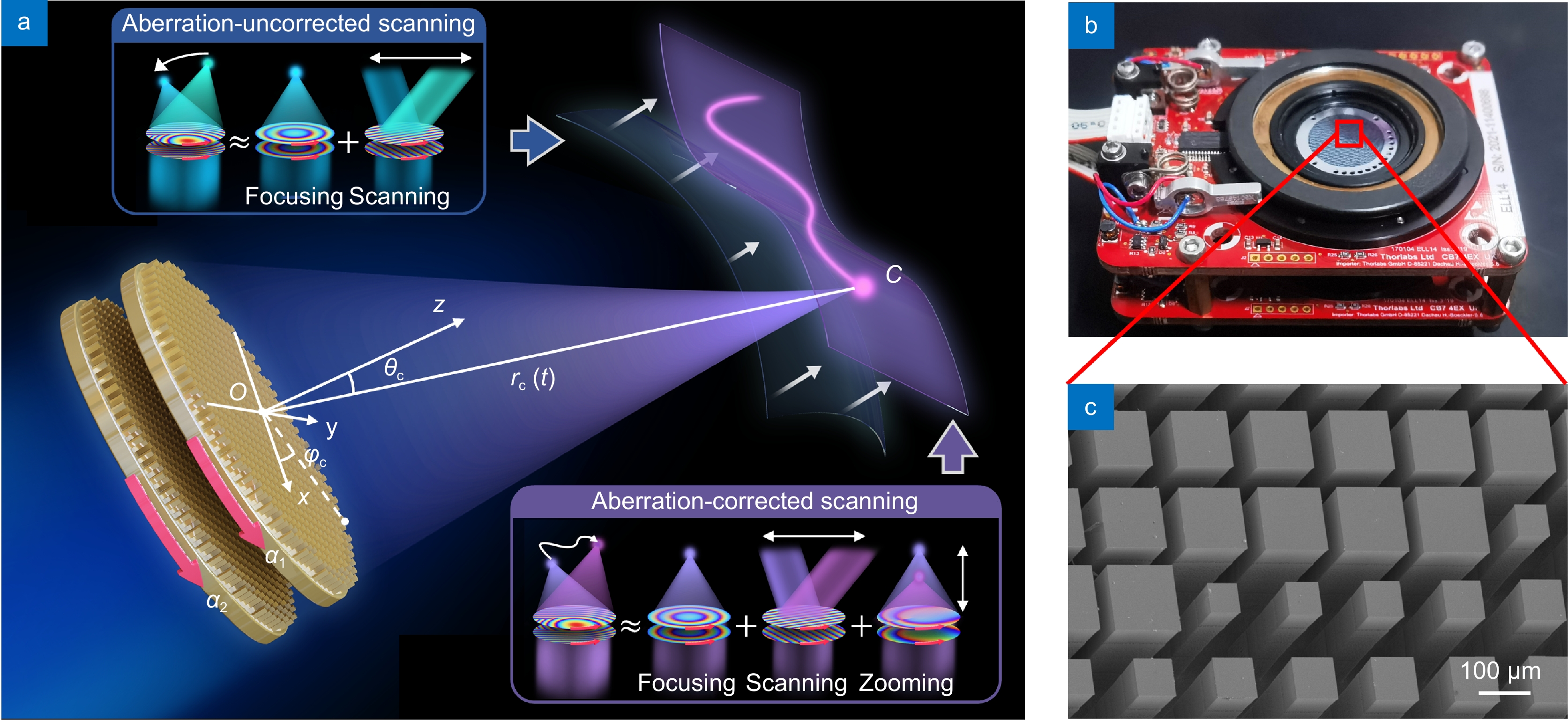
Scanning focused light with corrected aberrations holds great importance in high-precision optical systems. However, conventional optical systems, relying on additional dynamical correctors to eliminate scanning aberrations, inevitably result in undesired bulkiness and complexity.
In this paper, we propose achieving adaptive aberration corrections coordinated with focus scanning by rotating only two cascaded transmissive metasurfaces. Each metasurface is carefully designed by searching for optimal phase-profile parameters of three coherently worked phase functions, allowing flexible control of both the longitudinal and lateral focal position to scan on any custom-designed curved surfaces. As proof-of-concept, we engineer and fabricate two all-silicon terahertz meta-devices capable of scanning the focal spot with adaptively corrected aberrations.
Experimental results demonstrate that the first one dynamically scans the focal spot on a planar surface, achieving an average scanning aberration of 1.18% within the scanning range of ±30°. Meanwhile, the second meta-device scans two focal points on a planar surface and a conical surface with 2.5% and 4.6% scanning aberrations, respectively. Our work pioneers a breakthrough pathway enabling the development of high-precision yet compact optical devices across various practical domains.
Electrically switchable bright-field and interference-synthesized edge-enhanced imaging with a polarization-multiplexed metalens
Xiaotong Li, Junhwa Seong, Yeseul Kim, Kwang-Suk Oh, Shiqi Hu, Le Dai, Harit Keawmuang, Beomha Yang, Minseok Choi, Youngsun Jeon, Cherry Park, Weiyan Li, Tianxu Jia, Han Zhu, Xiaodong Cai, Qi Zheng, Jinhui Shi, Young-Ki Kim, Yuchuan Shao, Trevon Badloe, Junsuk Rho
Opto-Electronic Science
2026-09-20
3D-printed copper water cooling system assisted fabrication of 10.6-μm high-power CO₂ laser resistance reflectors
Hongfei Jiao, Binbin Jiang, Xinshang Niu, Yifan Wang, Dongdong Li, Jun Yu, Xiaochuan Ji, Jingjing Xia, Jinlong Zhang, Xinbin Cheng, Zhanshan Wang
Opto-Electronic Advances
2026-09-15
Ultrafast all-optical modulation of wide-bandwidth pulses enabled by silicon-metasurfaces
Kaloyan Georgiev, Khosro Zangeneh Kamali, Anton A. Trifonov, Giulia Crotti, Lyuben Petrov, Stefan Georgiev, Hristo Iliev, Lei Xu, Unai Arregui Leon, Mohsen Rahmani, Giuseppe Della Valle, Ivan Buchvarov, Dragomir Neshev
Opto-Electronic Advances
2026-09-15
Physics-informed neural fields enable blind aberration correction for partially coherent quantitative phase imaging
Shun Zhou, Xingyu Huang, Linpeng Lu, Habib Ullah, Kaiyu Du, Maciej Trusiak, Malgorzata Kujawinska, Yuzhen Zhang, Yao Fan, Qian Chen, Qinrong Zhang, Chao Zuo
Opto-Electronic Science
2026-08-26