(Peer-Reviewed) Prognostic role of plasma levels of γ-glutamyl transpeptidase in patients with advanced gastric cancer treated with anti-PD-1 immunotherapy
Shaojie Xu ¹, Yiming Feng 冯一鸣 ², Xingyin Li ¹, Zaozao Huang 黄早早 ³, Hewei Li 李贺伟 ⁴, Ganxin Wang ⁵
¹ First Clinical College, Huazhong University of Science and Technology, Wuhan 430022, China
中国 武汉 华中科技大学第一临床学院
² Department of Radiology, Union Hospital, Tongji Medical College, Huazhong University of Science and Technology, Wuhan 430022, China
中国 武汉 华中科技大学同济医学院附属协和医院放射科
³ Yangchunhu Community Hospital, Liyuan Hospital, Tongji Medical College, Huazhong University of Science and Technology, Wuhan 430077, China
中国 武汉 华中科技大学同济医学院附属梨园医院 杨春湖社区卫生服务中心
⁴ Department of Orthopedics, Liyuan Hospital, Tongji Medical College, Huazhong University of Science and Technology, Wuhan 430077, China
中国 武汉 华中科技大学同济医学院附属梨园医院 骨外科
⁵ Cancer Center, Union Hospital, Tongji Medical College, Huazhong University of Science and Technology, Wuhan 430022, China
中国 武汉 华中科技大学同济医学院附属协和医院肿瘤中心
Abstract
Objective
Antibodies targeting programmed cell death protein 1 (PD-1) have become the mainstay of treatment for chemotherapy-refractory gastric cancer, characterized by high levels of programmed cell death ligand-1 (PDL-1) expression. However, the routine clinical implementation of PDL-1 testing is currently limited by the lack of robust detection methods. In this regard, the role of plasma γ-glutamyl transpeptidase (GGT), an N-terminal nucleophilic hydrolase, as an independent predictor of the efficacy of anti-PD-1 therapy remains unknown. In this study, we aimed to assessed the prognostic role of changes in plasma GGT levels (6 weeks vs. baseline) in patients with advanced gastric cancer treated with anti-PD-1 immunotherapy.
Methods
We retrospectively analyzed data from 57 patients with gastric cancer treated with anti-PD-1
antibodies (camrelizumab, sintilimab, nivolumab, tislelizumab, and toripalimab) at the Union Hospital, Tongji Medical College, Huazhong University of Science and Technology, Wuhan, China, from July 2018 to February 2021.
Results
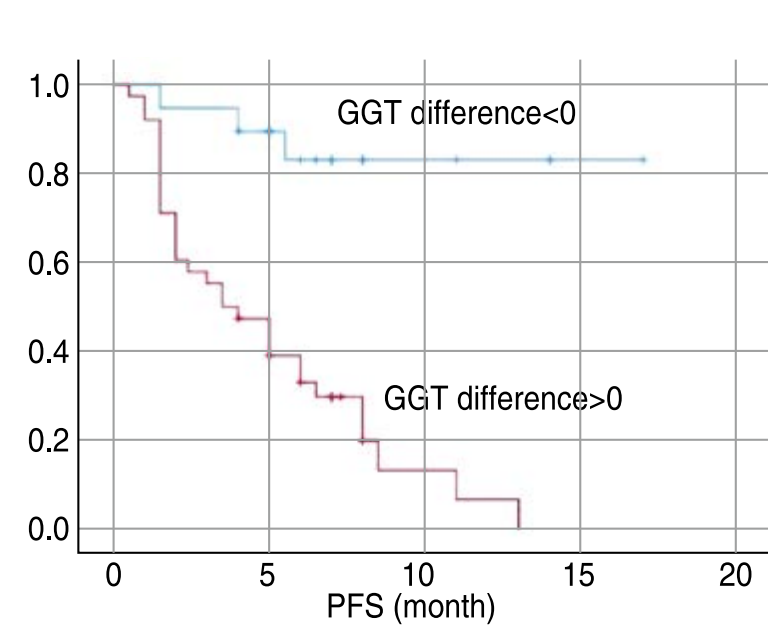
We found that after 6 weeks of treatment, there were significant differences between responders and non-responders with respect to plasma GGT levels (P < 0.001). Multivariate logistic regression analysis revealed that the continuous value of the 6-week difference in GGT levels (OR = 1.437, 95% CI = 1.116–1.849, P = 0.005) and 6-week difference in GGT ≥ 0 or < 0 (OR = 53.675, 95% CI = 6.379–451.669, P < 0.001) were independent predictors of disease control. Survival analysis indicated that a reduction in plasma GGT6 levels during treatment was significantly associated with a favorable progression-free survival (PFS) and overall survival (P < 0.001). Consistently, univariate and multivariate Cox regression analyses revealed that a reduction in plasma GGT6 levels during treatment was an independent predictor
of PFS (HR = 1.033, 95% CI = 1.013–1.053, P = 0.001).
Conclusion
Alterations in plasma GGT levels during treatment can be used as a predictor of disease
progression and survival in patients with advanced gastric cancer undergoing treatment with anti-PD-1 antibodies.
Ultrafast all-optical modulation of wide-bandwidth pulses enabled by silicon-metasurfaces
Kaloyan Georgiev, Khosro Zangeneh Kamali, Anton A. Trifonov, Giulia Crotti, Lyuben Petrov, Stefan Georgiev, Hristo Iliev, Lei Xu, Unai Arregui Leon, Mohsen Rahmani, Giuseppe Della Valle, Ivan Buchvarov, Dragomir Neshev
Opto-Electronic Advances
2026-09-15
Physics-informed neural fields enable blind aberration correction for partially coherent quantitative phase imaging
Shun Zhou, Xingyu Huang, Linpeng Lu, Habib Ullah, Kaiyu Du, Maciej Trusiak, Malgorzata Kujawinska, Yuzhen Zhang, Yao Fan, Qian Chen, Qinrong Zhang, Chao Zuo
Opto-Electronic Science
2026-08-26
Heterogeneously integrated micro-ring with SnS₂ for dual-functional optical modulation and photodetection
Jinyi Du, Lidan Lu, Xu Zhang, Bofei Zhu, Wenbo Bo, Yingjie Xu, Guang Chen, Yanlin He, Guanghui Ren, Xiaoping Lou, Zheng You, Lianqing Zhu
Opto-Electronic Advances
2026-08-25
Hardware-aware lightweight photonic spiking neural network for pattern classification
Shuiying Xiang, Yahui Zhang, Shangxuan Shi, Haowen Zhao, Dianzhuang Zheng, Xingxing Guo, Yanan Han, Ye Tian, Liyue Zhang, Yuechun Shi, Yue Hao
Opto-Electronic Advances
2026-08-25
PhyspeNet: An empirical physics-aware network for adaptive speckle reconstructive spectrometry
Junrui Liang, Min Jiang, Jun Li, Zhongming Huang, Junhong He, Yanting Guo, Yanzhao Ke, Jun Ye, Jiangming Xu, Jinyong Leng, Pu Zhou
Opto-Electronic Advances
2026-08-25
A 36 × 240 Gbps hybrid mode/wavelength division multiplexing transmitter using lithium niobate on insulator
Mingyu Zhu, Weihan Wang, Ruitao Ma, Aoyun Gao, Chun Gao, Zexu Wang, Fei Huang, Zhenyuan Bao, Dajian Liu, Jiaxuan Gan, Zejie Yu, Huan Li, Weike Zhao, Daoxin Dai
Opto-Electronic Advances
2026-08-25