(Peer-Reviewed) Improved resilience measure for component recovery priority in power grids
Guanghan BAI 白光晗 ¹, Han WANG 王寒 ², Xiaoqian ZHENG 郑小倩 ³, Hongyan DUI 兑红炎 ³, Min XIE 谢旻 ⁴
¹ Laboratory of Science and Technology on Integrated Logistics Support, College of Intelligence Science and Technology, National University of Defense Technology, Changsha 410073, China
中国 长沙 国防科技大学 装备综合保障技术重点实验室
² School of Management and Economics, Beijing Institute of Technology, Beijing 100081, China
中国 北京 北京理工大学管理与经济学院
³ School of Management Engineering, Zhengzhou University, Zhengzhou 450001, China
中国 郑州 郑州大学管理工程学院
⁴ Department of Systems Engineering and Engineering Management, City University of Hong Kong, Hong Kong, China
中国 香港 香港城市大学系统工程与工程管理系
Abstract
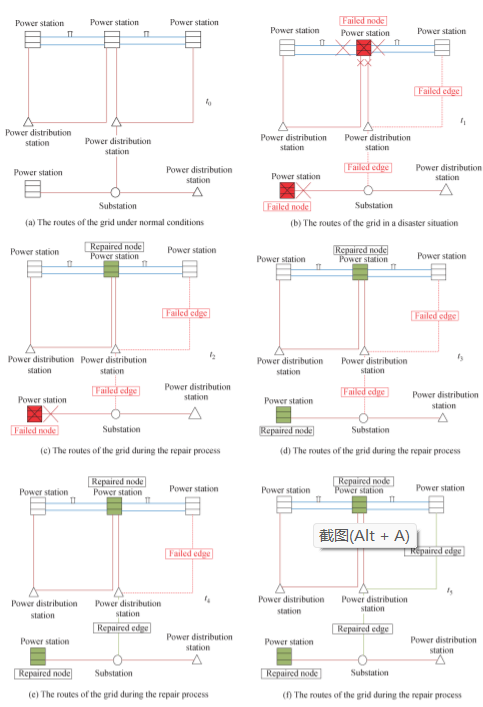
Given the complexity of power grids, the failure of any component may cause large-scale economic losses. Consequently, the quick recovery of power grids after disasters has become a new research direction. Considering the severity of power grid disasters, an improved power grid resilience measure and its corresponding importance measures are proposed. The recovery priority of failed components after a disaster is determined according to the influence of the failed components on the power grid resilience.
Finally, based on the data from the 2019 Power Yearbook of each city in Shandong Province, China, the power grid resilience after a disaster is analyzed for two situations, namely, partial components failure and failure of all components. Result shows that the recovery priorities of components with different importance measures vary. The resilience evaluations under different repair conditions prove the feasibility of the proposed method.
Unlocking home-based nocturnal health management: A fiber-optic approach for early detection of cardiorespiratory rhythm disorders
Hanyu Jin, Hao Li, Zhuolin Chen, Liangye Li, Zurui Wang, Kai Zhou, Weijian Hang, Zhipeng Chen, Junfeng Chen, Kai Shen, Jianfeng Wen, Chen Chen, Cunzheng Fan, Zhijun Yan, Feng Wang, Qizhen Sun
Opto-Electronic Advances
2026-07-10
A flexible wireless system for prospective photodynamic therapy applications
Rolan Mansour, Bhavani Yalagala, Vikas Vikas, Nikolas Bruce, Fawziye Tarhini, Georgios N. Arvanitakis, Mohammed Mughal, Jamie Blanche, Ahmad Taha, Jonathan Copper, Muhammad Imran, Karin Williams, Karin Oien, Mahmoud Wagih, Hadi Heidari, Robert Hadfield, David Flynn
Opto-Electronic Advances
2026-07-10
Parallel bright-field and multi-order edge imaging via wide field-of-view trichannel metalens
Xiaotong Li, Yeseul Kim, Youngsun Jeon, Junhwa Seong, Jaekyung Kim, Peng Tang, Shiqi Hu, Harit Keawmuang, Beomha Yang, Dongmin Jeon, Le Dai, Weiyan Li, Xiaodong Cai, Jinhui Shi, Yong-Sang Ryu, Trevon Badloe, Junsuk Rho
Opto-Electronic Advances
2026-07-10