(Peer-Reviewed) Breaking the optical efficiency limit of virtual reality with a nonreciprocal polarization rotator
Yuqiang Ding 丁玉强 ¹, Zhenyi Luo 罗桢埸 ¹, Garimagai Borjigin ¹ ² ³, Shin-Tson Wu 吴诗聪 ¹
¹ College of Optics and Photonics, University of Central Florida, Orlando FL 32816, USA
² Department of Intelligent Interaction Technologies, University of Tsukuba, Tsukuba, Ibaraki 305-8573, Japan
³ Research Fellow of Japan Society for the Promotion of Science, Chiyoda-ku, Tokyo 102-0083, Japan
Opto-Electronic Advances, 2024-03-20
Abstract
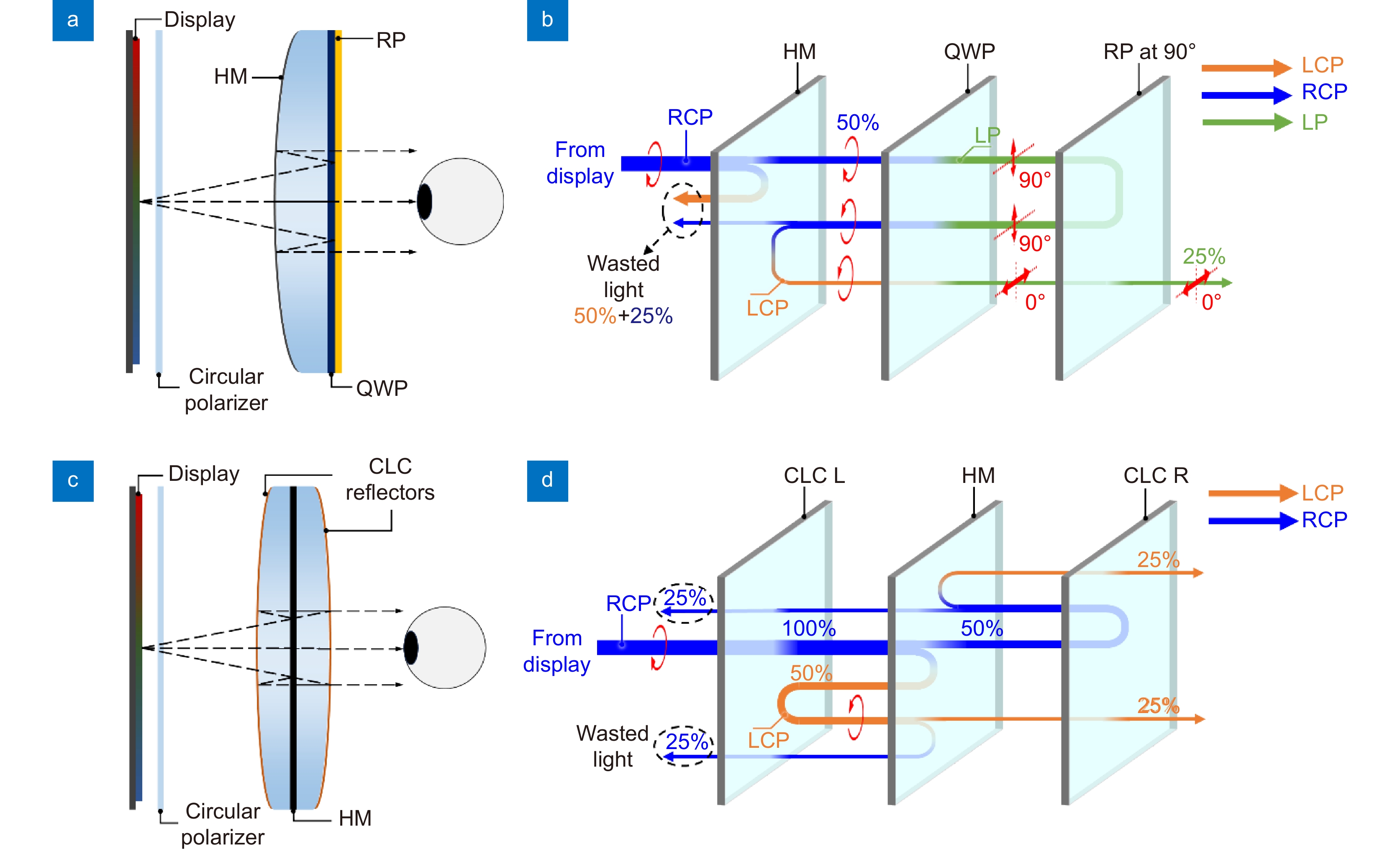
A catadioptric lens structure, also known as pancake lens, has been widely used in virtual reality (VR) displays to reduce the formfactor. However, the utilization of a half mirror (HM) to fold the optical path thrice leads to a significant optical loss. The theoretical maximum optical efficiency is merely 25%.
To transcend this optical efficiency constraint while retaining the foldable characteristic inherent to traditional pancake optics, in this paper, we propose a theoretically lossless folded optical system to replace the HM with a nonreciprocal polarization rotator. In our feasibility demonstration experiment, we used a commercial Faraday rotator (FR) and reflective polarizers to replace the lossy HM. The theoretically predicted 100% efficiency can be achieved approximately by using two high-extinction-ratio reflective polarizers.
In addition, we evaluated the ghost images using a micro-OLED panel in our imaging system. Indeed, the ghost images can be suppressed to undetectable level if the optics are with antireflection coating. Our novel pancake optical system holds great potential for revolutionizing next-generation VR displays with lightweight, compact formfactor, and low power consumption.
Ultrafast all-optical modulation of wide-bandwidth pulses enabled by silicon-metasurfaces
Kaloyan Georgiev, Khosro Zangeneh Kamali, Anton A. Trifonov, Giulia Crotti, Lyuben Petrov, Stefan Georgiev, Hristo Iliev, Lei Xu, Unai Arregui Leon, Mohsen Rahmani, Giuseppe Della Valle, Ivan Buchvarov, Dragomir Neshev
Opto-Electronic Advances
2026-09-15
Physics-informed neural fields enable blind aberration correction for partially coherent quantitative phase imaging
Shun Zhou, Xingyu Huang, Linpeng Lu, Habib Ullah, Kaiyu Du, Maciej Trusiak, Malgorzata Kujawinska, Yuzhen Zhang, Yao Fan, Qian Chen, Qinrong Zhang, Chao Zuo
Opto-Electronic Science
2026-08-26
Heterogeneously integrated micro-ring with SnS₂ for dual-functional optical modulation and photodetection
Jinyi Du, Lidan Lu, Xu Zhang, Bofei Zhu, Wenbo Bo, Yingjie Xu, Guang Chen, Yanlin He, Guanghui Ren, Xiaoping Lou, Zheng You, Lianqing Zhu
Opto-Electronic Advances
2026-08-25
Hardware-aware lightweight photonic spiking neural network for pattern classification
Shuiying Xiang, Yahui Zhang, Shangxuan Shi, Haowen Zhao, Dianzhuang Zheng, Xingxing Guo, Yanan Han, Ye Tian, Liyue Zhang, Yuechun Shi, Yue Hao
Opto-Electronic Advances
2026-08-25
PhyspeNet: An empirical physics-aware network for adaptive speckle reconstructive spectrometry
Junrui Liang, Min Jiang, Jun Li, Zhongming Huang, Junhong He, Yanting Guo, Yanzhao Ke, Jun Ye, Jiangming Xu, Jinyong Leng, Pu Zhou
Opto-Electronic Advances
2026-08-25
A 36 × 240 Gbps hybrid mode/wavelength division multiplexing transmitter using lithium niobate on insulator
Mingyu Zhu, Weihan Wang, Ruitao Ma, Aoyun Gao, Chun Gao, Zexu Wang, Fei Huang, Zhenyuan Bao, Dajian Liu, Jiaxuan Gan, Zejie Yu, Huan Li, Weike Zhao, Daoxin Dai
Opto-Electronic Advances
2026-08-25