(Peer-Reviewed) Spectro-polarimetric detection enabled by multidimensional metasurface with quasi-bound states in the continuum
Haoyang He 贺昊阳 ¹, Fangxing Lai 赖方兴 ², Yan Zhang 张岩 ¹, Xue Zhang 张雪 ¹, Chenyi Tian 田宸易 ¹, Xin Li 李昕 ¹, Yongtian Wang 王涌天 ¹, Shumin Xiao 肖淑敏 ², Lingling Huang 黄玲玲 ¹
¹ Beijing Engineering Research Center of Mixed Reality and Advanced Display, Key Laboratory of Photoelectronic Imaging Technology and System of Ministry of Education of China, School of Optics and Photonics, Beijing Institute of Technology, Beijing 100081, China
中国 北京 北京理工大学光电学院 光电成像技术与系统教育部重点实验室 北京市混合现实与新型显示工程技术研究中心
² Ministry of Industry and Information Technology Key Lab of Micro-Nano Optoelectronic Information System, Harbin Institute of Technology, Shenzhen 518055, China
中国 深圳 哈尔滨工业大学 微纳光电信息系统理论与技术工信部重点实验室
Opto-Electronic Advances, 2025-06-30
Abstract
Spectral and polarization information are crucial for characterizing the composition and surface morphology of various materials. However, traditional spectral and polarization detection systems are hampered by bulky, single-function optical components and complex configurations, hindering the portable, low-cost, and multifunctional applications in compact, field-deployable devices.
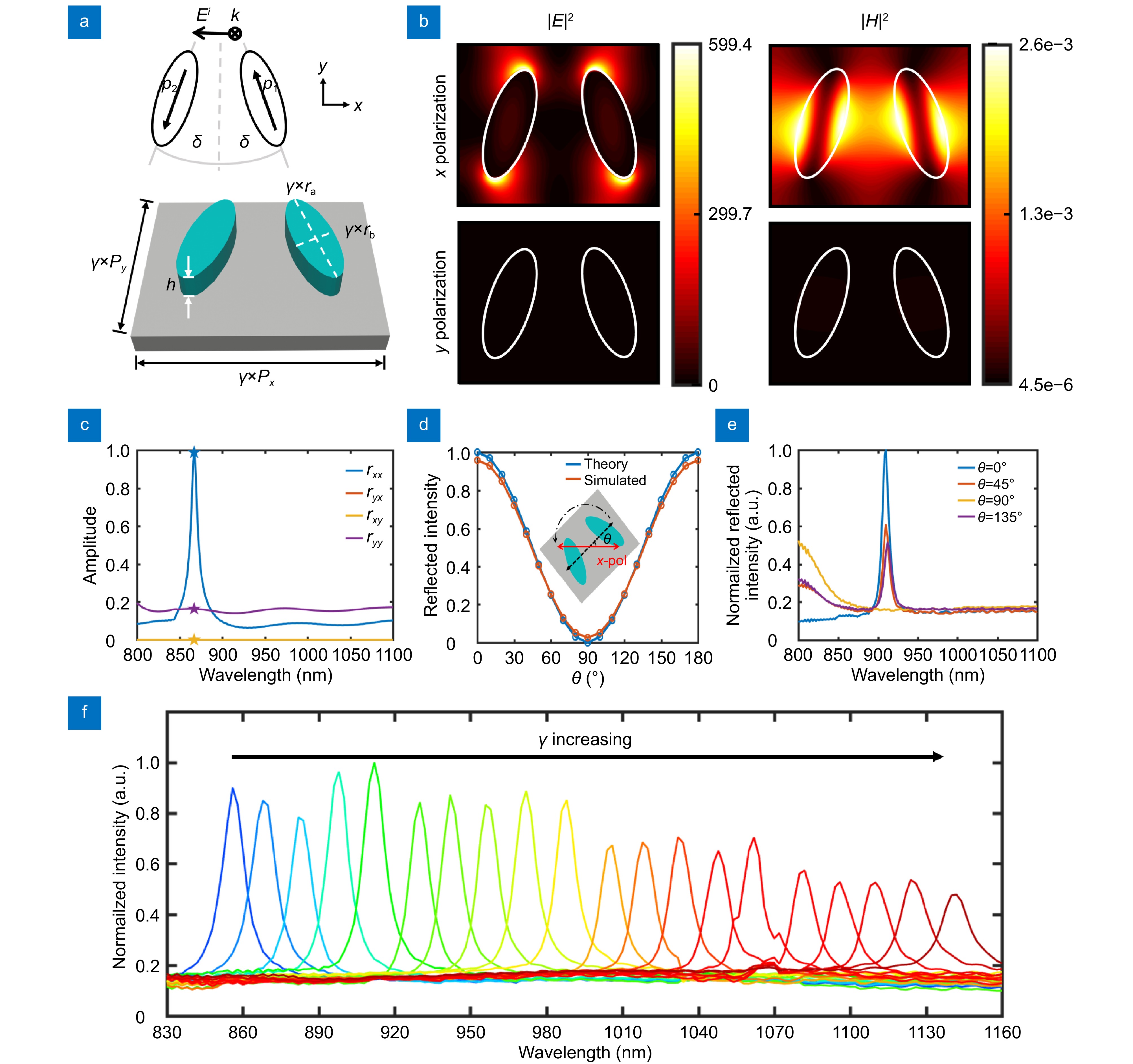
In this study, we introduce a miniaturized near-infrared (NIR) spectro-polarimetric detection device utilizing a group of meta-spectro-polarimeters (MSPs), which support quasi-bound states in the continuum (Q-BIC) under specific incident polarization, significantly reducing the spatial footprint and improving the design scalability.
By precisely adjusting the high quality resonances and polarization sensitive radiation behavior of MSPs, we not only extend the number of spectral waveband to 20 that greatly surpassing traditional division-of-amplitude or division-of-time schemes, but also ensure an average spectral resolution power (SRP, λ/Δλ) of 71.03.
We achieve high accuracy multidimensional spectro-polarization detection, resulting in the angle of linear polarization (AoLP) with an average error of 4.67° and precise spectrum reconstruction in a machine-learning free way, avoiding the huge computational power and energy during the training process.
Additionally, we demonstrate the high spectro-polarimetric imaging performance of our system in different experimental scene. Such multidimensional detection device holds great promise for adoption in fields like aerospace, chemical detection, machine vision, and so on.
A 36 × 240 Gbps hybrid mode/wavelength division multiplexing transmitter using lithium niobate on insulator
Mingyu Zhu, Weihan Wang, Ruitao Ma, Aoyun Gao, Chun Gao, Zexu Wang, Fei Huang, Zhenyuan Bao, Dajian Liu, Jiaxuan Gan, Zejie Yu, Huan Li, Weike Zhao, Daoxin Dai
Opto-Electronic Advances
2026-08-25
Light-perception-based interactive control of an underwater digital twin hand
Jinlong Lu, Chao Zhang, Hengchang Nong, Dongying Wang, Hongyu Zhou, Junjie Weng, Yuehua Deng, Yang Yu, Qiang Bian, Jianfa Zhang, Chaofan Zhang, Zhenrong Zhang, Junbo Yang
Opto-Electronic Advances
2026-07-10
Unlocking home-based nocturnal health management: A fiber-optic approach for early detection of cardiorespiratory rhythm disorders
Hanyu Jin, Hao Li, Zhuolin Chen, Liangye Li, Zurui Wang, Kai Zhou, Weijian Hang, Zhipeng Chen, Junfeng Chen, Kai Shen, Jianfeng Wen, Chen Chen, Cunzheng Fan, Zhijun Yan, Feng Wang, Qizhen Sun
Opto-Electronic Advances
2026-07-10
A flexible wireless system for prospective photodynamic therapy applications
Rolan Mansour, Bhavani Yalagala, Vikas Vikas, Nikolas Bruce, Fawziye Tarhini, Georgios N. Arvanitakis, Mohammed Mughal, Jamie Blanche, Ahmad Taha, Jonathan Copper, Muhammad Imran, Karin Williams, Karin Oien, Mahmoud Wagih, Hadi Heidari, Robert Hadfield, David Flynn
Opto-Electronic Advances
2026-07-10
Parallel bright-field and multi-order edge imaging via wide field-of-view trichannel metalens
Xiaotong Li, Yeseul Kim, Youngsun Jeon, Junhwa Seong, Jaekyung Kim, Peng Tang, Shiqi Hu, Harit Keawmuang, Beomha Yang, Dongmin Jeon, Le Dai, Weiyan Li, Xiaodong Cai, Jinhui Shi, Yong-Sang Ryu, Trevon Badloe, Junsuk Rho
Opto-Electronic Advances
2026-07-10