(Peer-Reviewed) Coulomb attraction driven spontaneous molecule-hotspot paring enables universal, fast, and large-scale uniform single-molecule Raman spectroscopy
Lihong Hong 洪丽红 ¹ ², Haiyao Yang 杨海遥 ¹, Jianzhi Zhang 张简智 ¹, Zihan Gao 高子涵 ¹, Zhi-Yuan Li 李志远 ¹ ³
¹ School of Physics and Optoelectronics, South China University of Technology, Guangzhou 510640, China
中国 广州 华南理工大学物理与光电学院
² Institute of Physics, Henan Academy of Sciences, Zhengzhou 450046, China
中国 郑州 河南省科学院物理研究所
³ State Key Laboratory of Luminescent Materials and Devices, South China University of Technology, Guangzhou 510640, China
中国 广州 华南理工大学发光材料与器件国家重点实验室
Opto-Electronic Advances, 2025-07-17
Abstract
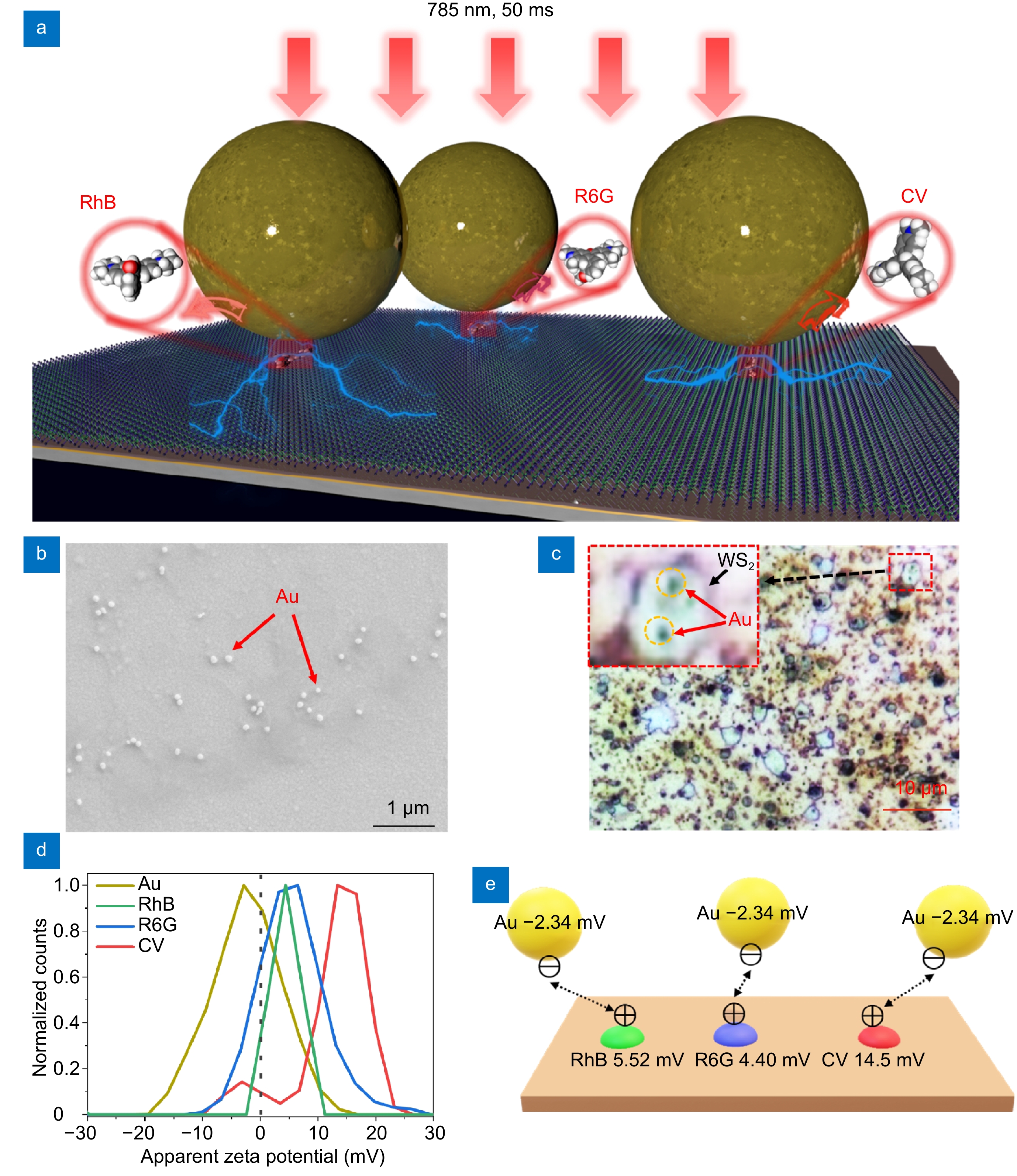
Raman spectroscopy offers a great power to detect, analyze and identify molecules, and monitor their temporal dynamics and evolution when combined with single-molecule surface-enhanced Raman scattering (SM-SERS) substrates. Here we present a SM-SERS scheme that involves simultaneously giant chemical enhancement from WS2 2D materials, giant electromagnetic enhancement from plasmonic nanogap hot spot, and inhibition of molecular fluorescence influence under near-infrared laser illumination.
Remarkably we find Coulomb attraction between analyte and gold nanoparticle can trigger spontaneous formation of molecule-hotspot pairing with high precision, stability and robustness. The scheme has enabled realization of universal, robust, fast, and large-scale uniform SM-SERS detection for three Raman molecules of rhodamine B, rhodamine 6G, and crystal violet with a very low detection limit of 10−16 M and at a very fast spectrum acquisition time of 50 ms.
Light-perception-based interactive control of an underwater digital twin hand
Jinlong Lu, Chao Zhang, Hengchang Nong, Dongying Wang, Hongyu Zhou, Junjie Weng, Yuehua Deng, Yang Yu, Qiang Bian, Jianfa Zhang, Chaofan Zhang, Zhenrong Zhang, Junbo Yang
Opto-Electronic Advances
2026-07-10
Unlocking home-based nocturnal health management: A fiber-optic approach for early detection of cardiorespiratory rhythm disorders
Hanyu Jin, Hao Li, Zhuolin Chen, Liangye Li, Zurui Wang, Kai Zhou, Weijian Hang, Zhipeng Chen, Junfeng Chen, Kai Shen, Jianfeng Wen, Chen Chen, Cunzheng Fan, Zhijun Yan, Feng Wang, Qizhen Sun
Opto-Electronic Advances
2026-07-10
A flexible wireless system for prospective photodynamic therapy applications
Rolan Mansour, Bhavani Yalagala, Vikas Vikas, Nikolas Bruce, Fawziye Tarhini, Georgios N. Arvanitakis, Mohammed Mughal, Jamie Blanche, Ahmad Taha, Jonathan Copper, Muhammad Imran, Karin Williams, Karin Oien, Mahmoud Wagih, Hadi Heidari, Robert Hadfield, David Flynn
Opto-Electronic Advances
2026-07-10
Parallel bright-field and multi-order edge imaging via wide field-of-view trichannel metalens
Xiaotong Li, Yeseul Kim, Youngsun Jeon, Junhwa Seong, Jaekyung Kim, Peng Tang, Shiqi Hu, Harit Keawmuang, Beomha Yang, Dongmin Jeon, Le Dai, Weiyan Li, Xiaodong Cai, Jinhui Shi, Yong-Sang Ryu, Trevon Badloe, Junsuk Rho
Opto-Electronic Advances
2026-07-10