(Peer-Reviewed) Incorporation of a histone mutant with H3K56 site substitution perturbs the replication machinery in mouse embryonic stem cells
Xuan Kang ¹, Xiaomei Yang ¹, Xiaobo Guo ¹, Yabin Li ¹, Chenxin Yang ¹, Huimin Wei ¹ ², Jianfeng Chang 常建锋 ¹
¹ Research Center for Translational Medicine, East Hospital, School of Life Sciences and Technology, Tongji University, Shanghai 200092, China
中国 上海 同济大学生命科学与技术学院东方医院转化医学研究中心
² Tsingdao Advanced Research Institute, Tongji University, Qingdao 266071, China
同济大学青岛高等研究院
Abstract
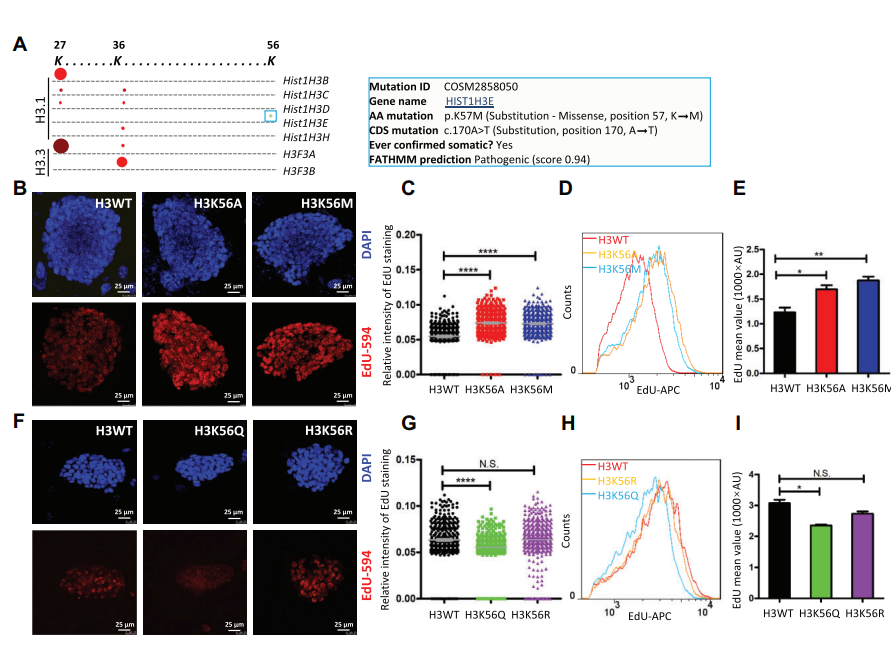
Sense mutations in several conserved modifiable sites of histone H3 have been found to be strongly correlated with multiple tissue-specific clinical cancers. These clinical site mutants acquire a distinctively new epigenetic role and mediate cancer evolution. In this study, we mimicked histone H3 at the 56th lysine (H3K56) mutant incorporation in mouse embryonic stem cells (mESCs) by lentivirus-mediated ectopic expression and analyzed the effects on replication and epigenetic regulation.
The data show that two types of H3K56 mutants, namely H3 lysine 56-to-methionine (H3K56M) and H3 lysine 56-to-alanine (H3K56A), promote replication by recruiting more minichromosome maintenance complex component 3 and checkpoint kinase 1 onto chromatin compared with wild-type histone H3 and other site substitution mutants. Under this condition, the frequency of genomic copy number gain in H3K56M and H3K56A cells globally increases, especially in the Mycl1 region, a known molecular marker frequently occurring in multiple malignant cancers.
Additionally, we found the disruption of H3K56 acetylation distribution in the copy-gain regions, which indicates a probable epigenetic mechanism of H3K56M and H3K56A. We then identified that H3K56M and H3K56A can trigger a potential adaptation to transcription; genes involved in the mitogen-activated protein kinase pathway are partially upregulated, whereas genes associated with intrinsic apoptotic function show obvious downregulation. The final outcome of ectopic H3K56M and H3K56A incorporation in mESCs is an enhanced ability to form carcinomas.
This work indicates that H3K56 site conservation and proper modification play important roles in harmonizing the function of the replication machinery in mESCs.
Ultrafast all-optical modulation of wide-bandwidth pulses enabled by silicon-metasurfaces
Kaloyan Georgiev, Khosro Zangeneh Kamali, Anton A. Trifonov, Giulia Crotti, Lyuben Petrov, Stefan Georgiev, Hristo Iliev, Lei Xu, Unai Arregui Leon, Mohsen Rahmani, Giuseppe Della Valle, Ivan Buchvarov, Dragomir Neshev
Opto-Electronic Advances
2026-09-15
Physics-informed neural fields enable blind aberration correction for partially coherent quantitative phase imaging
Shun Zhou, Xingyu Huang, Linpeng Lu, Habib Ullah, Kaiyu Du, Maciej Trusiak, Malgorzata Kujawinska, Yuzhen Zhang, Yao Fan, Qian Chen, Qinrong Zhang, Chao Zuo
Opto-Electronic Science
2026-08-26
Heterogeneously integrated micro-ring with SnS₂ for dual-functional optical modulation and photodetection
Jinyi Du, Lidan Lu, Xu Zhang, Bofei Zhu, Wenbo Bo, Yingjie Xu, Guang Chen, Yanlin He, Guanghui Ren, Xiaoping Lou, Zheng You, Lianqing Zhu
Opto-Electronic Advances
2026-08-25
Hardware-aware lightweight photonic spiking neural network for pattern classification
Shuiying Xiang, Yahui Zhang, Shangxuan Shi, Haowen Zhao, Dianzhuang Zheng, Xingxing Guo, Yanan Han, Ye Tian, Liyue Zhang, Yuechun Shi, Yue Hao
Opto-Electronic Advances
2026-08-25
PhyspeNet: An empirical physics-aware network for adaptive speckle reconstructive spectrometry
Junrui Liang, Min Jiang, Jun Li, Zhongming Huang, Junhong He, Yanting Guo, Yanzhao Ke, Jun Ye, Jiangming Xu, Jinyong Leng, Pu Zhou
Opto-Electronic Advances
2026-08-25
A 36 × 240 Gbps hybrid mode/wavelength division multiplexing transmitter using lithium niobate on insulator
Mingyu Zhu, Weihan Wang, Ruitao Ma, Aoyun Gao, Chun Gao, Zexu Wang, Fei Huang, Zhenyuan Bao, Dajian Liu, Jiaxuan Gan, Zejie Yu, Huan Li, Weike Zhao, Daoxin Dai
Opto-Electronic Advances
2026-08-25