(Peer-Reviewed) Hydraulic Fracturing-induced Seismicity at the Hot Dry Rock Site of the Gonghe Basin in China
CHEN Zubin 陈祖斌 ¹ ², ZHAO Fa 赵发 ¹ ², SUN Feng 孙锋 ¹ ², LÜ Hao 吕昊 ¹ ², WANG Chunlu 王春露 ¹ ², WU Haidong 吴海东 ³, ZHOU Xiaohua 周晓华 ¹ ²
¹ College of Instrumentation & Electrical Engineering, Jilin University, Changchun 130026, China
中国 长春 吉林大学仪器科学与电气工程学院
² Key Lab of Geo-Exploration Instrumentation of the Ministry of Education, Jilin University, Changchun 130026, China
中国 长春 吉林大学地球信息探测仪器教育部重点实验室
³ Center for Hydrogeology and Environmental Geology, China Geological Survey, Baoding, Hebei 071000, China
中国 河北 保定 中国地质调查局水文地质环境地质调查中心
Abstract
Hot dry rock is becoming an important clean energy source. Enhanced geothermal systems (EGS) hold great promise for the potential to make a contribution to the energy inventory. However, one controversial issue associated with EGS is the impact of induced seismicity.
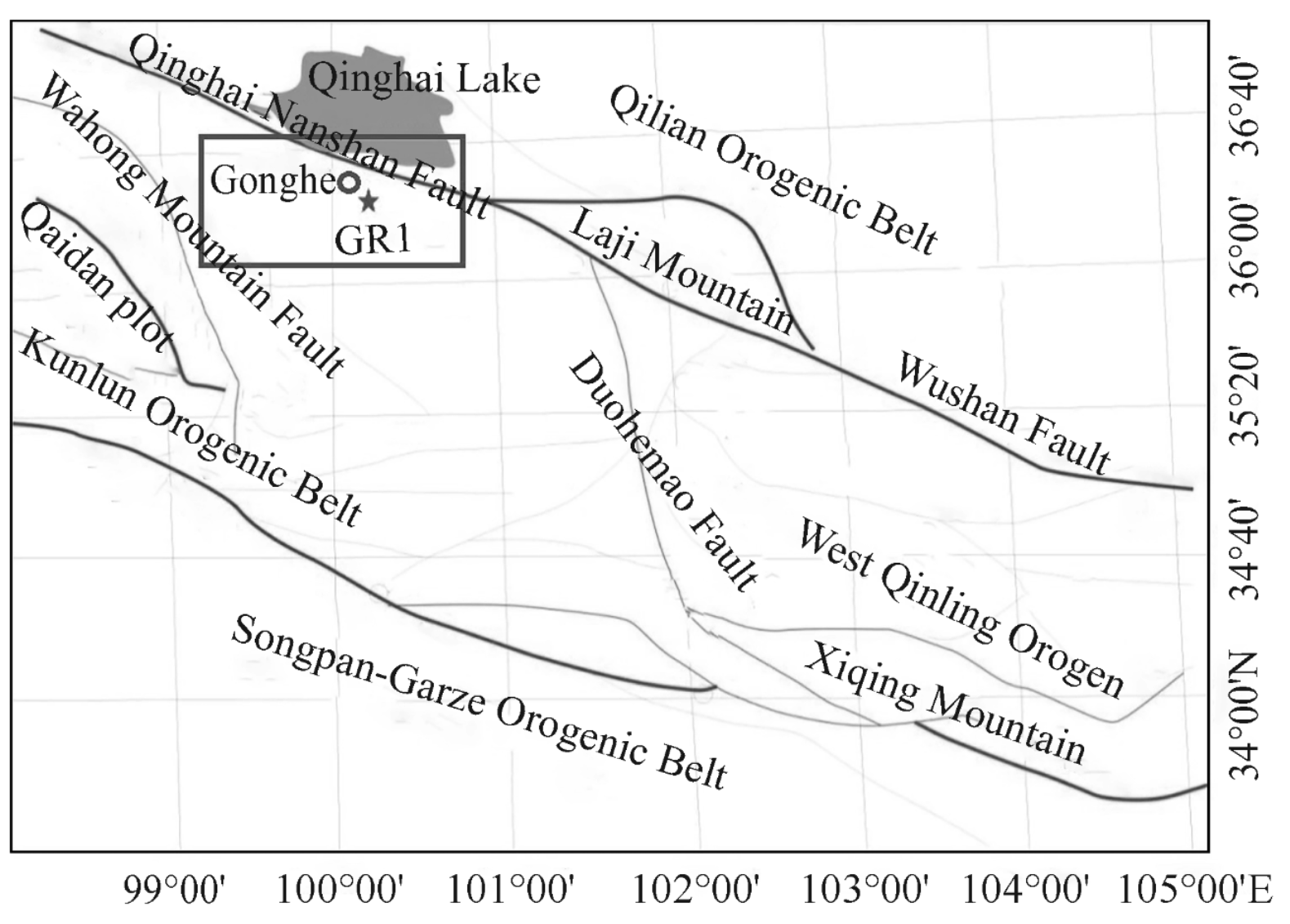
In August 2019, a hydraulic stimulation experiment took place at the hot dry rock site of the Gonghe Basin in Qinghai, China. Earthquakes of different magnitudes of 2 or less occurred during the hydraulic stimulation. Correlations between hydraulic stimulation and seismic risk are still under discussion. Here, we analyze the hydraulic stimulation test and microseismic activity. We quantify the evolution of several parameters to explore the correlations between hydraulic stimulation and induced seismicity, including hydraulic parameters, microseismic events, b-value and statistical forecasting of event magnitudes.
The results show that large-magnitude microseismic events have an upward trend with an increase of the total fluid volume. The variation of the b-value with time indicates that the stimulation experiment induces small amounts of seismicity. Forecasted magnitudes of events can guide operational decisions with respect to induced seismicity during hydraulic fracturing operations, thus providing the basis for risk assessment of hot dry rock exploitation.
Electrically switchable bright-field and interference-synthesized edge-enhanced imaging with a polarization-multiplexed metalens
Xiaotong Li, Junhwa Seong, Yeseul Kim, Kwang-Suk Oh, Shiqi Hu, Le Dai, Harit Keawmuang, Beomha Yang, Minseok Choi, Youngsun Jeon, Cherry Park, Weiyan Li, Tianxu Jia, Han Zhu, Xiaodong Cai, Qi Zheng, Jinhui Shi, Young-Ki Kim, Yuchuan Shao, Trevon Badloe, Junsuk Rho
Opto-Electronic Science
2026-09-20
3D-printed copper water cooling system assisted fabrication of 10.6-μm high-power CO₂ laser resistance reflectors
Hongfei Jiao, Binbin Jiang, Xinshang Niu, Yifan Wang, Dongdong Li, Jun Yu, Xiaochuan Ji, Jingjing Xia, Jinlong Zhang, Xinbin Cheng, Zhanshan Wang
Opto-Electronic Advances
2026-09-15
Ultrafast all-optical modulation of wide-bandwidth pulses enabled by silicon-metasurfaces
Kaloyan Georgiev, Khosro Zangeneh Kamali, Anton A. Trifonov, Giulia Crotti, Lyuben Petrov, Stefan Georgiev, Hristo Iliev, Lei Xu, Unai Arregui Leon, Mohsen Rahmani, Giuseppe Della Valle, Ivan Buchvarov, Dragomir Neshev
Opto-Electronic Advances
2026-09-15
Physics-informed neural fields enable blind aberration correction for partially coherent quantitative phase imaging
Shun Zhou, Xingyu Huang, Linpeng Lu, Habib Ullah, Kaiyu Du, Maciej Trusiak, Malgorzata Kujawinska, Yuzhen Zhang, Yao Fan, Qian Chen, Qinrong Zhang, Chao Zuo
Opto-Electronic Science
2026-08-26