(Peer-Reviewed) Silicon cuboid nanoantenna with simultaneous large Purcell factor for electric dipole, magnetic dipole and electric quadrupole emission
Qiurong Deng, Jianfeng Chen 陈剑锋, Li Long 龙利, Baoqin Chen 陈宝琴, Huakang Yu 虞华康, Zhiyuan Li 李志远
School of Physics and Optoelectronics, South China University of Technology, Guangzhou 510641, China
中国 广州 华南理工大学物理与光电学院
Opto-Electronic Advances, 2022-02-28
Abstract
The Purcell effect is commonly used to increase the spontaneous emission rate by modifying the local environment of a light emitter. Here, we propose a silicon dielectric cuboid nanoantenna for simultaneously enhancing electric dipole (ED), magnetic dipole (MD) and electric quadrupole (EQ) emission.
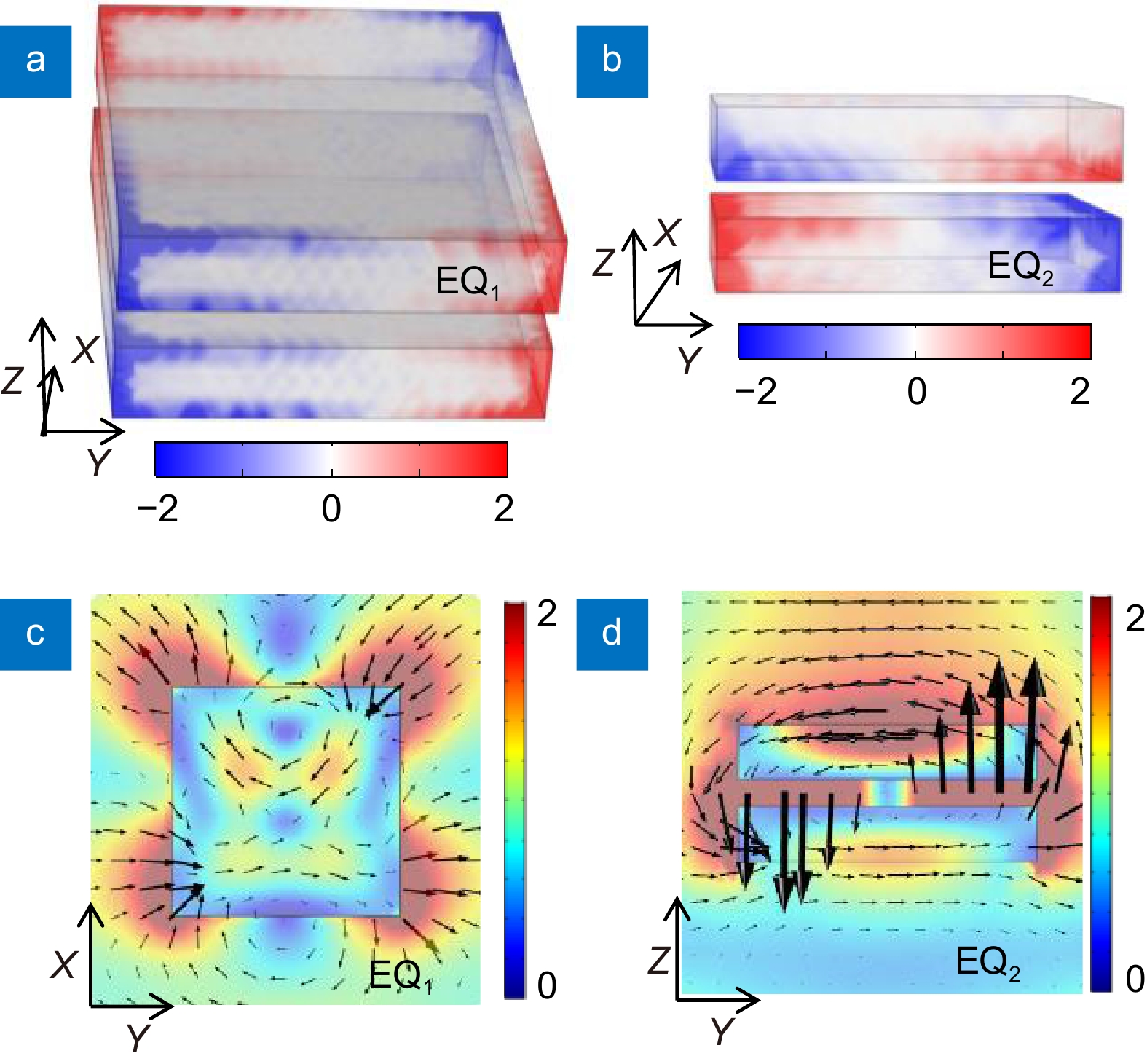
We study the scattering cross section, polarization charge distribution, and electromagnetic field distribution for electromagnetic plane wave illuminating the silicon dielectric cuboid nanoantenna, from which we have identified simultaneous existence of ED, MD and EQ resonance modes in this nanoantenna. We have calculated the Purcell factor of ED, MD and EQ emitters with different moment orientations as a function of radiation wavelength by placing these point radiation source within the nanoantenna, respectively.
We find that the resonances wavelengths of the Purcell factor spectrum are matching with the resonance modes in the nanoantenna. Moreover, the maximum Purcell factor of these ED, MD and EQ emitters is 18, 150 and 118 respectively, occurring at the resonance wavelength of 475, 750, and 562 nm, respectively, all within the visible range. The polarization charge distribution features allow us to clarify the excitation and radiation of these resonance modes as the physical origin of large Purcell factor simultaneously occurring in this silicon cuboid nanoantenna.
Our theoretical results might help to deeply explore and design the dielectric nanoantenna as an ideal candidate to enhance ED, MD and EQ emission simultaneously with very small loss in the visible range, which is superior than the more popular scheme of plasmonic nanoantenna.
Unlocking home-based nocturnal health management: A fiber-optic approach for early detection of cardiorespiratory rhythm disorders
Hanyu Jin, Hao Li, Zhuolin Chen, Liangye Li, Zurui Wang, Kai Zhou, Weijian Hang, Zhipeng Chen, Junfeng Chen, Kai Shen, Jianfeng Wen, Chen Chen, Cunzheng Fan, Zhijun Yan, Feng Wang, Qizhen Sun
Opto-Electronic Advances
2026-07-10
A flexible wireless system for prospective photodynamic therapy applications
Rolan Mansour, Bhavani Yalagala, Vikas Vikas, Nikolas Bruce, Fawziye Tarhini, Georgios N. Arvanitakis, Mohammed Mughal, Jamie Blanche, Ahmad Taha, Jonathan Copper, Muhammad Imran, Karin Williams, Karin Oien, Mahmoud Wagih, Hadi Heidari, Robert Hadfield, David Flynn
Opto-Electronic Advances
2026-07-10
Parallel bright-field and multi-order edge imaging via wide field-of-view trichannel metalens
Xiaotong Li, Yeseul Kim, Youngsun Jeon, Junhwa Seong, Jaekyung Kim, Peng Tang, Shiqi Hu, Harit Keawmuang, Beomha Yang, Dongmin Jeon, Le Dai, Weiyan Li, Xiaodong Cai, Jinhui Shi, Yong-Sang Ryu, Trevon Badloe, Junsuk Rho
Opto-Electronic Advances
2026-07-10