(Peer-Reviewed) A Comparison of Computational Approaches for Intron Retention Detection
Jiantao Zheng 郑剑涛, Cuixiang Lin 林翠香, Zhenpeng Wu 伍振鹏, Hong-Dong Li 李洪东
Hunan Provincial Key Lab on Bioinformatics, School of Computer Science and Engineering, Central South University, Changsha 410083, China
中国 长沙 中南大学计算机学院 生物信息学湖南省重点实验室
Abstract
Intron Retention (IR) is an alternative splicing mode through which introns are retained in mature RNAs rather than being spliced in most cases. IR has been gaining increasing attention in recent years because of its recognized association with gene expression regulation and complex diseases. Continuous efforts have been dedicated to the development of IR detection methods.
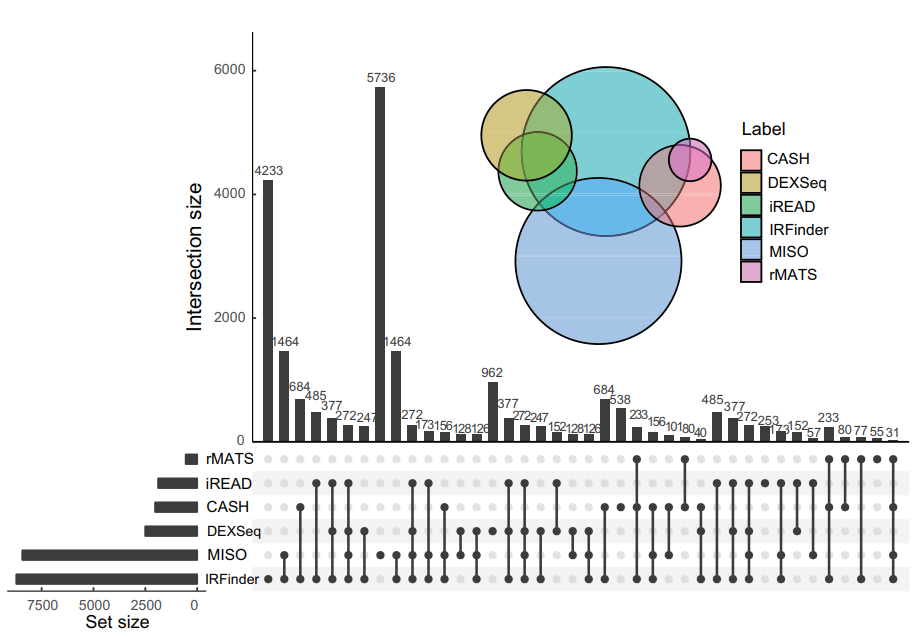
These methods differ in their metrics to quantify retention propensity, performance to detect IR events, functional enrichment of detected IRs, and computational speed. A systematic experimental comparison would be valuable to the selection and use of existing methods. In this work, we conduct an experimental comparison of existing IR detection methods. Considering the unavailability of a gold standard dataset of intron retention, we compare the IR detection performance on simulation datasets. Then, we compare the IR detection results with real RNA-Seq data.
We also describe the use of differential analysis methods to identify disease-associated IRs and compare differential IRs along with their Gene Ontology enrichment, which is illustrated on an Alzheimer's disease RNA-Seq dataset. We discuss key principles and features of existing approaches and outline their differences. This systematic analysis provides helpful guidance for interrogating transcriptomic data from the point of view of IR.
Unlocking home-based nocturnal health management: A fiber-optic approach for early detection of cardiorespiratory rhythm disorders
Hanyu Jin, Hao Li, Zhuolin Chen, Liangye Li, Zurui Wang, Kai Zhou, Weijian Hang, Zhipeng Chen, Junfeng Chen, Kai Shen, Jianfeng Wen, Chen Chen, Cunzheng Fan, Zhijun Yan, Feng Wang, Qizhen Sun
Opto-Electronic Advances
2026-07-10
A flexible wireless system for prospective photodynamic therapy applications
Rolan Mansour, Bhavani Yalagala, Vikas Vikas, Nikolas Bruce, Fawziye Tarhini, Georgios N. Arvanitakis, Mohammed Mughal, Jamie Blanche, Ahmad Taha, Jonathan Copper, Muhammad Imran, Karin Williams, Karin Oien, Mahmoud Wagih, Hadi Heidari, Robert Hadfield, David Flynn
Opto-Electronic Advances
2026-07-10
Parallel bright-field and multi-order edge imaging via wide field-of-view trichannel metalens
Xiaotong Li, Yeseul Kim, Youngsun Jeon, Junhwa Seong, Jaekyung Kim, Peng Tang, Shiqi Hu, Harit Keawmuang, Beomha Yang, Dongmin Jeon, Le Dai, Weiyan Li, Xiaodong Cai, Jinhui Shi, Yong-Sang Ryu, Trevon Badloe, Junsuk Rho
Opto-Electronic Advances
2026-07-10