(Peer-Reviewed) Application and Prospect of Platelet Multi-Omics Technology in Study of Blood Stasis Syndrome
Ying Li 张颖, Ming-qian Sun 孙明谦, Lei Li 李磊, Ye-hao Zhang 张业昊, Lan Miao 苗兰, Jian-xun Liu 刘建勋
Beijing Key Laboratory of Pharmacology of Chinese Materia Region, Xiyuan Hospital, China Academy of Chinese Medical Sciences, National Clinical Research Center for Chinese Medicine Cardiology, Beijing, 100091, China
中国 北京 中国中医科学院西苑医院 中药药理北京市重点实验室 国家中医心血管病临床医学研究中心
Abstract
The abnormality of platelet function plays an important role in the pathogenesis and evolution of blood stasis syndrome (BSS). The explanation of its mechanism is a key scientific issue in the study of cardiovascular and cerebrovascular diseases and treatment. System biology technology provides a good technical platform for further development of platelet multi-omics, which is conducive to the scientific interpretation of the biological mechanism of BSS.
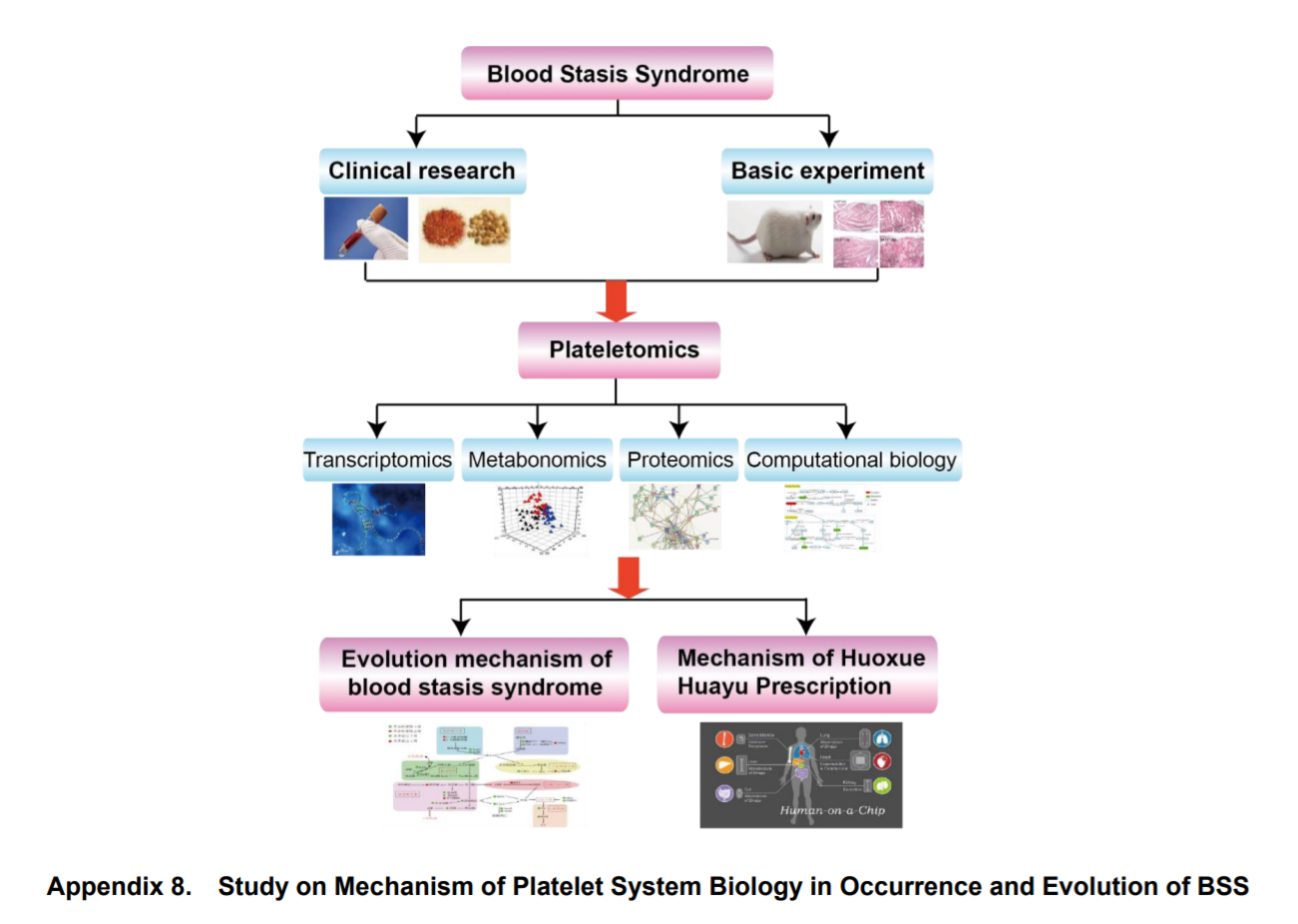
The article summarized the pathogenesis of platelets in BSS, the mechanism of action of blood activating and stasis resolving drugs, and the application of genomics, proteomics, and metabonomics in platelet research, and put forward the concept of “plateletomics in BSS”. Through the combination and cross-validation of multi-omics technology, it mainly focuses on the clinical and basic research of cardiovascular and cerebrovascular diseases; through the interactive verification of multi-omics technology and system biology, it mainly focuses on the platelet function and secretion system.
The article systematically explains the molecular biological mechanism of platelet activation, aggregation, release, and other stages in the formation and development of BSS, and provides a new research idea and method for clarifying the pathogenesis of BSS and the mechanism of action of blood activating and stasis resolving drugs.
Light-perception-based interactive control of an underwater digital twin hand
Jinlong Lu, Chao Zhang, Hengchang Nong, Dongying Wang, Hongyu Zhou, Junjie Weng, Yuehua Deng, Yang Yu, Qiang Bian, Jianfa Zhang, Chaofan Zhang, Zhenrong Zhang, Junbo Yang
Opto-Electronic Advances
2026-07-10
Unlocking home-based nocturnal health management: A fiber-optic approach for early detection of cardiorespiratory rhythm disorders
Hanyu Jin, Hao Li, Zhuolin Chen, Liangye Li, Zurui Wang, Kai Zhou, Weijian Hang, Zhipeng Chen, Junfeng Chen, Kai Shen, Jianfeng Wen, Chen Chen, Cunzheng Fan, Zhijun Yan, Feng Wang, Qizhen Sun
Opto-Electronic Advances
2026-07-10
A flexible wireless system for prospective photodynamic therapy applications
Rolan Mansour, Bhavani Yalagala, Vikas Vikas, Nikolas Bruce, Fawziye Tarhini, Georgios N. Arvanitakis, Mohammed Mughal, Jamie Blanche, Ahmad Taha, Jonathan Copper, Muhammad Imran, Karin Williams, Karin Oien, Mahmoud Wagih, Hadi Heidari, Robert Hadfield, David Flynn
Opto-Electronic Advances
2026-07-10
Parallel bright-field and multi-order edge imaging via wide field-of-view trichannel metalens
Xiaotong Li, Yeseul Kim, Youngsun Jeon, Junhwa Seong, Jaekyung Kim, Peng Tang, Shiqi Hu, Harit Keawmuang, Beomha Yang, Dongmin Jeon, Le Dai, Weiyan Li, Xiaodong Cai, Jinhui Shi, Yong-Sang Ryu, Trevon Badloe, Junsuk Rho
Opto-Electronic Advances
2026-07-10