(Peer-Reviewed) Giant magneto field effect in up-conversion amplified spontaneous emission via spatially extended states in organic-inorganic hybrid perovskites
Tangyao Shen 沈唐尧 ¹, Jiajun Qin ², Yujie Bai 白玉杰 ¹, Jia Zhang ³, Lei Shi 石磊 ¹, Xiaoyuan Hou 侯晓远 ¹, Jian Zi 资剑 ¹, Bin Hu 胡斌 ³
¹ Department of Physics, Fudan University, Shanghai 200433, China
中国 上海 复旦大学物理系
² Department of Physics, Chemistry and Biology (IFM), Linköping University, Linköping 58183, Sweden
³ Department of Materials Science and Engineering, University of Tennessee, Knoxville, Tennessee 37996, USA
Opto-Electronic Advances, 2022-02-28
Abstract
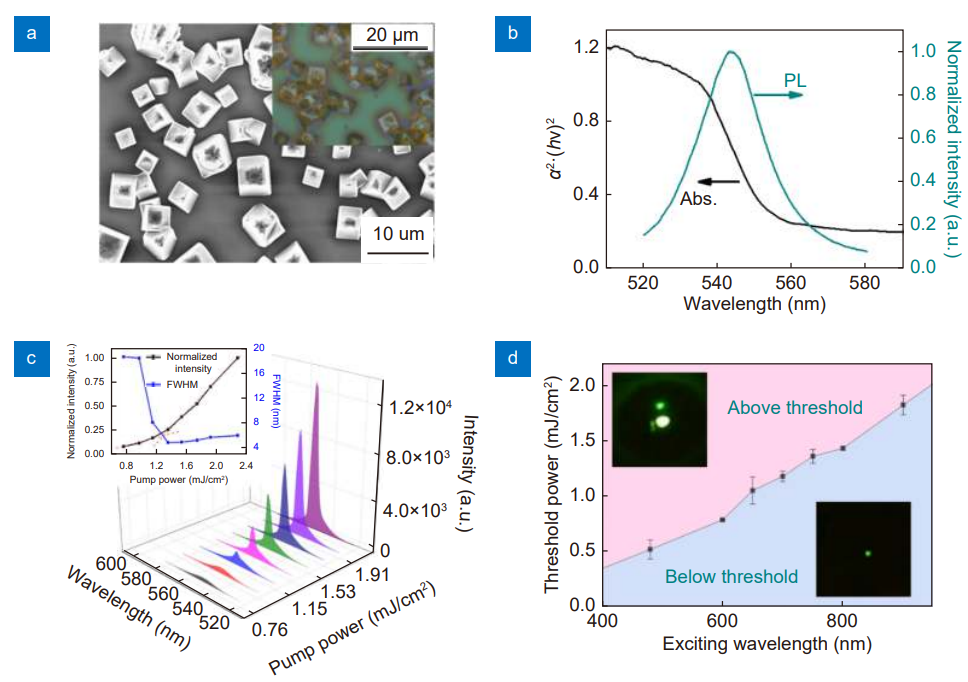
Up-conversion lasing actions are normally difficult to realize in light-emitting materials due to small multi-photon absorption cross section and fast dephasing of excited states during multi-photon excitation. This paper reports an easily accessible up-conversion amplified spontaneous emission (ASE) in organic-inorganic hybrid perovskites (MAPbBr3) films by optically exciting broad gap states with sub-bandgap laser excitation.
The broad absorption was optimized by adjusting the grain sizes in the MAPbBr₃ films. At low sub-bandgap pumping intensities, directly exciting the gap states leads to 2-photon, 3-photon, and 4-photon up-conversion spontaneous emission, revealing a large optical cross section of multi-photon excitation occurring in such hybrid perovskite films. At moderate pumping intensity (1.19 mJ/cm²) of 700 nm laser excitation, a significant spectral narrowing phenomenon was observed with the full width at half maximum (FWHM) decreasing from 18 nm to 4 nm at the peak wavelength of 550 nm, simultaneously with a nonlinear increase on spectral peak intensity, showing an up-conversion ASE realized at low threshold pumping fluence.
More interestingly, the up-conversion ASE demonstrated a giant magnetic field effect, leading to a magneto-ASE reaching 120%. In contrast, the up-conversion photoluminescence (PL) showed a negligible magnetic field effect (< 1%). This observation provides an evidence to indicate that the light-emitting states responsible for up-conversion ASE are essentially formed as spatially extended states.
The angular dependent spectrum results further verify the existence of spatially extended states which are polarized to develop coherent in-phase interaction. Clearly, using broad gap states with spatially extended light-emitting states presents a new approach to develop up-conversion ASE in organic-inorganic hybrid perovskites.
Unlocking home-based nocturnal health management: A fiber-optic approach for early detection of cardiorespiratory rhythm disorders
Hanyu Jin, Hao Li, Zhuolin Chen, Liangye Li, Zurui Wang, Kai Zhou, Weijian Hang, Zhipeng Chen, Junfeng Chen, Kai Shen, Jianfeng Wen, Chen Chen, Cunzheng Fan, Zhijun Yan, Feng Wang, Qizhen Sun
Opto-Electronic Advances
2026-07-10
A flexible wireless system for prospective photodynamic therapy applications
Rolan Mansour, Bhavani Yalagala, Vikas Vikas, Nikolas Bruce, Fawziye Tarhini, Georgios N. Arvanitakis, Mohammed Mughal, Jamie Blanche, Ahmad Taha, Jonathan Copper, Muhammad Imran, Karin Williams, Karin Oien, Mahmoud Wagih, Hadi Heidari, Robert Hadfield, David Flynn
Opto-Electronic Advances
2026-07-10
Parallel bright-field and multi-order edge imaging via wide field-of-view trichannel metalens
Xiaotong Li, Yeseul Kim, Youngsun Jeon, Junhwa Seong, Jaekyung Kim, Peng Tang, Shiqi Hu, Harit Keawmuang, Beomha Yang, Dongmin Jeon, Le Dai, Weiyan Li, Xiaodong Cai, Jinhui Shi, Yong-Sang Ryu, Trevon Badloe, Junsuk Rho
Opto-Electronic Advances
2026-07-10