(Peer-Reviewed) 3D printing of bioinspired compartmentalized capsular structure for controlled drug release
Jingwen LI 李静雯 ¹, Mingxin WU 武明信 ², Wenhui CHEN ¹, Haiyang LIU 刘海洋 ¹, Di TAN 谭迪 ¹, Shengnan SHEN 申胜男 ¹, Yifeng LEI 雷祎凤 ², Longjian XUE 薛龙建 ¹
¹ School of Power and Mechanical Engineering, Wuhan University, Wuhan 430072, China
中国 武汉 武汉大学动力与机械学院
² The Institute of Technological Science, Wuhan University, Wuhan 430072, China
中国 武汉 武汉大学工业科学研究院
Abstract
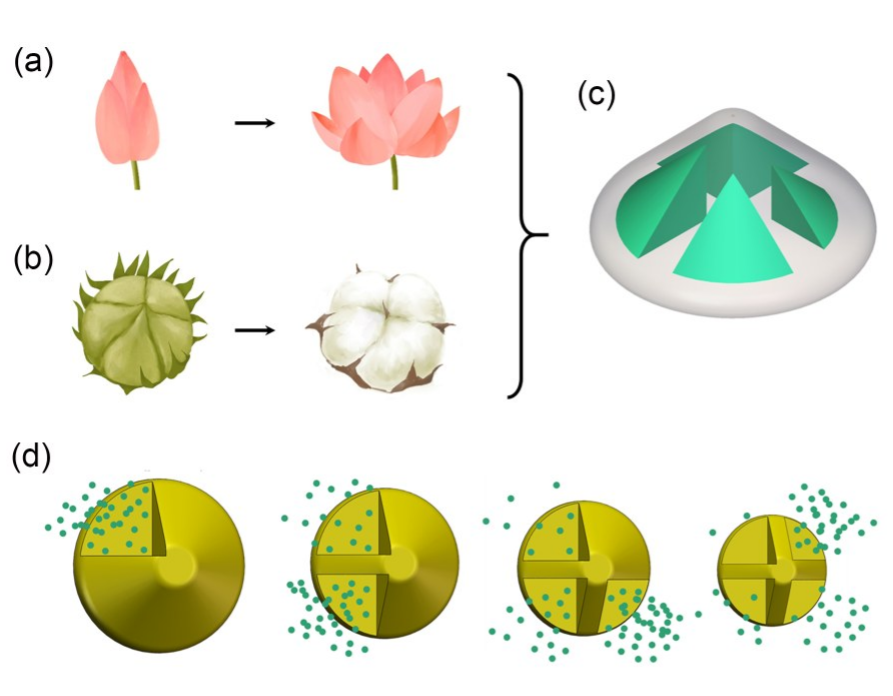
Drug delivery with customized combinations of drugs, controllable drug dosage, and on-demand release kinetics is critical for personalized medicine. In this study, inspired by successive opening of layered structures and compartmentalized structures in plants, we designed a multiple compartmentalized capsular structure for controlled drug delivery.
The structure was designed as a series of compartments, defined by the gradient thickness of their external walls and internal divisions. Based on the careful choice and optimization of bioinks composed of gelatin, starch, and alginate, the capsular structures were successfully manufactured by fused deposition modeling three-dimensional (3D) printing. The capsules showed fusion and firm contact between printed layers, forming complete structures without significant defects on the external walls and internal joints. Internal cavities with different volumes were achieved for different drug loading as designed.
In vitro swelling demonstrated a successive dissolving and opening of external walls of different capsule compartments, allowing successive drug pulses from the capsules, resulting in the sustained release for about 410 min. The drug release was significantly prolonged compared to a single burst release from a traditional capsular design. The bioinspired design and manufacture of multiple compartmentalized capsules enable customized drug release in a controllable fashion with combinations of different drugs, drug doses, and release kinetics, and have potential for use in personalized medicine.
Unlocking home-based nocturnal health management: A fiber-optic approach for early detection of cardiorespiratory rhythm disorders
Hanyu Jin, Hao Li, Zhuolin Chen, Liangye Li, Zurui Wang, Kai Zhou, Weijian Hang, Zhipeng Chen, Junfeng Chen, Kai Shen, Jianfeng Wen, Chen Chen, Cunzheng Fan, Zhijun Yan, Feng Wang, Qizhen Sun
Opto-Electronic Advances
2026-07-10
A flexible wireless system for prospective photodynamic therapy applications
Rolan Mansour, Bhavani Yalagala, Vikas Vikas, Nikolas Bruce, Fawziye Tarhini, Georgios N. Arvanitakis, Mohammed Mughal, Jamie Blanche, Ahmad Taha, Jonathan Copper, Muhammad Imran, Karin Williams, Karin Oien, Mahmoud Wagih, Hadi Heidari, Robert Hadfield, David Flynn
Opto-Electronic Advances
2026-07-10
Parallel bright-field and multi-order edge imaging via wide field-of-view trichannel metalens
Xiaotong Li, Yeseul Kim, Youngsun Jeon, Junhwa Seong, Jaekyung Kim, Peng Tang, Shiqi Hu, Harit Keawmuang, Beomha Yang, Dongmin Jeon, Le Dai, Weiyan Li, Xiaodong Cai, Jinhui Shi, Yong-Sang Ryu, Trevon Badloe, Junsuk Rho
Opto-Electronic Advances
2026-07-10