(Peer-Reviewed) Spectrally encoded diffractive optical unclonable functions using graphene zone plates
Geon Mo Kim, Yun Ji Hwang, Teajong Hwang, Seo Jun Yoon, Chengyi Li, Seong Chan Jun
School of Mechanical Engineering, Yonsei University, 50, Yonsei-ro, Seodaemun-gu, Seoul 03722, Republic of Korea
Opto-Electronic Advances, 2026-10-25
Abstract
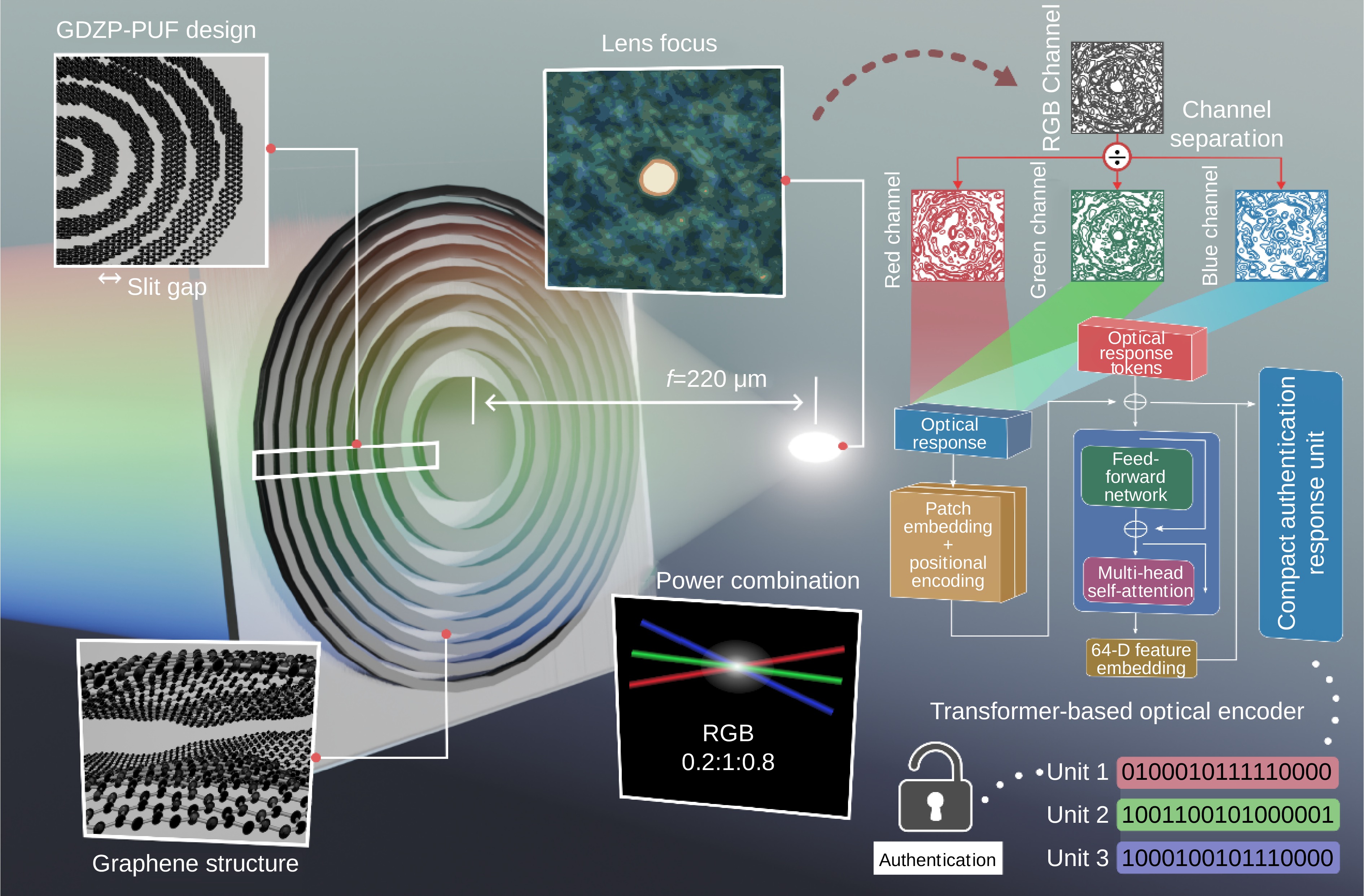
Diffractive photonic structures exhibit high-dimensional, device-specific variability arising from coherent interference, wavelength-dependent phase accumulation, and fabrication-induced disorder. These properties have motivated increasing interest in optical physical unclonable functions (O-PUFs); however, converting analog optical responses into compact and repeatable binary representations suitable for practical authentication remains challenging.
In this work, we address this limitation using graphene diffractive zone plates (GDZPs) combined with a vision transformer-based model. Rather than compensating for diffractive chromatic aberration, we exploit the wavelength-dependent focusing behavior of GDZPs as an additional optical challenge dimension. Under multi-wavelength excitation with predefined RGB power ratios, the devices generate spatial-spectral diffraction patterns shaped by device geometry, material dispersion, and inherent fabrication variations, enabling spectrally programmable optical readout. A self-attention-based encoder captures global diffraction features and maps the optical responses into a compact 64-dimensional representation, from which stable 16-bit binary response units are extracted through statistical thresholding and reliability-based bit selection.
Experimental evaluation demonstrates highly repeatable binary response units, near-random cross-configuration Hamming-distance behavior, low configuration-level error estimates, and clear separability across spectral challenge conditions. These results establish a proof-of-concept spectral-challenge GDZP-transformer pipeline that converts structured diffractive optical responses into repeatable and composable binary response units, highlighting the potential of programmable spectral-spatial optical authentication.
Electrically switchable bright-field and interference-synthesized edge-enhanced imaging with a polarization-multiplexed metalens
Xiaotong Li, Junhwa Seong, Yeseul Kim, Kwang-Suk Oh, Shiqi Hu, Le Dai, Harit Keawmuang, Beomha Yang, Minseok Choi, Youngsun Jeon, Cherry Park, Weiyan Li, Tianxu Jia, Han Zhu, Xiaodong Cai, Qi Zheng, Jinhui Shi, Young-Ki Kim, Yuchuan Shao, Trevon Badloe, Junsuk Rho
Opto-Electronic Science
2026-09-20
3D-printed copper water cooling system assisted fabrication of 10.6-μm high-power CO₂ laser resistance reflectors
Hongfei Jiao, Binbin Jiang, Xinshang Niu, Yifan Wang, Dongdong Li, Jun Yu, Xiaochuan Ji, Jingjing Xia, Jinlong Zhang, Xinbin Cheng, Zhanshan Wang
Opto-Electronic Advances
2026-09-15
Ultrafast all-optical modulation of wide-bandwidth pulses enabled by silicon-metasurfaces
Kaloyan Georgiev, Khosro Zangeneh Kamali, Anton A. Trifonov, Giulia Crotti, Lyuben Petrov, Stefan Georgiev, Hristo Iliev, Lei Xu, Unai Arregui Leon, Mohsen Rahmani, Giuseppe Della Valle, Ivan Buchvarov, Dragomir Neshev
Opto-Electronic Advances
2026-09-15
Physics-informed neural fields enable blind aberration correction for partially coherent quantitative phase imaging
Shun Zhou, Xingyu Huang, Linpeng Lu, Habib Ullah, Kaiyu Du, Maciej Trusiak, Malgorzata Kujawinska, Yuzhen Zhang, Yao Fan, Qian Chen, Qinrong Zhang, Chao Zuo
Opto-Electronic Science
2026-08-26
Heterogeneously integrated micro-ring with SnS₂ for dual-functional optical modulation and photodetection
Jinyi Du, Lidan Lu, Xu Zhang, Bofei Zhu, Wenbo Bo, Yingjie Xu, Guang Chen, Yanlin He, Guanghui Ren, Xiaoping Lou, Zheng You, Lianqing Zhu
Opto-Electronic Advances
2026-08-25