(Peer-Reviewed) Learning from hybrid bright-dark field imaging for resolution-enhanced digital pathology
Runjie Huang ¹ ² ³ ⁴, Runnan Zhang ¹ ² ³ ⁴, Xiyu Chen ¹ ² ³ ⁴, Yefeng Shu ¹ ² ³ ⁴, Wenjian Chen ³, Kun Gui ⁵, Kehui Wang ⁵, Jiasong Sun ¹ ² ³ ⁴, Juergen W. Czarske ⁶ ⁷, Chao Zuo ¹ ² ³ ⁴
¹ Smart Computational Imaging Laboratory (SCILab), School of Electronic and Optical Engineering, Nanjing University of Science and Technology, Nanjing 210094, China
中国 南京 南京理工大学智能计算成像实验室(SCILab)
² Smart Computational Imaging Research Institute (SCIRI) of Nanjing University of Science and Technology, Nanjing 210019, China
中国 南京 南京理工大学智能计算成像研究院 (SCIRI)
³ Jiangsu Key Laboratory of Spectral Imaging & Intelligent Sense Nanjing University of Science and Technology, Nanjing 210094, China
中国 南京 南京理工大学江苏省光谱成像与智能感知重点实验室
⁴ State Key Laboratory of Extreme Environment Optoelectronic Dynamic Measurement Technology and Instrument, Taiyuan 030051, China
中国 太原 极限环境光电动态测试技术与仪器全国重点实验室
⁵ Konfoong Biotech International Co., LTD, Yuyao 315400, China
中国 余姚市 宁波江丰生物信息技术有限公司
⁶ Competence Center for Biomedical Computational Laser Systems (BIOLAS), TU Dresden, Helmholtzstrasse 18, 01069 Dresden, Germany
⁷ Laboratory of Measurement and Sensor System Technique (MST), TU Dresden, Helmholtzstrasse 18, 01069 Dresden, Germany
Opto-Electronic Advances, 2026-10-25
Abstract
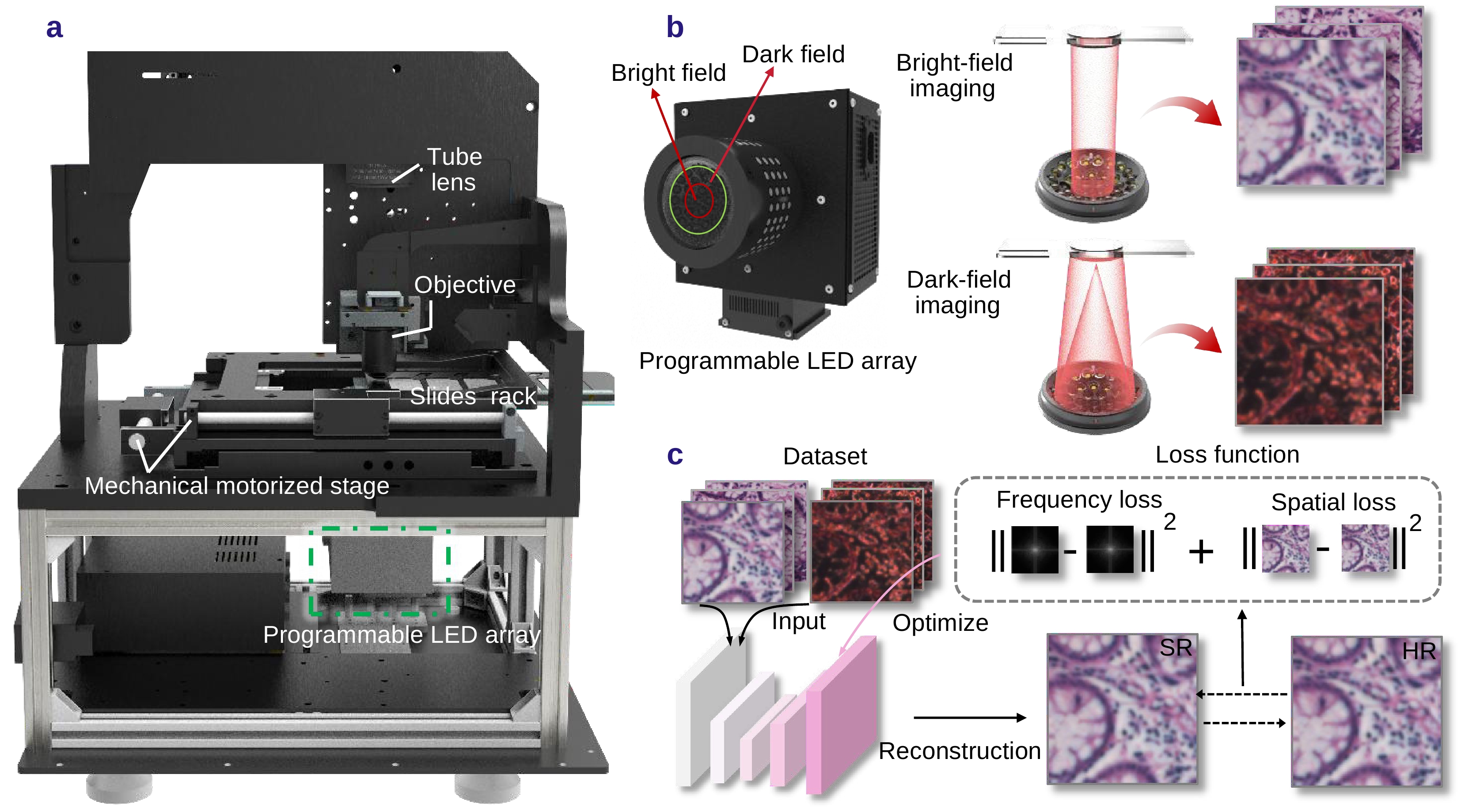
High-throughput whole-slide imaging (WSI) confronts a trade-off between scanning speed and optical resolution, rendering low-numerical-aperture objectives inadequate for resolving critical microstructures. Computational resolution enhancement offers an alternative; however, the ill-posedness of single-image resolution enhancement leads to over-smoothed reconstructions or hallucinations, undermining clinical reliability.
We present HBDF-RE, a hybrid bright-field and dark-field resolution enhancement framework that exploits complementary physical contrast to constrain the reconstruction problem. A single dark-field acquisition, enriched with high-frequency scattering information inaccessible to conventional bright-field imaging, serves as a reference that reduces the solution space and guides reconstruction from low-resolution bright-field inputs. HBDF-RE integrates multimodal feature fusion, spatial attention, and joint spatial-frequency domain optimization to preserve global tissue morphology while recovering fine textural details.
Experimental results demonstrate a 2.1× enhancement in resolution (from 950 nm to 445 nm), a 3.2 dB improvement in PSNR (Peak Signal-to-Noise Ratio), and an 84% reduction in reconstruction artifacts compared with representative single-image resolution enhancement methods. Importantly, in large-scale AI-assisted cervical cancer screening, HBDF-RE-reconstructed images yield an 11.14% improvement in diagnostic sensitivity, with pronounced gains in clinically ambiguous lesion categories.
These results establish HBDF-RE as a physically grounded and clinically reliable resolution enhancement paradigm for digital pathology, offering a pathway toward next-generation WSI and computer-aided diagnosis.
Electrically switchable bright-field and interference-synthesized edge-enhanced imaging with a polarization-multiplexed metalens
Xiaotong Li, Junhwa Seong, Yeseul Kim, Kwang-Suk Oh, Shiqi Hu, Le Dai, Harit Keawmuang, Beomha Yang, Minseok Choi, Youngsun Jeon, Cherry Park, Weiyan Li, Tianxu Jia, Han Zhu, Xiaodong Cai, Qi Zheng, Jinhui Shi, Young-Ki Kim, Yuchuan Shao, Trevon Badloe, Junsuk Rho
Opto-Electronic Science
2026-09-20
3D-printed copper water cooling system assisted fabrication of 10.6-μm high-power CO₂ laser resistance reflectors
Hongfei Jiao, Binbin Jiang, Xinshang Niu, Yifan Wang, Dongdong Li, Jun Yu, Xiaochuan Ji, Jingjing Xia, Jinlong Zhang, Xinbin Cheng, Zhanshan Wang
Opto-Electronic Advances
2026-09-15
Ultrafast all-optical modulation of wide-bandwidth pulses enabled by silicon-metasurfaces
Kaloyan Georgiev, Khosro Zangeneh Kamali, Anton A. Trifonov, Giulia Crotti, Lyuben Petrov, Stefan Georgiev, Hristo Iliev, Lei Xu, Unai Arregui Leon, Mohsen Rahmani, Giuseppe Della Valle, Ivan Buchvarov, Dragomir Neshev
Opto-Electronic Advances
2026-09-15
Physics-informed neural fields enable blind aberration correction for partially coherent quantitative phase imaging
Shun Zhou, Xingyu Huang, Linpeng Lu, Habib Ullah, Kaiyu Du, Maciej Trusiak, Malgorzata Kujawinska, Yuzhen Zhang, Yao Fan, Qian Chen, Qinrong Zhang, Chao Zuo
Opto-Electronic Science
2026-08-26
Heterogeneously integrated micro-ring with SnS₂ for dual-functional optical modulation and photodetection
Jinyi Du, Lidan Lu, Xu Zhang, Bofei Zhu, Wenbo Bo, Yingjie Xu, Guang Chen, Yanlin He, Guanghui Ren, Xiaoping Lou, Zheng You, Lianqing Zhu
Opto-Electronic Advances
2026-08-25