(Peer-Reviewed) Rapid inactivation of human respiratory RNA viruses by deep ultraviolet irradiation from light-emitting diodes on a high-temperature-annealed AlN/Sapphire template
Ke Jiang 蒋科 ¹ ², Simeng Liang 梁斯萌 ³, Xiaojuan Sun 孙晓娟 ¹ ², Jianwei Ben ¹ ², Liang Qu 屈亮 ³, Shanli Zhang ¹ ², Yang Chen 陈洋 ¹ ², Yucheng Zheng 郑雨澄 ³, Ke Lan 蓝柯 ³ ⁴, Dabing Li 黎大兵 ¹ ², Ke Xu 徐可 ³ ⁴
¹ State Key Laboratory of Luminescence and Applications, Changchun Institute of Optics, Fine Mechanics and Physics, Chinese Academy of Sciences, Changchun 130033, China
中国 长春 中国科学院长春光学精密机械与物理研究所 发光学及应用国家重点实验室
² Center of Materials Science and Optoelectronics Engineering, University of Chinese Academy of Sciences, Beijing 100049, China
中国 北京 中国科学院大学 材料科学与光电工程中心
³ State Key Laboratory of Virology, College of Life Sciences, Wuhan University, Wuhan 430072, China
中国 武汉 武汉大学 生命科学学院 病毒学国家重点实验室
⁴ Institute for Vaccine Research, Animal Biosafety Level 3 Laboratory, Wuhan University, Wuhan 430072, China
中国 武汉 武汉大学 生物安全三级动物实验室 疫苗研究院
Opto-Electronic Advances, 2023-09-27
Abstract
Efficient and eco-friendly disinfection of air-borne human respiratory RNA viruses is pursued in both public environment and portable usage. The AlGaN-based deep ultraviolet (DUV) light-emission diode (LED) has high practical potentials because of its advantages of variable wavelength, rapid sterilization, environmental protection, and miniaturization. Therefore, whether the emission wavelength has effects on the disinfection as well as whether the device is feasible to sterilize various respiratory RNA viruses under portable conditions is crucial.
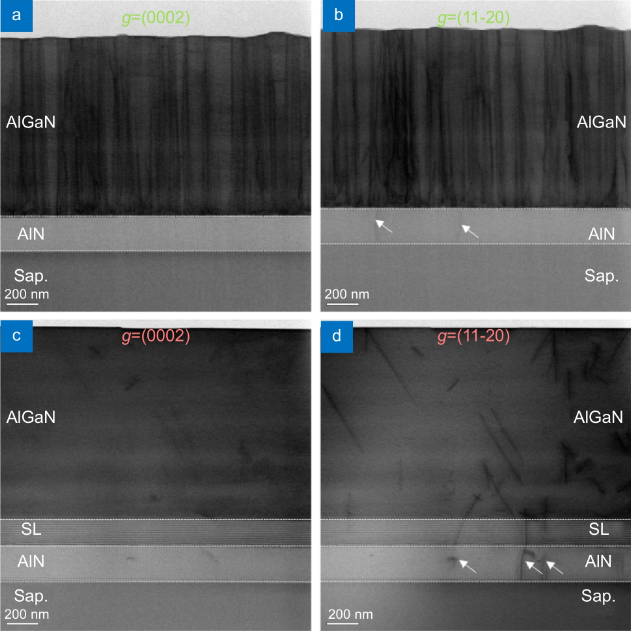
Here, we fabricate AlGaN-based DUV LEDs with different wavelength on high-temperature-annealed (HTA) AlN/Sapphire templates and investigate the inactivation effects for several respiratory RNA viruses. The AlN/AlGaN superlattices are employed between the template and upper n-AlGaN to release the strong compressive stress (SCS), improving the crystal quality and interface roughness.
DUV LEDs with the wavelength of 256, 265, and 278 nm, corresponding to the light output power of 6.8, 9.6, and 12.5 mW, are realized, among which the 256 nm-LED shows the most potent inactivation effect in human respiratory RNA viruses, including SARS-CoV-2, influenza A virus (IAV), and human parainfluenza virus (HPIV), at a similar light power density (LPD) of ~0.8 mW/cm2 for 10 s.
These results will contribute to the advanced DUV LED application of disinfecting viruses with high potency and broad spectrum in a portable and eco-friendly use.
A 36 × 240 Gbps hybrid mode/wavelength division multiplexing transmitter using lithium niobate on insulator
Mingyu Zhu, Weihan Wang, Ruitao Ma, Aoyun Gao, Chun Gao, Zexu Wang, Fei Huang, Zhenyuan Bao, Dajian Liu, Jiaxuan Gan, Zejie Yu, Huan Li, Weike Zhao, Daoxin Dai
Opto-Electronic Advances
2026-08-25
Light-perception-based interactive control of an underwater digital twin hand
Jinlong Lu, Chao Zhang, Hengchang Nong, Dongying Wang, Hongyu Zhou, Junjie Weng, Yuehua Deng, Yang Yu, Qiang Bian, Jianfa Zhang, Chaofan Zhang, Zhenrong Zhang, Junbo Yang
Opto-Electronic Advances
2026-07-10
Unlocking home-based nocturnal health management: A fiber-optic approach for early detection of cardiorespiratory rhythm disorders
Hanyu Jin, Hao Li, Zhuolin Chen, Liangye Li, Zurui Wang, Kai Zhou, Weijian Hang, Zhipeng Chen, Junfeng Chen, Kai Shen, Jianfeng Wen, Chen Chen, Cunzheng Fan, Zhijun Yan, Feng Wang, Qizhen Sun
Opto-Electronic Advances
2026-07-10
A flexible wireless system for prospective photodynamic therapy applications
Rolan Mansour, Bhavani Yalagala, Vikas Vikas, Nikolas Bruce, Fawziye Tarhini, Georgios N. Arvanitakis, Mohammed Mughal, Jamie Blanche, Ahmad Taha, Jonathan Copper, Muhammad Imran, Karin Williams, Karin Oien, Mahmoud Wagih, Hadi Heidari, Robert Hadfield, David Flynn
Opto-Electronic Advances
2026-07-10
Parallel bright-field and multi-order edge imaging via wide field-of-view trichannel metalens
Xiaotong Li, Yeseul Kim, Youngsun Jeon, Junhwa Seong, Jaekyung Kim, Peng Tang, Shiqi Hu, Harit Keawmuang, Beomha Yang, Dongmin Jeon, Le Dai, Weiyan Li, Xiaodong Cai, Jinhui Shi, Yong-Sang Ryu, Trevon Badloe, Junsuk Rho
Opto-Electronic Advances
2026-07-10