(Peer-Reviewed) High-resolution tumor marker detection based on microwave photonics demodulated dual wavelength fiber laser sensor
Jie Hu 胡杰 ¹, Weihao Lin 林伟浩 ¹, Liyang Shao 邵理阳 ¹, Chenlong Xue 薛陈龙 ¹, Fang Zhao 赵芳 ¹, Dongrui Xiao 肖冬瑞 ², Yang Ran 冉洋 ³, Yue Meng 肖冬瑞 ⁴, Panpan He 贺盼盼 ⁵, Zhiguang Yu 余枝广 ⁵, Jinna Chen 陈金娜 ¹, Perry Ping Shum 沈平 ¹
¹ Department of Electronic and Electrical Engineering, Southern University of Science and Technology, Shenzhen 518055, China
中国 深圳 南方科技大学电子与电气工程系
² School of Electrical Information Engineering, Hunan Institute of Technology, Hengyang 421002, China
中国 衡阳 湖南工学院电气与信息工程学院
³ Guangdong Provincial Key Laboratory of Optical Fiber Sensing and Communications, Institute of Photonics Technology, Jinan University, Guangzhou 510632, China
中国 广州 暨南大学光子技术研究院 广东省光纤传感与通信技术重点实验室
⁴ Department of Clinical Laboratory, Guangdong Provincial People’s Hospital, Guangdong Academy of Medical Sciences, Guangzhou 511436, China
中国 广州 广东省医学科学院 广东省人民医院检验科
⁵ Medcaptain Medical Technology Co., Ltd., Shenzhen 518055, China
中国 深圳 深圳麦科田生物医疗技术股份有限公司
Opto-Electronic Advances, 2024-12-16
Abstract
The specific detection of tumor markers is crucial in early tumor screening and subsequent treatment processes. To accurately distinguish the signal response caused by trace markers, the high demodulation resolution of the sensor is necessary.
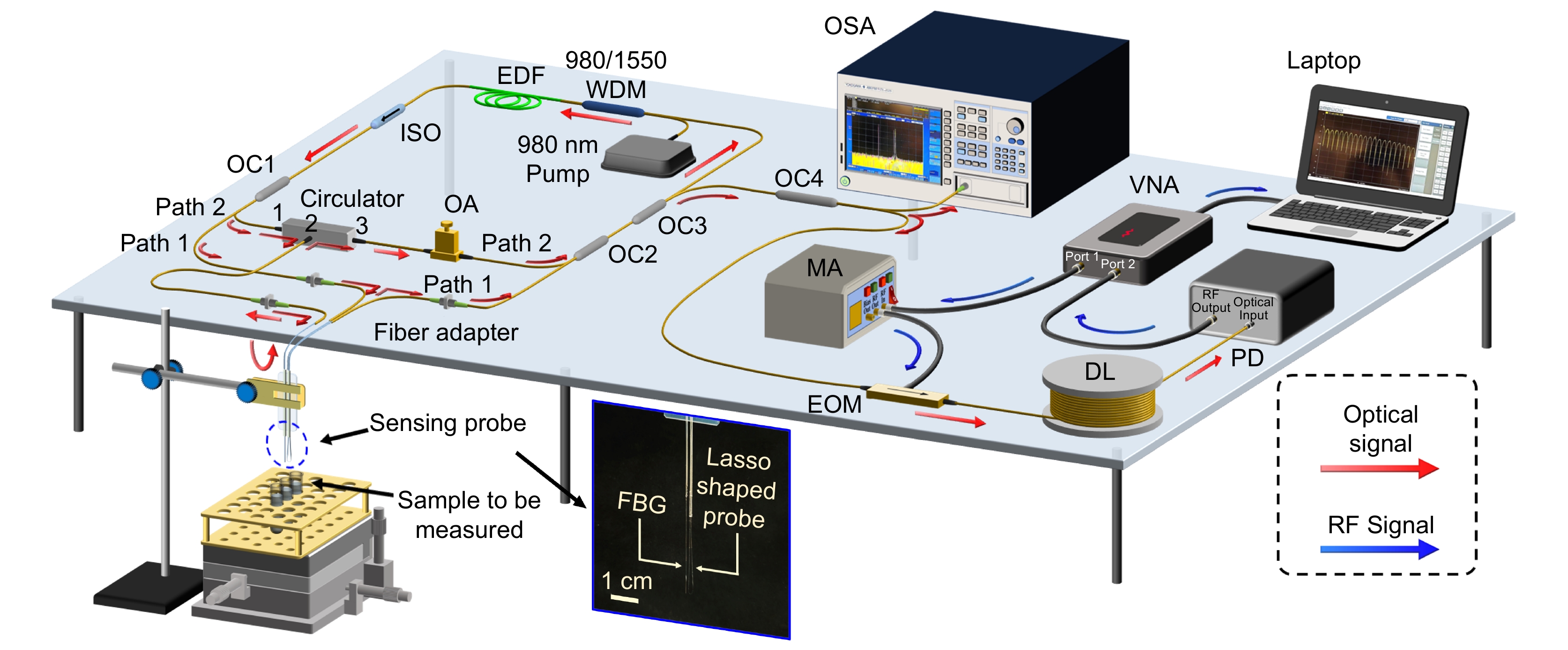
In this paper, we propose a dual-wavelength fiber laser sensing system enhanced with microwave photonics demodulation technology to achieve high-resolution tumor marker detection. This sensing system can simultaneously perform spectral wavelength-domain and frequency-domain analyses. Experimental results demonstrate that this system's refractive index (RI) sensitivity reaches 1083 nm/RIU by wavelength analysis and –1902 GHz/RIU by frequency analysis, with ideal detection resolutions of 1.85×10⁻⁵ RIU and 5.26×10⁻⁸ RIU, respectively.
Compared with traditional wavelength domain analysis, the demodulation resolution is improved by three orders of magnitude, based on the same sensing structure. To validate its biosensing performance, carcinoembryonic antigen-related cell adhesion molecule 5 (CEACAM5) is selected as the detection target.
Experimental results show that the improved sensing system has a limit of detection (LOD) of 0.076 ng/mL and a detection resolution of 0.008 ng/mL. Experimental results obtained from human serum samples are consistent with clinical data, highlighting the strong clinical application potential of the proposed sensing system and analysis method.
Ultrafast all-optical modulation of wide-bandwidth pulses enabled by silicon-metasurfaces
Kaloyan Georgiev, Khosro Zangeneh Kamali, Anton A. Trifonov, Giulia Crotti, Lyuben Petrov, Stefan Georgiev, Hristo Iliev, Lei Xu, Unai Arregui Leon, Mohsen Rahmani, Giuseppe Della Valle, Ivan Buchvarov, Dragomir Neshev
Opto-Electronic Advances
2026-09-15
Physics-informed neural fields enable blind aberration correction for partially coherent quantitative phase imaging
Shun Zhou, Xingyu Huang, Linpeng Lu, Habib Ullah, Kaiyu Du, Maciej Trusiak, Malgorzata Kujawinska, Yuzhen Zhang, Yao Fan, Qian Chen, Qinrong Zhang, Chao Zuo
Opto-Electronic Science
2026-08-26
Heterogeneously integrated micro-ring with SnS₂ for dual-functional optical modulation and photodetection
Jinyi Du, Lidan Lu, Xu Zhang, Bofei Zhu, Wenbo Bo, Yingjie Xu, Guang Chen, Yanlin He, Guanghui Ren, Xiaoping Lou, Zheng You, Lianqing Zhu
Opto-Electronic Advances
2026-08-25
Hardware-aware lightweight photonic spiking neural network for pattern classification
Shuiying Xiang, Yahui Zhang, Shangxuan Shi, Haowen Zhao, Dianzhuang Zheng, Xingxing Guo, Yanan Han, Ye Tian, Liyue Zhang, Yuechun Shi, Yue Hao
Opto-Electronic Advances
2026-08-25
PhyspeNet: An empirical physics-aware network for adaptive speckle reconstructive spectrometry
Junrui Liang, Min Jiang, Jun Li, Zhongming Huang, Junhong He, Yanting Guo, Yanzhao Ke, Jun Ye, Jiangming Xu, Jinyong Leng, Pu Zhou
Opto-Electronic Advances
2026-08-25
A 36 × 240 Gbps hybrid mode/wavelength division multiplexing transmitter using lithium niobate on insulator
Mingyu Zhu, Weihan Wang, Ruitao Ma, Aoyun Gao, Chun Gao, Zexu Wang, Fei Huang, Zhenyuan Bao, Dajian Liu, Jiaxuan Gan, Zejie Yu, Huan Li, Weike Zhao, Daoxin Dai
Opto-Electronic Advances
2026-08-25