(Peer-Reviewed) Enhanced photoacoustic microscopy with physics-embedded degeneration learning
Haigang Ma 马海钢 ¹ ² ³, Shili Ren 任世利 ¹ ² ³, Xiang Wei 魏翔 ¹ ² ³, Yinshi Yu 于音什 ¹ ² ³, Jiaming Qian 钱佳铭 ¹ ² ³, Qian Chen 陈钱 ¹ ³, Chao Zuo 左超 ¹ ² ³
¹ Smart Computational Imaging Laboratory (SCILab), School of Electronic and Optical Engineering, Nanjing University of Science and Technology, Nanjing 210094, China
中国 南京 南京理工大学 电子工程与光电技术学院 智能计算成像实验室
² Smart Computational Imaging Research Institute (SCIRI) of Nanjing University of Science and Technology, Nanjing 210019, China
中国 南京 南京理工大学 智能计算成像实验室
³ Jiangsu Key Laboratory of Spectral Imaging & Intelligent Sense, Nanjing 210094, China
中国 南京 江苏省光谱成像与智能感知重点实验室
Opto-Electronic Advances
, 2024-03-28
Abstract
Deep learning (DL) is making significant inroads into biomedical imaging as it provides novel and powerful ways of accurately and efficiently improving the image quality of photoacoustic microscopy (PAM). Off-the-shelf DL models, however, do not necessarily obey the fundamental governing laws of PAM physical systems, nor do they generalize well to scenarios on which they have not been trained.
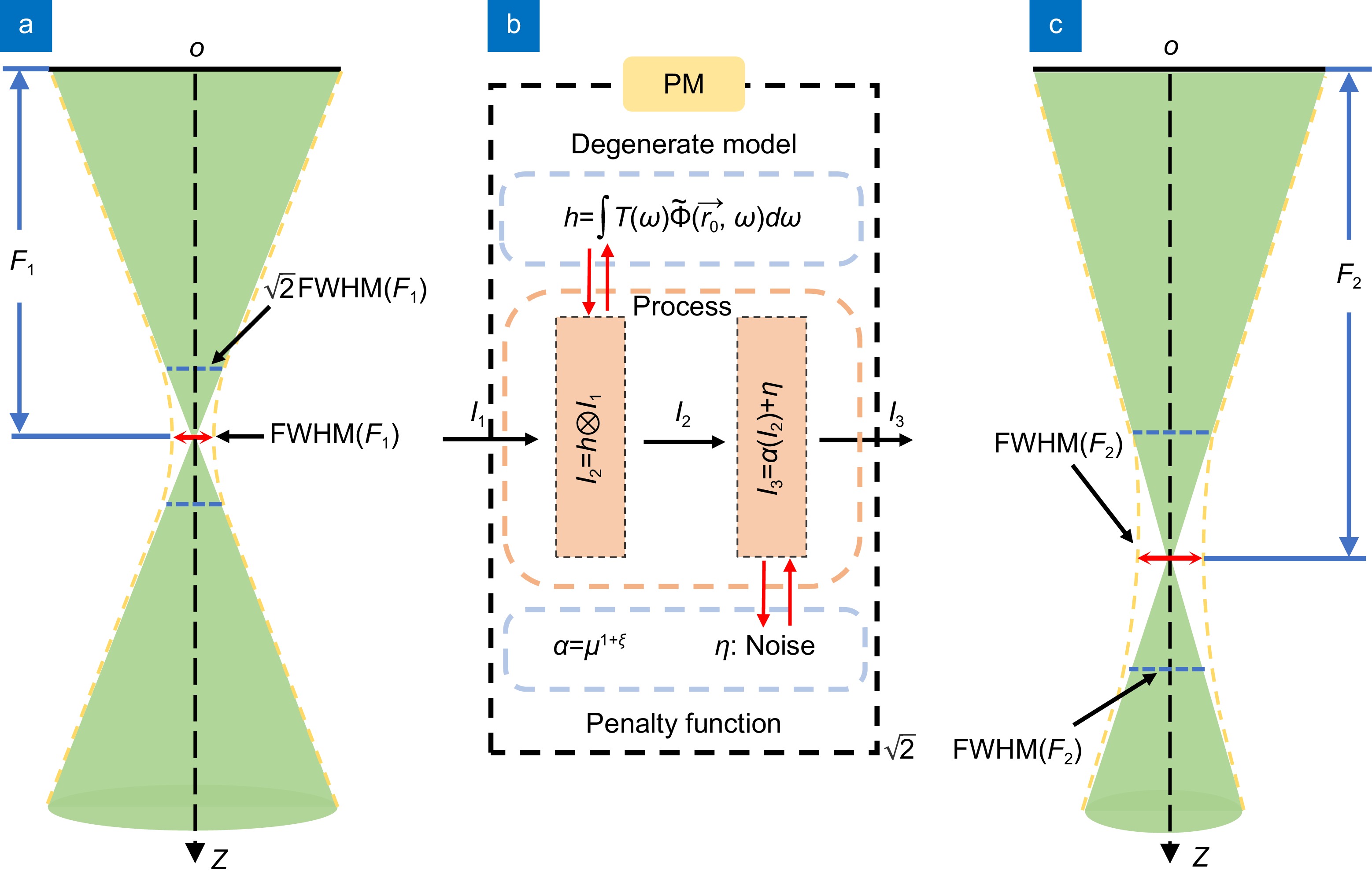
In this work, a physics-embedded degeneration learning (PEDL) approach is proposed to enhance the image quality of PAM with a self-attention enhanced U-Net network, which obtains greater physical consistency, improves data efficiency, and higher adaptability. The proposed method is demonstrated on both synthetic and real datasets, including animal experiments in vivo (blood vessels of mouse's ear and brain). And the results show that compared with previous DL methods, the PEDL algorithm exhibits good performance in recovering PAM images qualitatively and quantitatively.
It overcomes the challenges related to training data, accuracy, and robustness which a typical data-driven approach encounters, whose exemplary application envisions to provide a new perspective for existing DL tools of enhanced PAM.
Ultrafast all-optical modulation of wide-bandwidth pulses enabled by silicon-metasurfaces
Kaloyan Georgiev, Khosro Zangeneh Kamali, Anton A. Trifonov, Giulia Crotti, Lyuben Petrov, Stefan Georgiev, Hristo Iliev, Lei Xu, Unai Arregui Leon, Mohsen Rahmani, Giuseppe Della Valle, Ivan Buchvarov, Dragomir Neshev
Opto-Electronic Advances
2026-09-15
Physics-informed neural fields enable blind aberration correction for partially coherent quantitative phase imaging
Shun Zhou, Xingyu Huang, Linpeng Lu, Habib Ullah, Kaiyu Du, Maciej Trusiak, Malgorzata Kujawinska, Yuzhen Zhang, Yao Fan, Qian Chen, Qinrong Zhang, Chao Zuo
Opto-Electronic Science
2026-08-26
Heterogeneously integrated micro-ring with SnS₂ for dual-functional optical modulation and photodetection
Jinyi Du, Lidan Lu, Xu Zhang, Bofei Zhu, Wenbo Bo, Yingjie Xu, Guang Chen, Yanlin He, Guanghui Ren, Xiaoping Lou, Zheng You, Lianqing Zhu
Opto-Electronic Advances
2026-08-25
Hardware-aware lightweight photonic spiking neural network for pattern classification
Shuiying Xiang, Yahui Zhang, Shangxuan Shi, Haowen Zhao, Dianzhuang Zheng, Xingxing Guo, Yanan Han, Ye Tian, Liyue Zhang, Yuechun Shi, Yue Hao
Opto-Electronic Advances
2026-08-25
PhyspeNet: An empirical physics-aware network for adaptive speckle reconstructive spectrometry
Junrui Liang, Min Jiang, Jun Li, Zhongming Huang, Junhong He, Yanting Guo, Yanzhao Ke, Jun Ye, Jiangming Xu, Jinyong Leng, Pu Zhou
Opto-Electronic Advances
2026-08-25
A 36 × 240 Gbps hybrid mode/wavelength division multiplexing transmitter using lithium niobate on insulator
Mingyu Zhu, Weihan Wang, Ruitao Ma, Aoyun Gao, Chun Gao, Zexu Wang, Fei Huang, Zhenyuan Bao, Dajian Liu, Jiaxuan Gan, Zejie Yu, Huan Li, Weike Zhao, Daoxin Dai
Opto-Electronic Advances
2026-08-25