(Peer-Reviewed) Spectro-polarimetric detection enabled by multidimensional metasurface with quasi-bound states in the continuum
Haoyang He 贺昊阳 ¹, Fangxing Lai 赖方兴 ², Yan Zhang 张岩 ¹, Xue Zhang 张雪 ¹, Chenyi Tian 田宸易 ¹, Xin Li 李昕 ¹, Yongtian Wang 王涌天 ¹, Shumin Xiao 肖淑敏 ², Lingling Huang 黄玲玲 ¹
¹ Beijing Engineering Research Center of Mixed Reality and Advanced Display, Key Laboratory of Photoelectronic Imaging Technology and System of Ministry of Education of China, School of Optics and Photonics, Beijing Institute of Technology, Beijing 100081, China
中国 北京 北京理工大学光电学院 光电成像技术与系统教育部重点实验室 北京市混合现实与新型显示工程技术研究中心
² Ministry of Industry and Information Technology Key Lab of Micro-Nano Optoelectronic Information System, Harbin Institute of Technology, Shenzhen 518055, China
中国 深圳 哈尔滨工业大学 微纳光电信息系统理论与技术工信部重点实验室
Opto-Electronic Advances
, 2025-06-30
Abstract
Spectral and polarization information are crucial for characterizing the composition and surface morphology of various materials. However, traditional spectral and polarization detection systems are hampered by bulky, single-function optical components and complex configurations, hindering the portable, low-cost, and multifunctional applications in compact, field-deployable devices.
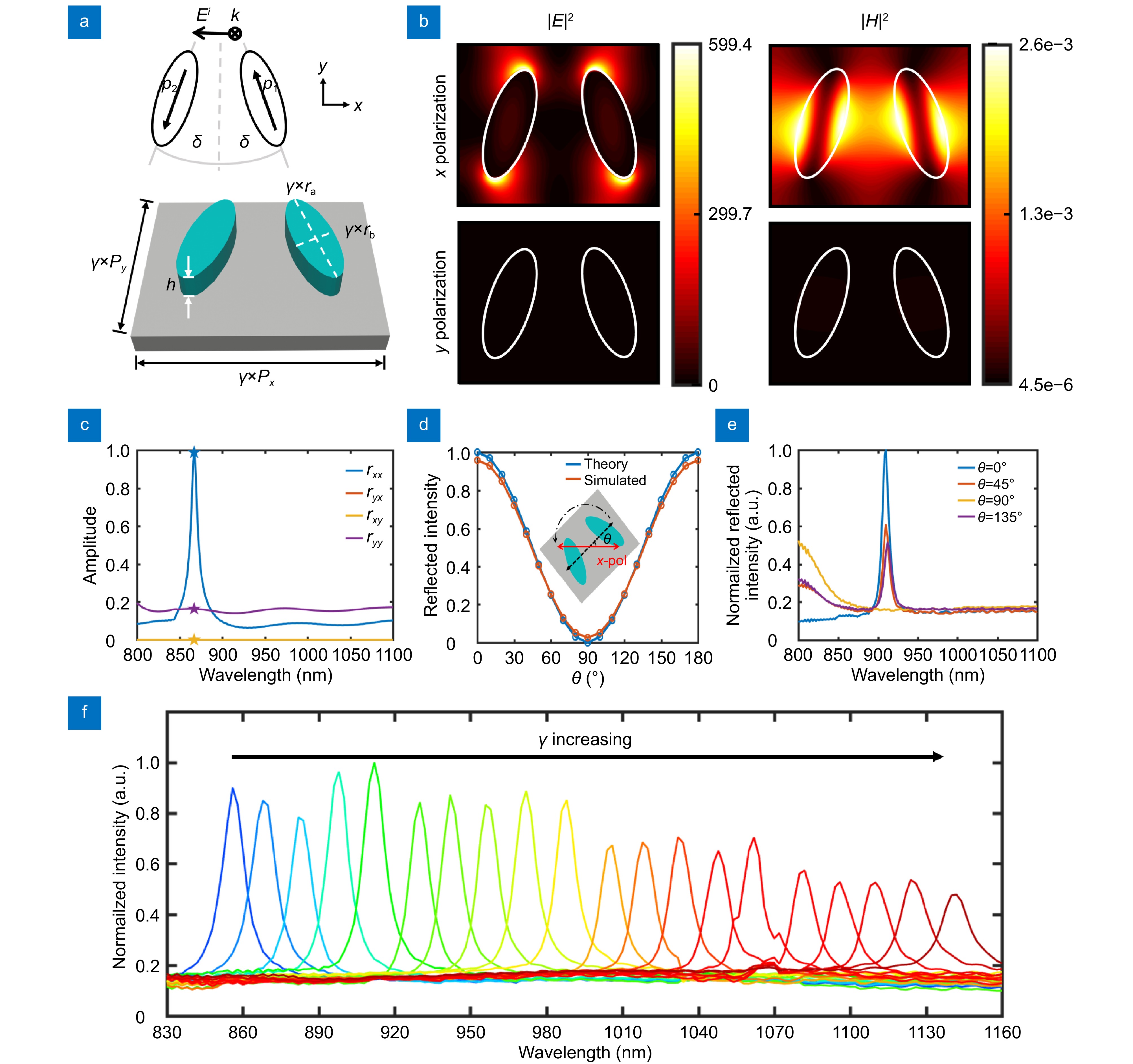
In this study, we introduce a miniaturized near-infrared (NIR) spectro-polarimetric detection device utilizing a group of meta-spectro-polarimeters (MSPs), which support quasi-bound states in the continuum (Q-BIC) under specific incident polarization, significantly reducing the spatial footprint and improving the design scalability.
By precisely adjusting the high quality resonances and polarization sensitive radiation behavior of MSPs, we not only extend the number of spectral waveband to 20 that greatly surpassing traditional division-of-amplitude or division-of-time schemes, but also ensure an average spectral resolution power (SRP, λ/Δλ) of 71.03.
We achieve high accuracy multidimensional spectro-polarization detection, resulting in the angle of linear polarization (AoLP) with an average error of 4.67° and precise spectrum reconstruction in a machine-learning free way, avoiding the huge computational power and energy during the training process.
Additionally, we demonstrate the high spectro-polarimetric imaging performance of our system in different experimental scene. Such multidimensional detection device holds great promise for adoption in fields like aerospace, chemical detection, machine vision, and so on.
Ultrafast all-optical modulation of wide-bandwidth pulses enabled by silicon-metasurfaces
Kaloyan Georgiev, Khosro Zangeneh Kamali, Anton A. Trifonov, Giulia Crotti, Lyuben Petrov, Stefan Georgiev, Hristo Iliev, Lei Xu, Unai Arregui Leon, Mohsen Rahmani, Giuseppe Della Valle, Ivan Buchvarov, Dragomir Neshev
Opto-Electronic Advances
2026-09-15
Physics-informed neural fields enable blind aberration correction for partially coherent quantitative phase imaging
Shun Zhou, Xingyu Huang, Linpeng Lu, Habib Ullah, Kaiyu Du, Maciej Trusiak, Malgorzata Kujawinska, Yuzhen Zhang, Yao Fan, Qian Chen, Qinrong Zhang, Chao Zuo
Opto-Electronic Science
2026-08-26
Heterogeneously integrated micro-ring with SnS₂ for dual-functional optical modulation and photodetection
Jinyi Du, Lidan Lu, Xu Zhang, Bofei Zhu, Wenbo Bo, Yingjie Xu, Guang Chen, Yanlin He, Guanghui Ren, Xiaoping Lou, Zheng You, Lianqing Zhu
Opto-Electronic Advances
2026-08-25
Hardware-aware lightweight photonic spiking neural network for pattern classification
Shuiying Xiang, Yahui Zhang, Shangxuan Shi, Haowen Zhao, Dianzhuang Zheng, Xingxing Guo, Yanan Han, Ye Tian, Liyue Zhang, Yuechun Shi, Yue Hao
Opto-Electronic Advances
2026-08-25
PhyspeNet: An empirical physics-aware network for adaptive speckle reconstructive spectrometry
Junrui Liang, Min Jiang, Jun Li, Zhongming Huang, Junhong He, Yanting Guo, Yanzhao Ke, Jun Ye, Jiangming Xu, Jinyong Leng, Pu Zhou
Opto-Electronic Advances
2026-08-25
A 36 × 240 Gbps hybrid mode/wavelength division multiplexing transmitter using lithium niobate on insulator
Mingyu Zhu, Weihan Wang, Ruitao Ma, Aoyun Gao, Chun Gao, Zexu Wang, Fei Huang, Zhenyuan Bao, Dajian Liu, Jiaxuan Gan, Zejie Yu, Huan Li, Weike Zhao, Daoxin Dai
Opto-Electronic Advances
2026-08-25