(Peer-Reviewed) Scene-level passive polarization 3D imaging
Xin Wang 王鑫 ¹, Pingli Han 韩平丽 ¹, Xiyuan Luo 罗熙媛 ¹, Qianqian Liu 刘倩倩 ¹, Tong Zhang 张桐 ¹, Xue Dong 董雪 ¹, Meng Xiang 相萌 ¹, Jinpeng Liu 刘金鹏 ¹, Yanyan Liu 刘严严 ², Fei Liu 刘飞 ¹ ³
¹ School of Optoelectronic Engineering, Xidian University, Xi'an 710071, China
中国 西安 西安电子科技大学光电工程学院
² National Key Laboratory of Electromagnetic Space Security, Tianjin 300308, China
中国 天津 电磁空间安全全国重点实验室
³ State Key Laboratory of Electromechanical Integrated Manufacturing of High-Performance Electronic Equipments, Xidian University, Xi’an 710071, China
中国 西安 西安电子科技大学高性能电子装备机电集成制造全国重点实验室
Opto-Electronic Advances
, 2026-02-12
Abstract
Scene-level passive 3D imaging under natural conditions is highly challenging yet urgently demanded. Polarization 3D provides possibility but impeded by two major obstacles brought by natural large scenes: discontinuities of multiple targets and dynamic reconstruction. This study proposed a scene-level passive polarization 3D imaging method, integrating binocular stereo and polarization.
We abstract the discontinuous targets reconstruction into a minimization problem. The pixel-level normal direction from polarization and the absolute scale information from binocular stereo vision then work as mutual constraints for iterative optimization of the problem. By iterating for final solution, the challenge of reconstructing discontinuous targets was tackled, and true depth was also recovered. The true depth then provides a reference for solving inter-frame scale inconsistencies which hinders dynamic reconstruction by the designed scale normalization strategy which globally aligns multi-view measurement data.
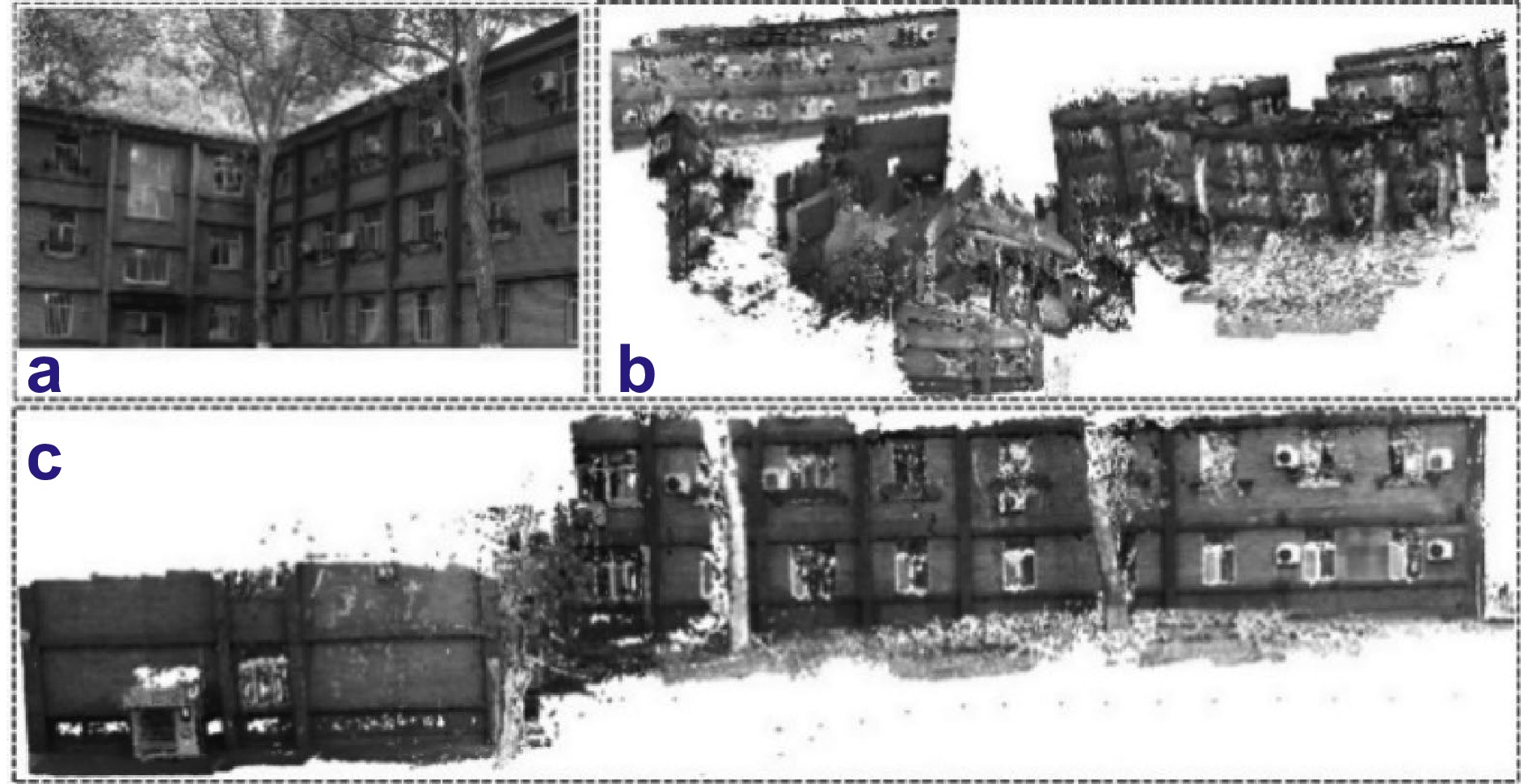
Scene-level 3D structure was finally reconstructed through multi-frame point cloud fusion. We showcase wide-scene, high-accuracy passive video reconstructions on natural field scenes. Our passive polarization stereo represents a major advancement in scene-level 3D imaging and may find broad applications in fields requiring passive 3D imaging solutions.
Ultrafast all-optical modulation of wide-bandwidth pulses enabled by silicon-metasurfaces
Kaloyan Georgiev, Khosro Zangeneh Kamali, Anton A. Trifonov, Giulia Crotti, Lyuben Petrov, Stefan Georgiev, Hristo Iliev, Lei Xu, Unai Arregui Leon, Mohsen Rahmani, Giuseppe Della Valle, Ivan Buchvarov, Dragomir Neshev
Opto-Electronic Advances
2026-09-15
Physics-informed neural fields enable blind aberration correction for partially coherent quantitative phase imaging
Shun Zhou, Xingyu Huang, Linpeng Lu, Habib Ullah, Kaiyu Du, Maciej Trusiak, Malgorzata Kujawinska, Yuzhen Zhang, Yao Fan, Qian Chen, Qinrong Zhang, Chao Zuo
Opto-Electronic Science
2026-08-26
Heterogeneously integrated micro-ring with SnS₂ for dual-functional optical modulation and photodetection
Jinyi Du, Lidan Lu, Xu Zhang, Bofei Zhu, Wenbo Bo, Yingjie Xu, Guang Chen, Yanlin He, Guanghui Ren, Xiaoping Lou, Zheng You, Lianqing Zhu
Opto-Electronic Advances
2026-08-25
Hardware-aware lightweight photonic spiking neural network for pattern classification
Shuiying Xiang, Yahui Zhang, Shangxuan Shi, Haowen Zhao, Dianzhuang Zheng, Xingxing Guo, Yanan Han, Ye Tian, Liyue Zhang, Yuechun Shi, Yue Hao
Opto-Electronic Advances
2026-08-25
PhyspeNet: An empirical physics-aware network for adaptive speckle reconstructive spectrometry
Junrui Liang, Min Jiang, Jun Li, Zhongming Huang, Junhong He, Yanting Guo, Yanzhao Ke, Jun Ye, Jiangming Xu, Jinyong Leng, Pu Zhou
Opto-Electronic Advances
2026-08-25
A 36 × 240 Gbps hybrid mode/wavelength division multiplexing transmitter using lithium niobate on insulator
Mingyu Zhu, Weihan Wang, Ruitao Ma, Aoyun Gao, Chun Gao, Zexu Wang, Fei Huang, Zhenyuan Bao, Dajian Liu, Jiaxuan Gan, Zejie Yu, Huan Li, Weike Zhao, Daoxin Dai
Opto-Electronic Advances
2026-08-25