(Peer-Reviewed) Luminescent YAG:Ce³⁺ 3D micro-structures via multi-photon laser lithography
Robertas Virkėtis ¹, Greta Merkininkaitė ¹, Artūr Harnik ³, Ugnė Ūsaitė ¹, Dominykas Dapšys ³, Arturo Susarrey-Arce ⁴, Simas Šakirzanovas ¹ ², Mangirdas Malinauskas ³
¹ Faculty of Chemistry and Geosciences, Vilnius University, Naugarduko Str. 24, Vilnius LT-03225, Lithuania
² Department of Chemical Engineering and Technology, Center for Physical Sciences and Technology, Saulėtekio Ave. 3, Vilnius LT-10257, Lithuania
³ Laser Research Center, Physics Faculty, Vilnius University, Saulėtekio Ave. 10, Vilnius LT-10223, Lithuania
⁴ Department of Chemical Engineering, Mesoscale Chemical Systems, MESA+ Institute, University of Twente, P.O. Box 217, Enschede 7500 AE, Netherlands
Opto-Electronic Advances
, 2026-08-25
Abstract
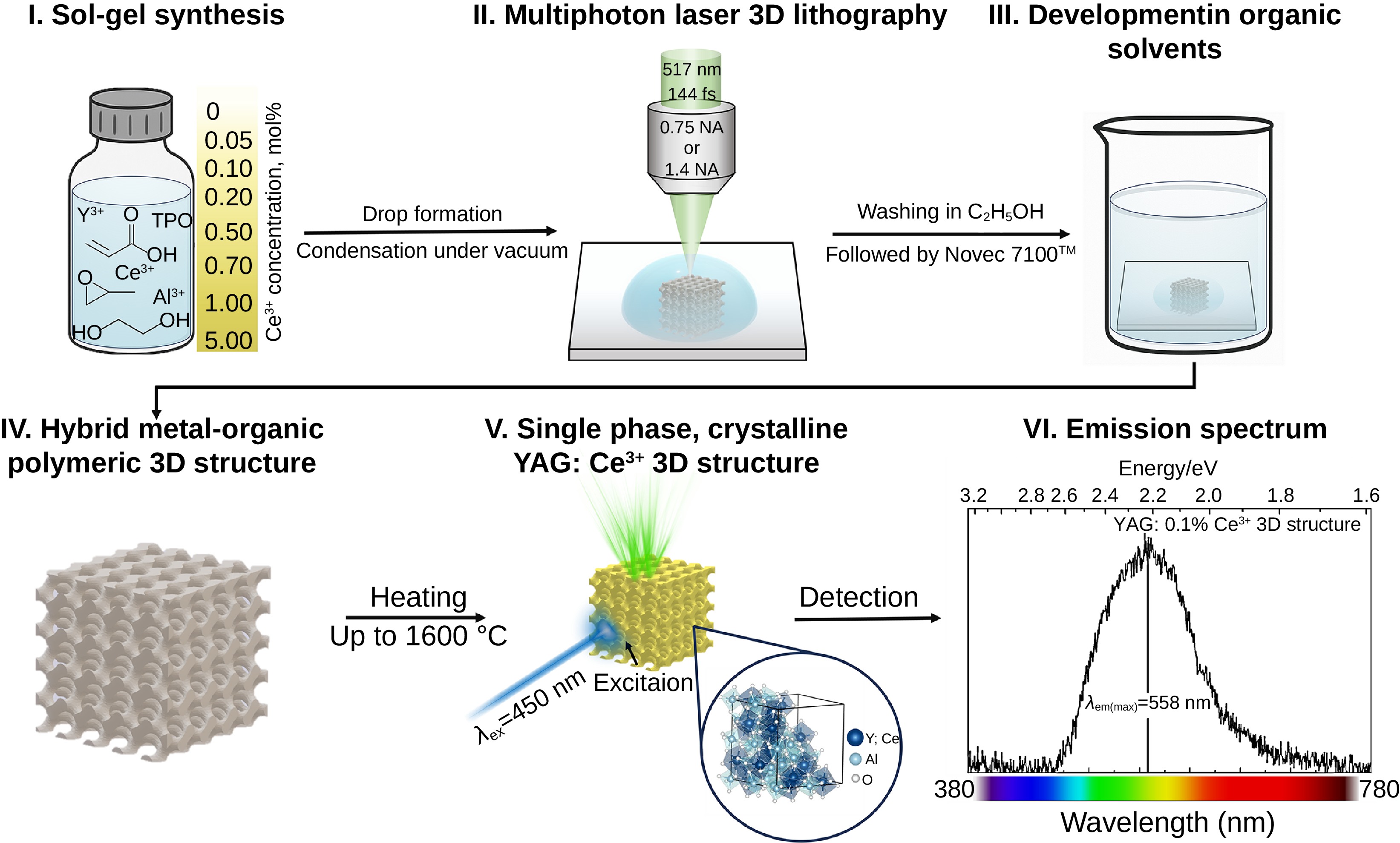
This work addresses the challenge of fabricating crystalline single-phase luminescent 3D microstructures by demonstrating a fabrication process of yttrium aluminum garnet doped with cerium (YAG:Ce³⁺) 3D micro-objects. Precursors were synthesized via a sol-gel method and characterized by refractive index (RI) measurements, Fourier-transform infrared spectroscopy (FT-IR), and thermogravimetric (TG) analysis to verify chemical composition changes during photopolymerization and thermal treatment.
Multiphoton laser 3D lithography (MP3DL) was employed to produce hybrid metal-organic 3D structures, which were subsequently converted into crystalline ceramics through controlled 3-step annealing. Structural analysis by X-ray diffraction (XRD) confirmed the formation of single-phase cubic YAG across Ce³⁺ concentrations up to 5 mol-% in 3D objects, while scanning electron microscopy (SEM) revealed isotropic shrinkage (ca. 39%) and well-preserved geometries with sub-micrometer features after pyrolysis.
The smallest feature of a crystalline 3D object achieved was 0.48 μm with a spatial resolution down to 2.4 μm. Luminescence measurements showed characteristic Ce³⁺ emission centered at 558 nm, with maximum intensity at 2 mol-% doping. These findings establish a reliable pathway to fabricate thermally stable, high-resolution, luminescent single-phase YAG:Ce³⁺ 3D micro-objects, enabling their integration into optoelectronic and photonic applications.
Ultrafast all-optical modulation of wide-bandwidth pulses enabled by silicon-metasurfaces
Kaloyan Georgiev, Khosro Zangeneh Kamali, Anton A. Trifonov, Giulia Crotti, Lyuben Petrov, Stefan Georgiev, Hristo Iliev, Lei Xu, Unai Arregui Leon, Mohsen Rahmani, Giuseppe Della Valle, Ivan Buchvarov, Dragomir Neshev
Opto-Electronic Advances
2026-09-15
Physics-informed neural fields enable blind aberration correction for partially coherent quantitative phase imaging
Shun Zhou, Xingyu Huang, Linpeng Lu, Habib Ullah, Kaiyu Du, Maciej Trusiak, Malgorzata Kujawinska, Yuzhen Zhang, Yao Fan, Qian Chen, Qinrong Zhang, Chao Zuo
Opto-Electronic Science
2026-08-26
Heterogeneously integrated micro-ring with SnS₂ for dual-functional optical modulation and photodetection
Jinyi Du, Lidan Lu, Xu Zhang, Bofei Zhu, Wenbo Bo, Yingjie Xu, Guang Chen, Yanlin He, Guanghui Ren, Xiaoping Lou, Zheng You, Lianqing Zhu
Opto-Electronic Advances
2026-08-25
Hardware-aware lightweight photonic spiking neural network for pattern classification
Shuiying Xiang, Yahui Zhang, Shangxuan Shi, Haowen Zhao, Dianzhuang Zheng, Xingxing Guo, Yanan Han, Ye Tian, Liyue Zhang, Yuechun Shi, Yue Hao
Opto-Electronic Advances
2026-08-25
PhyspeNet: An empirical physics-aware network for adaptive speckle reconstructive spectrometry
Junrui Liang, Min Jiang, Jun Li, Zhongming Huang, Junhong He, Yanting Guo, Yanzhao Ke, Jun Ye, Jiangming Xu, Jinyong Leng, Pu Zhou
Opto-Electronic Advances
2026-08-25
A 36 × 240 Gbps hybrid mode/wavelength division multiplexing transmitter using lithium niobate on insulator
Mingyu Zhu, Weihan Wang, Ruitao Ma, Aoyun Gao, Chun Gao, Zexu Wang, Fei Huang, Zhenyuan Bao, Dajian Liu, Jiaxuan Gan, Zejie Yu, Huan Li, Weike Zhao, Daoxin Dai
Opto-Electronic Advances
2026-08-25