(Peer-Reviewed) PhyspeNet: An empirical physics-aware network for adaptive speckle reconstructive spectrometry
Junrui Liang 梁峻锐 ¹, Min Jiang 蒋敏 ², Jun Li 李俊 ¹, Zhongming Huang 黄中鸣 ¹, Junhong He 何俊鸿 ¹, Yanting Guo ¹, Yanzhao Ke 柯延钊 ¹, Jun Ye 叶俊 ¹ ³ ⁴, Jiangming Xu 许将明 ¹, Jinyong Leng 冷进勇 ¹ ³ ⁴, Pu Zhou 周朴 ¹
¹ College of Advanced Interdisciplinary Studies, National University of Defense Technology, Changsha 410073, China
中国 长沙 国防科技大学前沿交叉学科学院
² Test Center, National University of Defense Technology, Xi'an 710106, China
中国 西安 国防科技大学试验训练基地
³ Nanhu Laser Laboratory, National University of Defense Technology, Changsha 410073, China
中国 长沙 国防科技大学南湖之光实验室
⁴ Hunan Provincial Key Laboratory of High Energy Laser Technology, National University of Defense Technology, Changsha 410073, China
中国 长沙 国防科技大学高能激光技术湖南省重点实验室
Opto-Electronic Advances
, 2026-08-25
Abstract
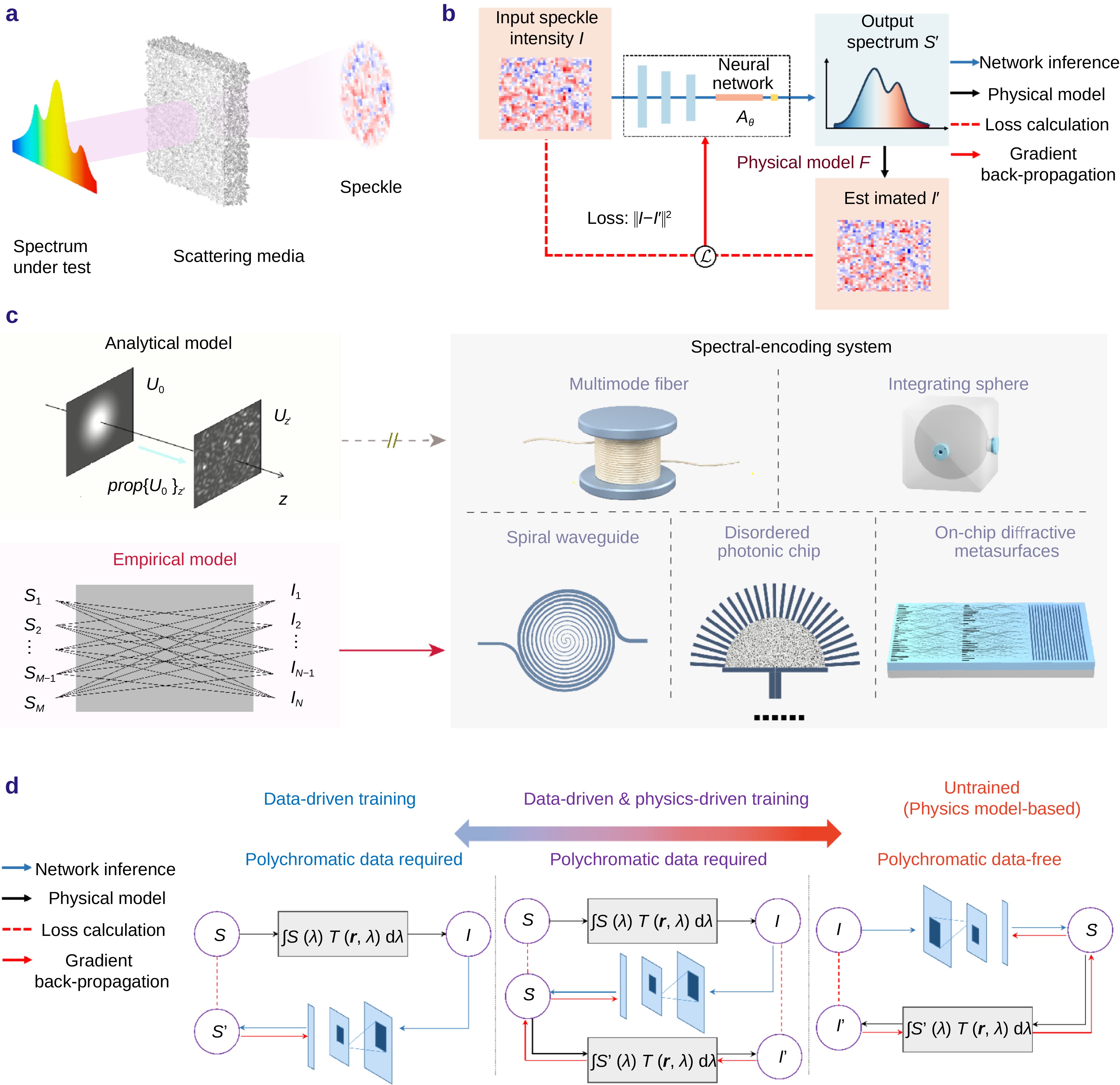
The speckle reconstructive spectrometer (RS) is revolutionizing the design paradigm of spectrometers, shifting from hardware-dominated architectures to algorithmically driven, computing-focused methodologies. However, traditional spectral reconstruction algorithms with pre-defined regularizes suffer from suboptimal adaptability, and similarly, deep learning methods struggle to handle unseen data types once deployed.
Here we propose a physics-aware spectral reconstruction framework named PhyspeNet, which consists of a convolutional neural network (CNN) and an empirical physics model, facilitating adaptive reconstruction of multiple spectral types without pre-training. The inherent structural priority in the CNN architecture provides an adaptive and remarkably powerful regularization, while the embedded empirical model endows our framework with generality across various dispersive devices, even those exhibiting complex light propagation beyond the scope of analytical models.
By leveraging PhyspeNet, we attain a resolving power of 7×10⁵, surpassing existing spectral reconstruction neural networks trained on polychromatic data. A 700 nm operating range in the near-infrared region is also realized, which, to the best of our knowledge, stands as the widest operational bandwidth ever reported in speckle spectrometry. We believe that this work constitutes a solid step toward adaptive speckle RSs and paves the way for advances in diverse fields, including high-dimensional light field detection, biomedicine and so on.
Ultrafast all-optical modulation of wide-bandwidth pulses enabled by silicon-metasurfaces
Kaloyan Georgiev, Khosro Zangeneh Kamali, Anton A. Trifonov, Giulia Crotti, Lyuben Petrov, Stefan Georgiev, Hristo Iliev, Lei Xu, Unai Arregui Leon, Mohsen Rahmani, Giuseppe Della Valle, Ivan Buchvarov, Dragomir Neshev
Opto-Electronic Advances
2026-09-15
Physics-informed neural fields enable blind aberration correction for partially coherent quantitative phase imaging
Shun Zhou, Xingyu Huang, Linpeng Lu, Habib Ullah, Kaiyu Du, Maciej Trusiak, Malgorzata Kujawinska, Yuzhen Zhang, Yao Fan, Qian Chen, Qinrong Zhang, Chao Zuo
Opto-Electronic Science
2026-08-26
Heterogeneously integrated micro-ring with SnS₂ for dual-functional optical modulation and photodetection
Jinyi Du, Lidan Lu, Xu Zhang, Bofei Zhu, Wenbo Bo, Yingjie Xu, Guang Chen, Yanlin He, Guanghui Ren, Xiaoping Lou, Zheng You, Lianqing Zhu
Opto-Electronic Advances
2026-08-25
Hardware-aware lightweight photonic spiking neural network for pattern classification
Shuiying Xiang, Yahui Zhang, Shangxuan Shi, Haowen Zhao, Dianzhuang Zheng, Xingxing Guo, Yanan Han, Ye Tian, Liyue Zhang, Yuechun Shi, Yue Hao
Opto-Electronic Advances
2026-08-25
A 36 × 240 Gbps hybrid mode/wavelength division multiplexing transmitter using lithium niobate on insulator
Mingyu Zhu, Weihan Wang, Ruitao Ma, Aoyun Gao, Chun Gao, Zexu Wang, Fei Huang, Zhenyuan Bao, Dajian Liu, Jiaxuan Gan, Zejie Yu, Huan Li, Weike Zhao, Daoxin Dai
Opto-Electronic Advances
2026-08-25